"U.S. Wabash Low-Carbon Ammonia Project" Breaks Ground
Targeting Completion in 2029 with Korea-U.S. Joint Investment
Annual Production Capacity of 500,000 Tons of Ammonia
Accelerating New Businesses for Future Energy Transition
On January 5 (local time), Samsung E&A announced that it held a groundbreaking ceremony for the "U.S. Wabash Low-Carbon Ammonia Project" at the Hay-Adams Hotel in Washington, D.C., marking the official start of local plant construction.
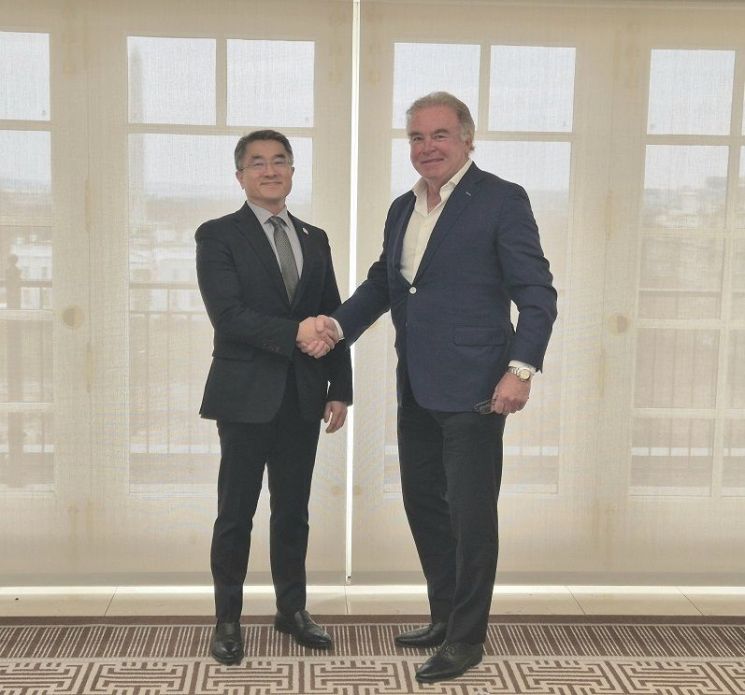 Samsung E&A President Hong Namgung (left) and Simon Greenshields, Chairman of the Wabash Valley Resources Board (right), are posing for a commemorative photo at the event. Samsung E&A
The ceremony was attended by more than 70 project and government officials, including Kim Yoonduk, Minister of Land, Infrastructure and Transport of Korea, Hong Namgung, President of Samsung E&A, James Danly, Deputy Secretary of the U.S. Department of Energy, and Simon Greenshields, Chairman of the Board of Wabash Valley Resources.
This project centers on building an eco-friendly ammonia production facility in West Terre Haute, Indiana. The facility is designed to produce 500,000 tons of ammonia annually and capture 1.67 million tons of carbon dioxide. It is being promoted as a national initiative, with funding participation from the U.S. Department of Energy (DOE), Korea’s Ministry of Land, Infrastructure and Transport, and the Ministry of Environment, Climate and Energy. In line with this, Samsung E&A signed an engineering, procurement, and fabrication (EPF) contract worth approximately 475 million dollars (about 680 billion won) with Wabash Valley Resources in October last year. The project is currently underway with a target completion date of 2029.
Samsung E&A plans to actively leverage its extensive experience in ammonia plant construction and its differentiated technological strengths in digital transformation (DT), artificial intelligence (AI), automation, and modularization for this project. The company will also closely collaborate with the client and technology provider, Honeywell UOP.
Samsung E&A continues to pursue technology development, investment, and partnerships to secure core technologies for energy transition, including ammonia, sustainable aviation fuel (SAF), liquefied natural gas (LNG), carbon capture, and hydrogen. Recently, the company has won contracts for a SAF plant in Malaysia, a biodegradable plastic plant in the UAE, basic design for an eco-friendly LNG plant in Indonesia, conceptual design for an LNG project in North America, and basic design for a SAF project in the United States.
© The Asia Business Daily(www.asiae.co.kr). All rights reserved.

















