Amendment Bills Pending in the National Assembly
Patent Attorney Community Calls for Inclusion,
While Ministry of Justice Urges Caution
As the revision of the Attorney-at-Law Act, which includes the introduction of Attorney-Client Privilege (ACP), awaits only passage at the National Assembly plenary session, there are growing calls to expedite the adoption of ACP in patent litigation as well. Some argue that an ACP provision should be included in the Patent Act to enhance the effectiveness of the Korean-style discovery system, while others insist that the scope of protection should be expanded to include patent attorneys. On the other hand, there are also cautious opinions based on constitutional grounds.
"Without ACP, Only Korean Companies Lose Out"
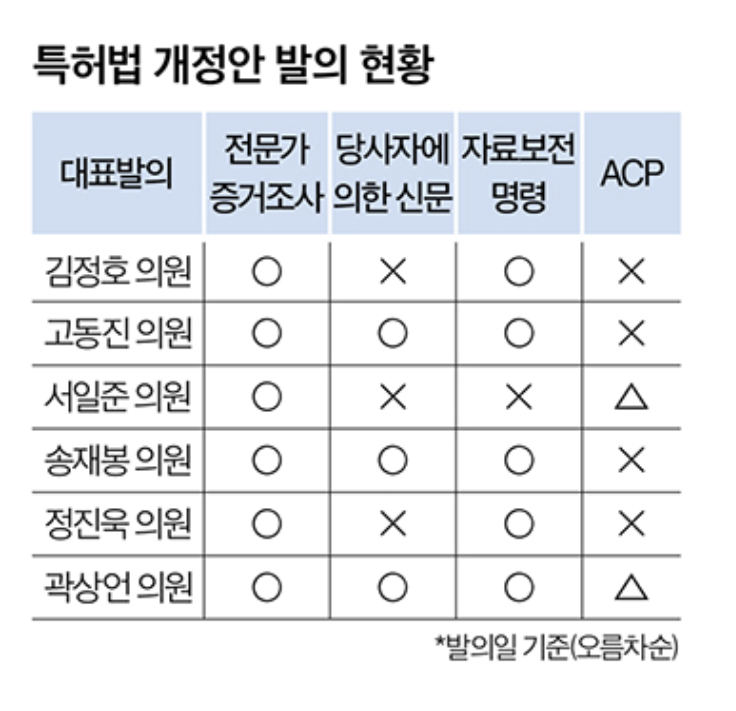
Currently, an amendment to the Patent Act related to the Korean-style discovery system, which would make it easier to prove patent infringement, is pending in the National Assembly. The purpose is to address the structural limitations faced by patent holders in actively proving infringement, as evidence of patent infringement is often concentrated on the side of the alleged infringer.
The core of the amendment is to establish procedures for securing evidence, such as "expert-led evidence investigation," in which an expert appointed by the court conducts a neutral investigation, and "party-led examination," in which the parties directly question each other and use the transcripts and recordings as evidence. The amendment also includes the introduction of a preservation order system for materials necessary to prove infringement or calculate damages, both before and after filing a patent infringement lawsuit.
The patent attorney community points out that out of the six pending amendments to the Patent Act in the National Assembly, only two include ACP-related provisions that protect communications and litigation preparation materials between representatives and clients. They argue that this could put Korean companies at a disadvantage. If the discovery system is introduced without ACP, Korean companies would be obligated to submit materials in overseas litigation, while opposing companies could be protected by privilege, placing Korean firms at a disadvantage.
According to the review report on the Patent Act amendment, the Ministry of Justice has stated that the issue of excluding legal opinions from expert fact-finding should be addressed through amendments to general laws such as the Attorney-at-Law Act, as a concrete form of introducing attorney-client privilege, and that a cautious approach is needed. The Ministry holds that introducing such provisions in individual litigation procedures, such as patent infringement lawsuits, is inappropriate when the overall discussion has not yet matured.
Should Patent Attorneys Also Be Covered by ACP?
There are also opinions that the scope of the ACP provision in the Patent Act should be expanded to include patent attorneys. Kim Dugyu, President of the Korean Patent Attorneys Association, stated, "Companies receive legal assistance from patent attorneys on key issues in infringement lawsuits, such as product development, securing patents, and infringement analysis," adding, "It is necessary to protect not only information and materials exchanged between attorneys and clients, but also those exchanged between patent attorneys and clients."
Intellectual property expert Lee Kyooho, Professor at Chung-Ang University Law School, also noted, "Patent attorneys hold a significant amount of key information, such as the history of patent applications and trade secrets," and warned, "If this information is not protected, the effectiveness of expert fact-finding will be diminished and it could result in a loss of national interest."
On the other hand, there is strong opposition arguing that the scope of ACP should be determined cautiously based on the Constitution. Choi Jaewon, President of the Patent Lawyers Association (3rd Bar Exam), said, "The basis for introducing ACP lies in the constitutional protection of the right to counsel by an attorney," and added, "Applying this by law to patent attorneys, who are not recognized as attorneys under the Constitution, lacks a clear constitutional basis."
Seo Hayeon, Legal Times Reporter
※This article is based on content supplied by Law Times.
© The Asia Business Daily(www.asiae.co.kr). All rights reserved.
![Clutching a Stolen Dior Bag, Saying "I Hate Being Poor but Real"... The Grotesque Con of a "Human Knockoff" [Slate]](https://cwcontent.asiae.co.kr/asiaresize/183/2026021902243444107_1771435474.jpg)
















