Scheduled for Delivery to Clients About Four Months Ahead of the Original Deadline
Hyundai Rotem announced on January 5 that it had completed the early rollout of the initial configuration of the second-generation EMU-320, a 320 km/h-class distributed power high-speed train.
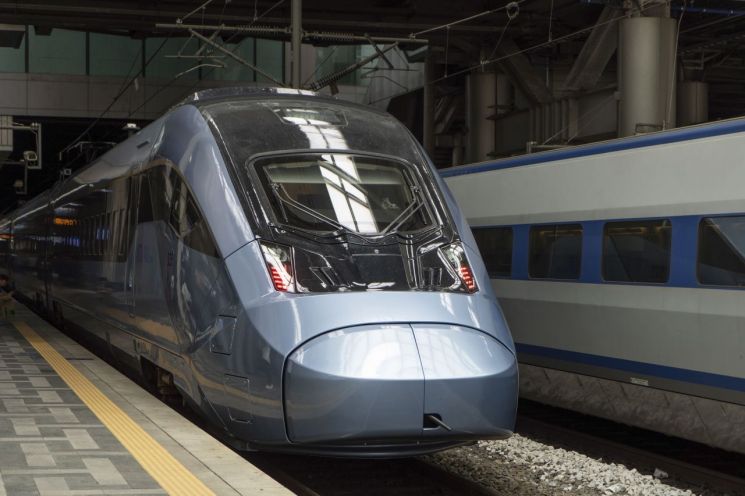
This train is the first 320 km/h-class distributed power high-speed train configuration ordered by Korea Railroad Corporation (KORAIL) and SR in March and April 2023, respectively. The trains were rolled out on December 30 and 31. After about a year of trial runs, they are scheduled to be delivered to the clients in December, four months ahead of the original delivery deadline.
The second-generation EMU-320 is an upgraded model of the first-generation EMU-320 (KTX-Cheongryong), which began commercial operation in Korea in May 2024. Compared to the first generation, it features reduced noise, as well as improved ride comfort, safety, and convenience.
Notably, the second-generation EMU-320 is the first to be equipped with the Korean Train Control System (KTCS-2), which was first applied to the second-generation EMU-260, a 260 km/h-class distributed power high-speed train. KTCS-2, developed domestically as a national research project under the Ministry of Land, Infrastructure and Transport and completed in 2018, is a railway signaling system that monitors the real-time position of high-speed trains and automatically controls safe distances. This signaling system, essential for high-speed train operations, not only ensures passenger safety but also shortens intervals between trains to maximize transport capacity. Additionally, as it does not rely on foreign parts for maintenance, it reduces both time and costs.
The Condition-Based Maintenance (CBM) system, which monitors the operating status of key train components in real time to enhance operational efficiency, has also been applied. CBM predicts the remaining lifespan and potential failures of train parts, enabling timely replacement and maintenance. Like KTCS-2, CBM was previously introduced with the second-generation EMU-260.
The capacity of the transformer and auxiliary power units has also been increased compared to the first generation, improving the performance of air conditioning systems that affect ride comfort. The braking distance has been shortened as well, resulting in enhanced safety.
Passenger convenience facilities have also been significantly improved. The destination display visible from outside the train has been upgraded to a larger and clearer full-color LED monitor compared to the first generation. Additional monitors displaying destination information have been installed inside the cabin and near the boarding doors to improve visibility. Wireless smartphone charging stations at each seat have been changed from pocket-type to cradle-type, allowing passengers to watch videos while charging their devices.
Hyundai Rotem plans to continue focusing on research and development (R&D) of high-speed trains and timely delivery to contribute to the improvement of the national transportation infrastructure. In December of last year, research results on a next-generation high-speed train capable of 370 km/h (with a design maximum speed of 407 km/h) were released. This project was led by the Korea Railroad Research Institute, with participation from Hyundai Rotem, domestic partner companies, and related railway organizations. This speed is the second fastest in the world for commercial operation.
A Hyundai Rotem representative stated, "We are pooling all our capabilities with domestic parts suppliers to create high-speed trains that the public can trust and use with confidence," adding, "We will continue to do our utmost to ensure that K-high-speed rail earns even greater trust in the future."
© The Asia Business Daily(www.asiae.co.kr). All rights reserved.
![User Who Sold Erroneously Deposited Bitcoins to Repay Debt and Fund Entertainment... What Did the Supreme Court Decide in 2021? [Legal Issue Check]](https://cwcontent.asiae.co.kr/asiaresize/183/2026020910431234020_1770601391.png)















