A new device has been developed that can precisely replicate drug side effects and acute kidney injury in a laboratory environment.
On January 5, KAIST announced that a research team led by Professor Jeon Sungyoon from the Department of Mechanical Engineering, in collaboration with Professor Shim Kidong's team from the same department and Professor Kim Sejoong from Seoul National University Bundang Hospital, has developed a "biomicrofluidic system" capable of reproducing the process by which drug-induced muscle damage leads to kidney injury.
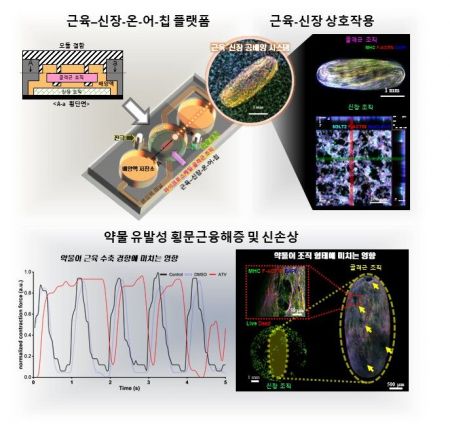 Schematic diagram of the Muscle Contraction-On-a-Chip (MKoaC) platform configuration and drug response analysis process. Provided by KAIST
The microfluidic system is a device that simulates the environment of human organs on a microchip. This study is significant as it is the first time in a laboratory setting that a modular (assembly-type) organ chip, which can connect and disconnect muscle and kidney tissues simultaneously, has precisely replicated the chain reaction between organs, where drug-induced muscle damage leads to kidney injury.
To create conditions similar to the human body, the joint research team developed a structure that connects three-dimensionally engineered muscle tissue and proximal tubule epithelial cells (key cells in the kidney) on a single small chip.
This system is a modular microfluidic chip with a "plug-and-socket" design, allowing organ tissues to be connected or disconnected as needed. On this small chip, cells and tissues are cultured to interact with each other, mimicking the behavior of real human organs.
In this device, muscle and kidney tissues are cultured separately under optimal conditions and are only connected at specific points required by the experiment to induce inter-organ interaction.
After the experiment, the two tissues can be separated again and analyzed independently, allowing researchers to quantify the effect of toxic substances released from damaged muscle on the kidney.
The joint research team applied this platform to test "atorvastatin" (a treatment for hyperlipidemia) and "fenofibrate" (a treatment for triglycerides), both known in clinical practice to induce muscle damage.
As a result, the muscle tissue on the chip showed reduced contractile ability and structural deterioration.
Additionally, levels of markers indicating muscle damage, such as myoglobin (a protein that stores oxygen in muscle cells and is released into blood or culture medium when muscle is damaged) and CK-MM (creatine kinase-MM, an enzyme abundant in muscle that increases as muscle cells are destroyed), were elevated, allowing observation of typical changes associated with rhabdomyolysis (a condition where drug-induced muscle damage leads to impaired kidney function and acute renal failure).
At the same time, the kidney tissue showed a decrease in the number of viable cells and an increase in cell death. There was also a significant increase in the expression of NGAL (a protein that rapidly increases when kidney cells are damaged) and KIM-1 (a protein that is more prevalent as proximal tubules in the kidney are damaged), both of which are markers that rise during acute kidney injury.
The joint research team explained that, in particular, they were able to confirm the sequential process in which toxic substances released from damaged muscle further exacerbate kidney injury in a stepwise manner.
Professor Jeon stated, "This research is significant in that it establishes a foundation for analyzing the interactions and toxic responses between muscle and kidney in a manner similar to the human body. Through this, we expect to be able to predict drug side effects in advance, identify the causes of acute kidney injury, and ultimately expand to personalized drug safety assessments."
Meanwhile, this research was supported by the Ministry of Science and ICT and the National Research Foundation of Korea. The results (paper) were published in the international journal 'Advanced Functional Materials' on November 12 of last year.
© The Asia Business Daily(www.asiae.co.kr). All rights reserved.


















