Ahead of State Visit to China, Interview with CCTV
"Minimizing Past Misunderstandings and Conflicts... Korea-China Relations Must Take a New Leap"
Describes President Xi Jinping as "a Leader with a Broad Perspective"
President Lee Jaemyung, ahead of his upcoming state visit to China, emphasized the need to establish a new, horizontal, and equal partnership in Korea-China economic cooperation during an interview with Chinese state broadcaster CCTV. He put forward a vision for joint growth in advanced fields such as artificial intelligence (AI). This suggests moving beyond the traditional division of labor model of "technology and capital versus labor force" to create a new framework for cooperation with China, which has significantly strengthened its technological and capital competitiveness. The President also expressed his intention to reduce misunderstandings and sources of conflict and to elevate the bilateral relationship to a new level during his state visit to China from January 4 to 7.
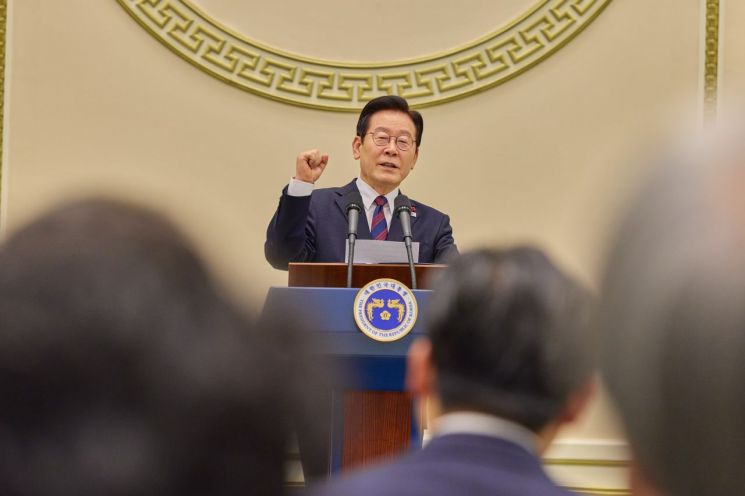
In the interview, President Lee described the existing Korea-China partnership as a "vertical model combining Korea's advanced technology and capital with China's labor force." He assessed that "China has achieved remarkable growth and development, and in many areas, it has caught up with or even surpassed Korea in technology and capital." He stressed the importance of establishing a new, horizontal partnership in fields such as AI and advanced industries, in order to create a mutually beneficial economic relationship.
President Lee described the current international situation as highly unstable and emphasized that, from Korea's perspective, relations with China are fundamentally important "historically, economically, geopolitically, and politically." He identified peace and stability in Northeast Asia, mutual respect, and shared prosperity as common goals for both countries, noting that misunderstandings or sources of conflict have sometimes hindered the development of Korea-China relations. He expressed his aim to minimize or eliminate these misunderstandings and sources of conflict during his visit, in order to elevate the relationship to a new stage.
Among domestic issues, President Lee identified "economic polarization" as the most serious problem. He analyzed that stagnating growth has reduced opportunities, entrenched disparities and inequality, and intensified social conflict. As a key task to reduce social conflict and create hope, President Lee pledged to "build an economy that achieves continuous growth and development."
He proposed expanding cooperation in advanced technology investment to achieve joint growth. President Lee noted that China is focusing on research and development investment and nurturing basic scientists, and assessed that "the economic growth strategies of Korea and China share similarities." He also pointed out that while Korea and China are competitors, there is considerable room for collaboration. He explained that "even amid competition, if we identify areas for cooperation and use collaboration to further enhance our capabilities," both countries can benefit from the relationship.
Citing China's transition to renewable energy and the rise of its solar industry as examples, President Lee praised China's "outstanding ability to identify opportunities within crises and concentrate national capabilities to drive new technological and industrial development." He expressed optimism that such changes are likely to continue, and stated his expectation that "in this respect as well, the Korea-China partnership could open significant new opportunities for Korea."
Regarding President Xi Jinping, President Lee described him as "a leader with a broad perspective" and noted that China's economic and technological development "has been achieved as planned in a short period of time." He also remarked that China is being "led stably" amid complex international circumstances. On the topic of communication between leaders, President Lee said he found President Xi to be "a reliable neighbor," and emphasized that resolving difficulties through communication and maximizing areas of cooperation would be mutually beneficial for both countries.
President Lee also pointed out that this interview was conducted "before any other media, including both foreign and domestic outlets," and asked people to recognize how much importance Korea places on its relationship with China. Regarding the move of symbolic items and the presidential office during the return to the Blue House, he explained that it was "a matter of restoring normalcy."
© The Asia Business Daily(www.asiae.co.kr). All rights reserved.

















