5-17th Air Cavalry Squadron with Hundreds Operating Apaches Deactivated
Part of U.S. Army Transformation Initiative
Key Issue: Will This Lead to a Reduction in USFK Troop Numbers?
As the possibility of reducing, relocating, or adjusting the roles of U.S. Forces Korea (USFK) is being raised as part of the Donald Trump administration's global military strategy overhaul, it has been confirmed that one U.S. Army aviation battalion stationed at the USFK base in Pyeongtaek was deactivated last month.
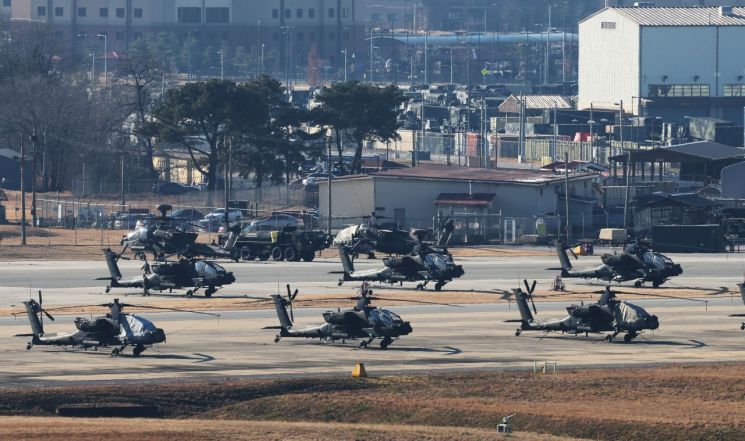 An Apache helicopter is on standby at Camp Humphreys in Pyeongtaek, Gyeonggi Province, on the 18th of last month. Photo by Yonhap News
According to a report from the U.S. Congressional Research Service (CRS) on January 1 (local time), the 5-17th Air Cavalry Squadron (5-17 ACS), which had been stationed at Camp Humphreys in Pyeongtaek, was deactivated on December 15. In military terms, "deactivation" means the actual operation of a specific unit is suspended or the unit is disbanded.
The 5-17th Air Cavalry Squadron, established in 2022, was known to operate Apache (AH-64E) attack helicopters and RQ-7B Shadow unmanned aerial vehicles with about 500 personnel. The fixed deployment of Apaches, which had previously been rotated among combined divisions, through the 5-17th Air Cavalry Squadron, was seen as strengthening the combat capabilities of USFK.
This measure was implemented as part of the "Army Transformation Initiative (ATI)" under the direction of U.S. Secretary of Defense Pete Hegseth. It remains unclear whether this deactivation signifies the end of operations, the withdrawal of the unit's personnel and equipment, or the deployment of a replacement unit.
The report also stated that on December 16, one day after the deactivation of the 5-17th Air Cavalry Squadron, the medical evacuation (MEDEVAC) unit of the 2nd Infantry Division Combat Aviation Brigade (CAB) stationed at Camp Humphreys was reorganized. However, specific details of the reorganization were not disclosed.
Whether the deactivation of the 5-17th Air Cavalry Squadron will lead to a reduction in USFK troop numbers has emerged as a key issue. As the second Trump administration is expected to demand greater security burden-sharing from allies such as South Korea, the possibility of reducing the current 28,500-strong USFK through a global posture adjustment has been raised. Additionally, there is speculation that the strategic flexibility of USFK's role could be enhanced in preparation for possible involvement in a Taiwan conflict and other contingencies.
These observations gained further traction when the phrase "maintaining the current level of USFK forces" was omitted from the joint statement of the 57th ROK-U.S. Security Consultative Meeting (SCM) announced by the defense ministers of South Korea and the United States in November last year. While the statement reaffirmed the commitment to "continuously maintain the force and posture levels of USFK," the word "current," which had been included in previous SCM joint statements, was omitted.
The Wall Street Journal (WSJ) reported in May last year, citing U.S. Department of Defense officials, that the Pentagon was preparing a plan to relocate about 4,500 USFK troops to other regions. However, at the time, the Department of Defense denied the report, stating, "It is not true."
Regarding the issue of reducing USFK, the National Defense Authorization Act (NDAA) for Fiscal Year 2026, which took effect on December 18, stipulates that the budget authorized by the bill cannot be used to reduce the number of U.S. troops stationed in South Korea below the current level of 28,500. However, the restriction can be lifted 60 days after submitting to the relevant standing committee that the reduction is in the national security interest of the United States or after consultation with South Korea, Japan, or United Nations Command member states. For this reason, the NDAA provision is not considered a binding clause that can effectively prevent a reduction of USFK.
© The Asia Business Daily(www.asiae.co.kr). All rights reserved.

















