Need to Re-examine the Impact of NPS Overseas Investments on the National Economy
Comprehensive Review Needed on Effects on Korea's Economic Growth and Capital Market Development
Exchange Rate in the High 1,400 Won Range Significantly Out of Lin
"The volume of National Pension Fund investment capital has become too large. Because the scale has changed, the 'framework' must also change."
On January 2, at the 2026 opening ceremony held at the Bank of Korea in Jung-gu, Seoul, and during a subsequent visit to the press room, Lee Chang-yong, Governor of the Bank of Korea, stated, "It is necessary to re-examine the impact of the National Pension Service's overseas investments, which are exerting increasing influence in the foreign exchange market, on the overall national economy."
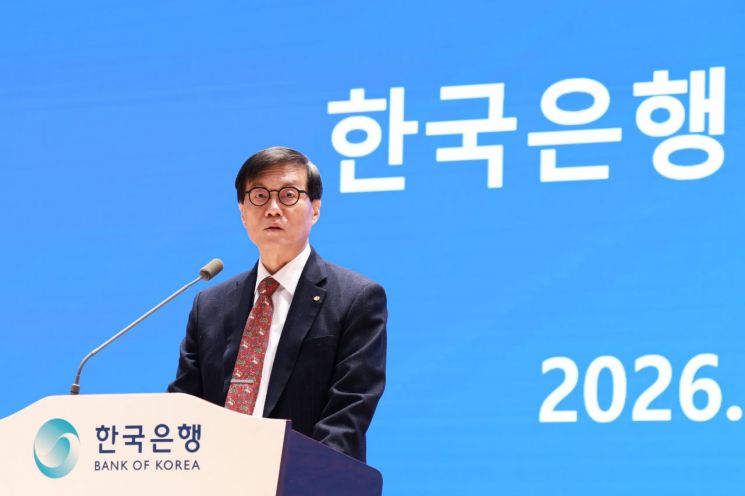 Lee Chang-yong, Governor of the Bank of Korea, is delivering the New Year's address at the opening ceremony held at the Bank of Korea in Jung-gu, Seoul, on the 2nd. Bank of Korea
Governor Lee explained, "Even in the mid-to-late 2000s, it was said that the National Pension Service should increase overseas investments to diversify destinations. However, after returning from working abroad, I found that the volume of National Pension Fund investment capital had become too large. Because the scale has changed, the framework must also change." He repeatedly pointed out that the scale, timing, and foreign exchange hedging strategies of the National Pension Service's overseas investments are excessively transparent to both domestic and international markets. This is because expectations of a weaker won are increasingly one-sided, which could significantly affect the investment direction of other economic agents both at home and abroad.
Whether it is individual investors in overseas stocks (so-called 'Seohak Ants') or the National Pension Service, investment decisions by economic agents are made based on rational expectations and judgments within the given environment. However, it is now time to comprehensively examine how residents' continued expansion of overseas investment affects Korea's macroeconomic growth and the development of the domestic capital market. Governor Lee pointed out, "If the won depreciates at the time of overseas investment, the returns abroad will be very high, but the opposite is true when bringing the funds back. It is also true that some say capital flows out because domestic market structural reforms are lacking and growth rates are low, but now that the National Pension Service has become a 'major player,' its outflows create a structure in which the domestic market cannot grow."
He further noted that, until now, the National Pension Service's investment process has not taken into account national costs such as the deterioration of importers' conditions due to high exchange rates, the worsening of certain domestic industries due to relatively low domestic investment, or the decline in domestic employment rates. However, as its influence as a major player has grown, these factors must be considered in the overall management of the country. He added, "We need to study further to determine what level of hedging and investment is appropriate, but under the current structure, none of these factors are being considered. From a macroeconomic perspective, I believe we should hedge more and reduce the scale of overseas investments compared to now."
Governor Lee emphasized, "At the very least, there needs to be a channel for discussing these issues with the foreign exchange authorities and those responsible for macroeconomic policy." He continued, "In light of these concerns, the Ministry of Health and Welfare recently formed a task force to respond flexibly to strategic foreign exchange hedging, and it is a significant step forward that relevant government ministries, the National Pension Service, and the Bank of Korea have agreed to cooperate and discuss building a 'new framework' for the National Pension Service's overseas investments."
High Exchange Rates Driven by 'Domestic Expectations'... Foreign Exchange Authorities to Continue 'Managing Market Expectations' at the Start of the Year
At the beginning of the year, market interventions by the foreign exchange authorities to manage expectations are expected to continue as an extension of the end of last year. Governor Lee pointed out, "The current issue with the exchange rate is that it is being driven largely by domestic expectations." He added, "While overseas investment banks and others may see the exchange rate declining further to the low 1,400 won range this year, domestically, YouTubers and others claim it will reach 1,500 won and that the won will soon become worthless, fueling expectations of a weaker won. Although it is difficult to define an appropriate exchange rate, the fact that the won is depreciating more than what the dollar index (DXY) would suggest is largely due to domestic expectations, so managing market expectations must continue at the start of the year."
From this perspective, Governor Lee assessed that the exchange rate level, which exceeded 1,480 won at the end of last year, was significantly out of line with the fundamentals of the Korean economy. He explained, "The main reasons for the higher exchange rate are the growth and interest rate differentials between Korea and the United States, as well as the 'Korea Discount' (undervaluation of the Korean stock market). To address these issues, it is necessary to strengthen the competitiveness of domestic industries and improve capital market systems to expand investment incentives in the medium to long term. However, since last October, the won's depreciation has outpaced the movement of the dollar, mainly because the continued increase in residents' overseas securities investments has caused an imbalance in the foreign exchange market."
Regarding concerns that annual investments of 20 billion dollars in the United States will lead to a weaker won, he clarified, "20 billion dollars is the maximum amount. As specified in the memorandum of understanding (MOU) between the two countries, the actual investment size will be determined within a range that does not undermine foreign exchange market stability." In other words, 20 billion dollars will not be mechanically sent to the United States every year. He added, "In this process, the Bank of Korea will not agree to any decisions that undermine foreign exchange market stability, together with the government. This principle will be strictly upheld."
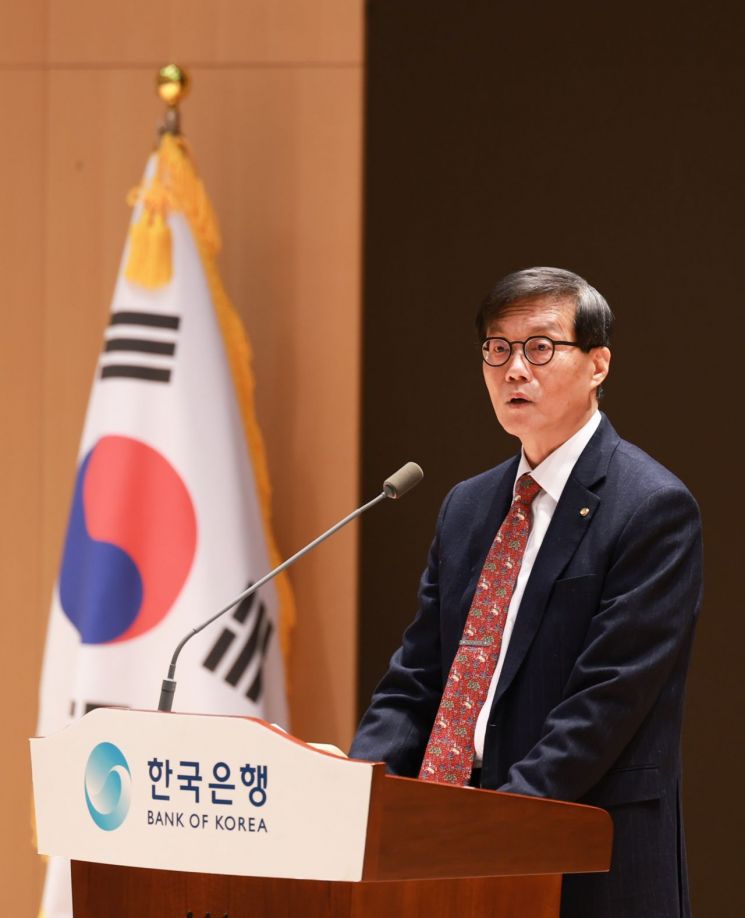 Lee Chang-yong, Governor of the Bank of Korea, is delivering the New Year's address at the opening ceremony held at the Bank of Korea in Jung-gu, Seoul, on the 2nd. Bank of Korea
This Year's Growth Rate Forecast at 1.8%, Only 1.4% Without IT... Warning Against 'Sectoral Concentration,' Need to Foster New Industries
The Bank of Korea forecasts that Korea's growth rate this year will be 1.8%, close to the potential growth rate of just under 2.0%. However, excluding the IT sector, which is expected to drive growth this year thanks to the global semiconductor cycle, the growth rate would be only 1.4%, indicating a significant gap with the real economy as experienced by the public. Governor Lee stated, "Such a 'K-shaped recovery' cannot be considered sustainable or complete. We must continue structural transformation efforts, such as diversifying the growth base by fostering new industries, to prevent a pattern of growth and recovery concentrated in specific sectors from repeating."
Domestic inflation is expected to remain stable compared to major countries, with the inflation rate projected at 2.1% this year, the same as last year, as demand pressures are not high. However, it was pointed out that if the high exchange rate persists, inflationary pressures could rise again. Regarding the increased burden on ordinary people due to the higher cost of living, he noted, "It is not enough to stabilize the inflation rate through monetary policy alone. For items with internationally high price levels, efforts to lower prices must be made in parallel through various structural reforms, such as improving distribution structures and expanding import liberalization."
"Timely Explanation of Monetary Policy Direction Is a Key Responsibility of the Central Bank... Will Do So Even in the Face of Criticism"
He explained that this year's monetary policy will be operated more precisely by monitoring various economic indicators, as uncertainty in the policy environment has increased and conflicts among policy variables have intensified. He said, "There are both upside and downside risks to the growth path, and inflation trends may also change depending on exchange rate movements. From the perspective of financial stability, we must continue to monitor housing price trends in the Seoul metropolitan area."
Governor Lee emphasized, "It is a key responsibility of the central bank to explain the direction of monetary policy in a timely manner when policy conditions change. If there is new information at the Monetary Policy Board, and a decision is made regarding the direction of monetary policy, I will provide that information even in the face of criticism."
He also stated that the Bank of Korea will further refine policy communication to enhance credibility by re-examining the operation of the 'conditional base rate outlook for the next three months' by Monetary Policy Board members. The Bank of Korea plans to restructure the Bank Intermediated Lending Support Facility to reduce its quasi-fiscal policy nature and instead use it as a supplementary tool for interest rate policy. The aim is to strengthen selective and temporary support for vulnerable sectors such as local small and medium-sized enterprises, which are more affected by interest rate policy.
He explained that the Bank of Korea will also strengthen its role as a think tank for the Korean economy. Governor Lee stated, "The main focus of the 'structural reform research series' over the past three years has been how to raise Korea's potential growth rate, which has been declining continuously, and this is closely related to monetary policy. In the future, it is important not only to raise issues but also to present practical solutions for restructuring, demonstrating expertise and competitiveness, as we did last year with reports on the won stablecoin, improvements to the autonomous taxi fare determination system, and continued employment for older adults."
To respond to the structural changes in digital finance, the Bank of Korea plans to conduct the second real transaction of 'Project Hangang' this year. Through this, the Bank of Korea will support the government's project to improve treasury fund management using blockchain technology. The 'Bank of Korea AI Language Model' will also be launched at the end of this month. The network integration project is scheduled to be completed by March.
© The Asia Business Daily(www.asiae.co.kr). All rights reserved.


















