Volcanic Rock Strata of Eorimok Valley
A Clear View of Groundwater Flow
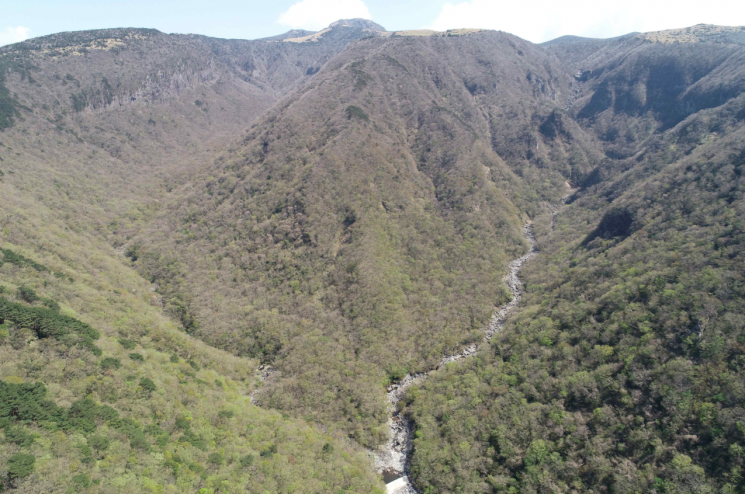
In most cases, water in Jeju emerges along the coastline where it meets the sea. Groundwater flows through the cracks in basalt and moves toward lower elevations, eventually rising as spring water at the shoreline. However, there is an exception in the northwestern part of Hallasan Mountain. In a deep valley over 1,000 meters above sea level, streams of water burst forth from between massive volcanic rock strata. This is Eorimok Valley.
On January 2, the National Heritage Administration announced a preliminary plan to designate the volcanic rock strata and spring water of Eorimok Valley, located in the upper reaches of the Gwangryeongcheon Stream on Hallasan Mountain (at elevations of 1,020 to 1,350 meters), as a Natural Monument and Natural Heritage Site. The agency will collect public opinions for one month and finalize the designation after a review by the Natural Heritage Committee.
This area clearly demonstrates the pattern of groundwater collection in high-altitude regions. Along the approximately 200-meter-deep valley cliffs, the water flow running above the impermeable old soil layer is fully exposed. Since the 1970s, up to 12,000 tons of spring water have been discharged daily, serving as a water source for the mid-mountain region.
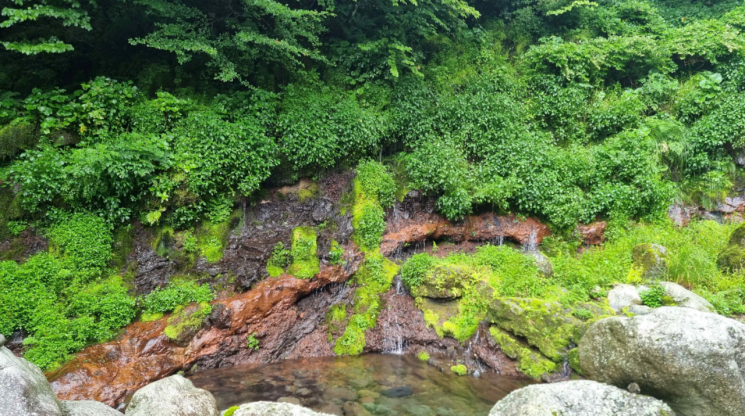
This region serves as a reference point for predicting changes in groundwater throughout Jeju by tracking the flow types, volume, and water quality variations. The combination of sheer cliffs and year-round green moss waterfalls also adds significant ecological value. Currently, the area is designated as both a Natural Protection Zone and a Water Source Protection Area.
The National Heritage Administration stated, "This is a place where it is possible to study the hydrological cycle inside the Hallasan volcanic body and the permeability and impermeability characteristics of the rocks," adding, "It holds important academic value for understanding the structure of groundwater outflow in Jeju."
© The Asia Business Daily(www.asiae.co.kr). All rights reserved.
![Clutching a Stolen Dior Bag, Saying "I Hate Being Poor but Real"... The Grotesque Con of a "Human Knockoff" [Slate]](https://cwcontent.asiae.co.kr/asiaresize/183/2026021902243444107_1771435474.jpg)

















