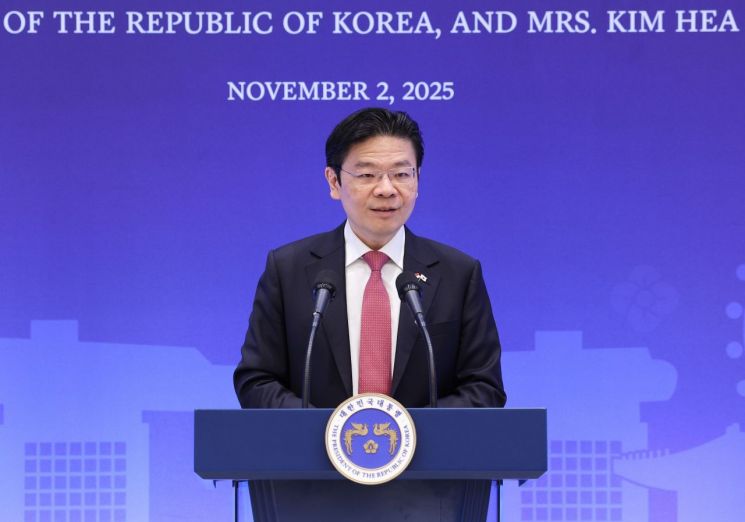
Although Singapore's economy recorded an almost 5% growth rate last year, surpassing expectations, Prime Minister Lawrence Wong stated that it will be difficult to maintain this growth momentum in the current year.
According to Bloomberg News on January 1 (local time), Prime Minister Wong announced in his New Year's address released the previous day that Singapore's gross domestic product (GDP) grew by 4.8% in 2025. This figure exceeds the government's forecast of about 4% announced in November last year.
Prime Minister Wong mentioned the uncertainty in global trade and said, "Despite these external challenges, our economy performed better than expected." He added that the global economy proved more resilient than anticipated and that the level of tariffs imposed by the United States was lower than feared.
He continued, "We also benefited from a surge in demand for semiconductors and electronic products related to artificial intelligence (AI). As a result, unemployment and inflation remained low, and real incomes generally increased."
However, he warned that "fragmented trade and geopolitical tensions are not temporary problems but permanent features of an increasingly divided world," and that it will be difficult to sustain this level of economic growth in the current year.
Prime Minister Wong pointed out, "We will face more obstacles to growth, and inflationary pressures may intensify. As a small and open economy, Singapore cannot fully shield itself from these headwinds."
Previously, in November last year, Singapore's Ministry of Trade projected that the country's economic growth rate in 2026 would be sluggish, at 1.0-3.0%, due to the more pronounced effects of U.S. tariffs and a weakening global economy.
Singapore is subject to a minimum reciprocal tariff rate of 10% from the United States, but it remains uncertain how sector-specific tariffs on major export items such as pharmaceuticals and semiconductors will impact the economy.
Prime Minister Wong emphasized that Singapore cannot simply stick to traditional approaches if it wants to remain competitive, stating, "We must review, reset, and renew our economic strategy." He added that the government will soon announce a draft of economic policies to address the upcoming economic challenges.
© The Asia Business Daily(www.asiae.co.kr). All rights reserved.
![Clutching a Stolen Dior Bag, Saying "I Hate Being Poor but Real"... The Grotesque Con of a "Human Knockoff" [Slate]](https://cwcontent.asiae.co.kr/asiaresize/183/2026021902243444107_1771435474.jpg)
















