Expansion of High-Durability Pavement Technologies
Climate-Resilient and Functional Pavement Solutions
Potholes Decrease Despite Increased Rainfall
With the application of Seoul City's 'Standard Road Pavement Model,' the number of road potholes significantly decreased last year. The 'Seoul-Type Standard Road Pavement Model' is a high-strength, high-durability pavement technology developed to address the frequent damage to urban roads caused by various climate changes.
According to Seoul City on January 1, the number of potholes that occurred within Seoul from January to November last year was 18,948, a decrease of 26.6% compared to the recent five-year average of 25,816 cases during the same period. Despite cumulative precipitation during the same period reaching 1,541mm-higher than the recent five-year average of 1,481mm-the number of potholes actually decreased.
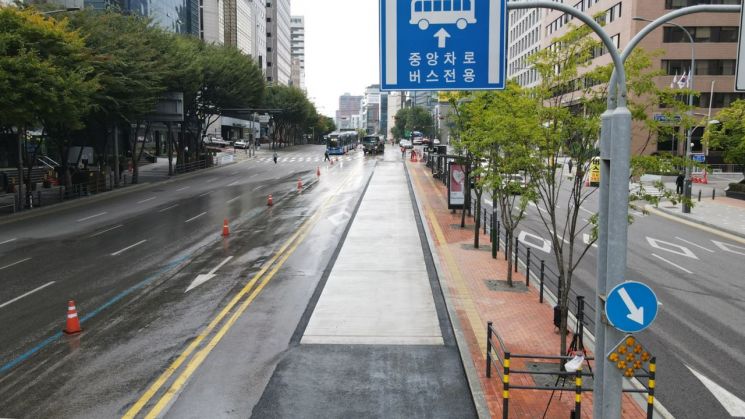
The city analyzed that the reduction in potholes, despite repeated heavy rainfall and freeze-thaw cycles (the process of roads freezing and thawing), demonstrates the effectiveness of the 'Seoul-Type Standard Road Pavement Model' introduced in response to climate change.
Since introducing high-strength concrete pavement at central bus stops in 2010, Seoul City has gradually verified and expanded the use of various new materials and construction methods. Based on this, the city completed the 'Seoul-Type Standard Road Pavement Model' in December 2024 and has been applying it to major roads since March last year. Citizen inconvenience has also decreased. From January to September last year, the number of civil complaints related to road damage was 15,771, about 8% lower than the recent three-year average of 17,044 cases during the same period.
In addition, Seoul City has reduced road damage by applying more durable pavement technologies, such as steel slag and high-strength concrete pavement, to major roads and central bus stops in sections where potholes frequently occur. Steel slag, an environmentally friendly recycled resource generated during the steel manufacturing process, has a strength more than 25% higher than ordinary aggregate. High-strength concrete pavement has been installed at 136 out of 403 central bus lane bus stops. The city plans to complete the phased replacement by 2032.
Han Byungyong, Director of Disaster and Safety at Seoul City, stated, "As the effectiveness of the strong road pavement standard model has been confirmed with concrete figures, we will expand its application to further improve road safety and convenience for citizens," adding, "We will also enhance road safety and quality through data-driven scientific maintenance."
© The Asia Business Daily(www.asiae.co.kr). All rights reserved.
![Clutching a Stolen Dior Bag, Saying "I Hate Being Poor but Real"... The Grotesque Con of a "Human Knockoff" [Slate]](https://cwcontent.asiae.co.kr/asiaresize/183/2026021902243444107_1771435474.jpg)
















