Ministry of Employment and Labor Releases Roadmap for Mid-to-Late Career Certification Acquisition
Synergy Effect Confirmed When Advancing from Engineer to Master Craftsman or Professional Engineer
A clear pathway has been identified in which middle-aged individuals in their 50s and 60s experience structural wage increases by sequentially acquiring national technical qualifications. The impact on wage growth varied significantly depending on how core technical certifications, such as industrial safety, fire protection systems, construction safety, and electrical engineering, were accumulated.
 A job seeker is looking at the recruitment board at an employment center in Seoul last month. (This photo is not directly related to the article). The Asia Business Daily DB
On December 31, the Ministry of Employment and Labor and the Korea Research Institute for Vocational Education and Training released a "Mid-to-Late Career Qualification Acquisition Roadmap" after analyzing wage data by qualification level among those aged 50 to under 65 who obtained national technical certifications. The analysis focused on the top five most frequently acquired engineer-level certifications among middle-aged individuals over the past ten years since 2015. The study not only tracked wage changes after obtaining these certifications but also analyzed wage data before and after acquiring other certifications and re-employment, thereby presenting information on certifications that generate a "synergy effect."
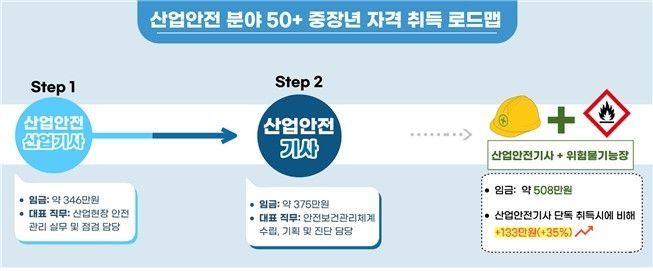
The field with the greatest wage increase was industrial safety. The average monthly wage for holders of the "Industrial Safety Industrial Engineer" certification was approximately 3.46 million won, but this rose to about 3.75 million won for those who obtained the "Industrial Safety Engineer" certification. Furthermore, those who additionally acquired the "Hazardous Materials Master Craftsman" certification saw their average monthly wage rise to about 5.08 million won. This is an increase of 1.33 million won compared to those with only the engineer-level certification, indicating that obtaining related certifications can serve as a turning point for wage growth.
In the fire protection systems field, acquiring additional certifications also led to wage increases. For example, in fire protection (electrical), those with the "Fire Protection System Industrial Engineer" certification earned an average of about 2.99 million won per month, which increased to approximately 3.13 million won with the "Fire Protection System Engineer" certification. If they additionally obtained the "Air Conditioning and Refrigeration Engineer" certification, the average monthly wage rose to about 3.72 million won. In fire protection (mechanical), the average monthly wage was about 2.92 million won for "Fire Protection System Industrial Engineer" holders and about 3.05 million won for "Fire Protection System Engineer" holders. When the "Construction Safety Engineer" certification was additionally acquired, the wage increased to approximately 3.78 million won.
In the construction safety field, a clear progression was observed where higher qualification levels led to higher wages. The average monthly wage was about 3.83 million won for "Construction Safety Industrial Engineer" holders, about 4.13 million won for "Construction Safety Engineer" holders, and about 4.51 million won for "Construction Safety Professional Engineer" holders. Those who obtained both the construction safety engineer and concrete engineer certifications also earned an average monthly wage of about 4.51 million won, similar to those with the professional engineer certification.
A similar trend was found in the electrical field. The average monthly wage was 2.61 million won for "Electrical Craftsman" holders, 2.8 million won for "Electrical Industrial Engineer" holders, and 2.92 million won for "Electrical Engineer" holders, showing a stepwise increase. After obtaining the engineer-level certification, those who also acquired the "Air Conditioning and Refrigeration Engineer" certification saw their average monthly wage jump to 3.57 million won, demonstrating a clear wage boost.
Based on these findings, the government plans to significantly expand the scale of Korea Polytechnics’ specialized training programs for middle-aged workers and broaden policies that support career transitions and reemployment for this demographic.
Kwon Jin-ho, Director General of the Integrated Employment Policy Bureau at the Ministry of Employment and Labor, said, "We hope this roadmap will serve as a useful reference for middle-aged workers to identify effective combinations of certifications in the field and to develop reemployment strategies. The government will continue to expand its support package, linking information provision, vocational training, work experience, job placement, and employment incentives, to broaden job opportunities for the middle-aged workforce."
Middle-aged individuals seeking more information about certifications can visit the Human Resources Development Service of Korea’s National Technical Qualifications website. For details about training courses to obtain certifications, they can check the Employment 24 website.
© The Asia Business Daily(www.asiae.co.kr). All rights reserved.


















