Dollar Index Down 9.5% From Start of Year
Tariff War and Rate Cuts Drive Decline
Wall Street Expects Weak Dollar Through 2026
Focus on Next Fed Chair's Policy Direction
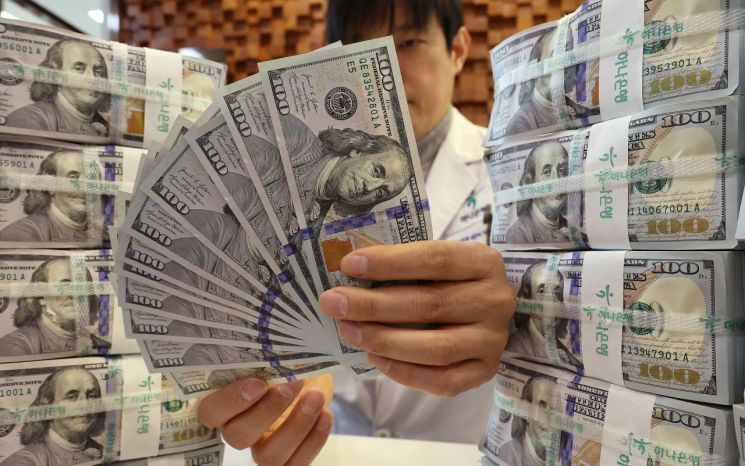
The value of the US dollar is expected to record its largest decline this year. Market experts also predict that the dollar will continue to weaken next year.
According to the Financial Times (FT) on the 30th (local time), the Dollar Index (DXY), which measures the value of the US dollar against the currencies of six major countries (Eurozone, Japan, United Kingdom, Canada, Sweden, and Switzerland), rose 0.12% from the previous trading day to 98.16. This represents a 9.5% decrease compared to the beginning of the year.
In particular, the dollar surged by about 14% against the euro, marking the largest increase. The euro-dollar exchange rate reached 1.17580 dollars, hitting its highest level since 2021.
This year, the dollar recorded its steepest annual decline since 2017. George Saravelos, Global Head of FX Research at Deutsche Bank, pointed out, "This year has been the worst-performing year for the dollar in the history of the free-floating exchange rate system."
The dollar's weakness began when US President Donald Trump initiated a global tariff war in April. This led to concerns about the US economy and heightened doubts among investors about the dollar's status as a safe-haven asset. At one point, the dollar fell as much as 15% against major currencies before partially recovering. However, since the Federal Reserve's interest rate cut in September, downward pressure on the dollar has persisted.
Market experts expect the dollar's weakness to continue into 2026. This is because the Federal Reserve is expected to cut its benchmark interest rate further next year. The market anticipates that the Federal Reserve will lower the benchmark rate by 0.25 percentage points two or three times by the end of 2026. In contrast, other central banks such as the European Central Bank (ECB) and the Bank of Japan (BOJ) are more likely to keep their rates steady or raise them.
Given these factors, a weak dollar trend appears inevitable. On Wall Street, the euro-dollar exchange rate is expected to rise to 1.20 dollars by the end of 2026. The pound-dollar rate is projected to increase from the current 1.33 dollars to 1.36 dollars. James Knightley, Chief International Economist at ING, said, "The Federal Reserve is moving in the opposite direction of the trend among global central banks," adding, "It is still maintaining an accommodative monetary policy stance."
In particular, the direction of the dollar is expected to depend on the next Federal Reserve Chair. If the next chair follows President Trump's calls for further rate cuts, the dollar's weakness could intensify. Mark Sobel, a former Treasury Department official, said, "Trump's actions are gradually undermining the dollar's status in the long term, but the burden currently felt by market participants is significant."
Another factor contributing to the dollar's weakness is that foreign investors are beginning to hedge their currency risk when purchasing US stocks. Saravelos of Deutsche Bank noted, "In particular, the structural reassessment by European global investors of unhedged dollar exposure products is also one of the reasons for the dollar's weakness." When currency hedging is used in derivatives trading, it increases downward pressure on the dollar.
Meanwhile, some believe the dollar could strengthen. This is based on the view that the artificial intelligence (AI) investment boom will allow the US economy to maintain a faster growth rate than Europe next year, which could limit the Federal Reserve's ability to aggressively cut rates.
© The Asia Business Daily(www.asiae.co.kr). All rights reserved.












