Ministry of Land Releases November Housing Statistics
29,166 Unsold Completed Units... Up 3.9% from Previous Month
The number of unsold completed housing units reached 29,166 as of the end of last month. This is the highest level in 13 years and 8 months since March 2012, when the figure stood at 30,438 units.
Unsold inventory after completion is considered particularly problematic for construction companies because it not only hampers smooth capital recovery but is also difficult to dispose of. In complexes where residents have already begun moving in, disputes sometimes arise over discounted sales. Despite the government introducing various measures to revitalize the local construction market, the number of unsold completed units continues to rise rather than decrease.
According to the November housing statistics released by the Ministry of Land, Infrastructure and Transport on December 31, the total number of unsold homes was 68,794, down 0.4% from the previous month. However, unsold completed units increased by 3.9% during the same period, continuing an upward trend. In the Seoul metropolitan area, the number rose by 0.1% from the previous month to 4,351 units, while in regional areas, it increased by 4.6% to 24,815 units.
Among metropolitan governments, Daegu had the highest number of unsold completed units at 3,719. In terms of the rate of increase, North Chungcheong Province more than doubled, rising from 702 units at the end of October this year to 1,417 units last month. North Gyeongsang Province and South Gyeongsang Province also have high inventories, each with over 3,000 units, although these figures saw a slight decrease compared to the previous month.
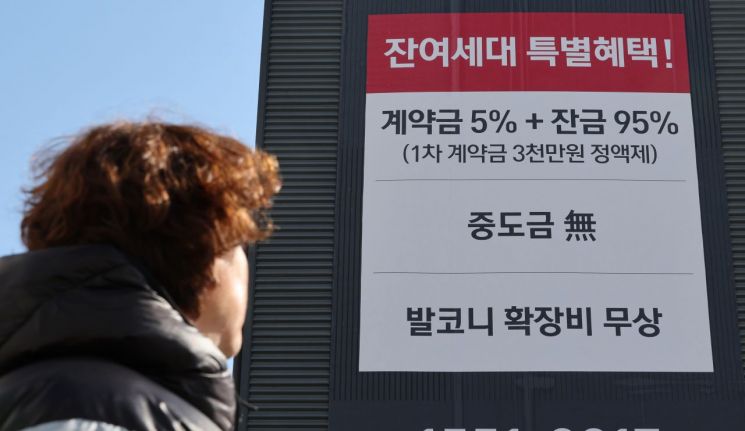 Model house of an apartment for sale in Seoul built on a site in Goyang-si, Gyeonggi-do. Photo by Yonhap News
As the problem of unsold homes in regional areas has become prolonged, the government has proposed resolving the issue by having the Korea Land and Housing Corporation (LH) or the Housing and Urban Guarantee Corporation (HUG) purchase these units. However, due to difficulties in reaching agreements over purchase prices and other terms, the actual number of units purchased has reportedly remained low.
The number of housing permits, considered a leading indicator for the construction market, totaled 277,045 units from January to November this year, a 0.5% increase from the same period last year. While the metropolitan area saw an increase of about 22.8%, regional areas experienced a decrease of 15.4%. In terms of housing starts, which the government uses as a supply indicator, 208,476 units were started from January to November, a 12.3% decrease compared to the same period last year. The metropolitan area saw a 5.1% decrease, while regional areas experienced a 21.5% decrease.
The number of pre-sale units for multi-family housing, which is counted separately, was 182,194 from January to November, a 13.9% decrease from the same period last year. The metropolitan area saw an 8.0% decrease, while regional areas experienced a 21.4% decrease. The number of completed units from January to November was 318,015, a 13.4% decrease from the same period last year. The metropolitan area saw an 8.1% decrease, while regional areas experienced an 18.0% decrease.
Last month, the number of housing sales transactions was 61,407, down 11.9% from the previous month. In the metropolitan area, which is subject to various regulations, transactions fell by 30.1% over the same period, while regional areas saw an increase of 12.1%. The number of rental transactions, including both jeonse and monthly rentals, was 208,002, up 4.1% from the previous month. The proportion of monthly rental contracts among all lease agreements was 62.7% from January to November, a 5.3 percentage point increase compared to the same period last year.
© The Asia Business Daily(www.asiae.co.kr). All rights reserved.
![Clutching a Stolen Dior Bag, Saying "I Hate Being Poor but Real"... The Grotesque Con of a "Human Knockoff" [Slate]](https://cwcontent.asiae.co.kr/asiaresize/183/2026021902243444107_1771435474.jpg)
















