From Comprehensive License Revocation to Annual Approval System
Policy to Prohibit Expansion of Chinese Plants Remains Unchanged
Samsung Electronics and SK Hynix have narrowly avoided operational disruptions that could have occurred if they had to wait for U.S. approval each time they brought equipment into their semiconductor plants in China. The U.S. government had initially canceled the comprehensive export license it had granted to Samsung Electronics and SK Hynix’s Chinese factories for U.S.-made semiconductor equipment, but has now decided to allow exports on an annual basis.
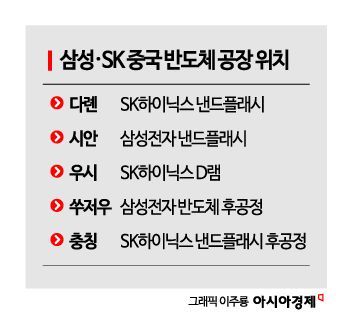
According to the semiconductor industry on December 30, the U.S. Department of Commerce’s Bureau of Industry and Security (BIS) has changed its policy. Instead of revoking the ‘Validated End-User (VEU)’ status for Korean semiconductor companies’ Chinese plants, it will now approve the export volume of equipment annually. The VEU is an exceptional status that allows the supply of U.S.-made equipment without separate licensing procedures or time limitations, provided certain security conditions are met. Until now, Samsung Electronics’ NAND plant in Xi’an, China, and SK Hynix’s DRAM plant in Wuxi have benefited from VEU status, enabling them to import U.S. equipment without significant regulatory hurdles.
Previously, at the end of August, the BIS announced that it would remove three Chinese subsidiaries operating these factories from the VEU list. This measure was set to take effect 120 days after its publication in the Federal Register, starting on December 31. If implemented as planned, Korean companies’ factories in China would have had to obtain individual U.S. approvals every time they imported U.S.-made equipment from December 31 onward. There were concerns that not only the approval process but also administrative procedures would cause significant disruptions to the operation of these plants in China.
However, during the grace period, the U.S. government eased its stance on revoking VEU status and decided to introduce a system requiring separate annual approvals. Under this system, companies must apply in advance for the types and quantities of semiconductor equipment and parts they need each year, and the U.S. government will decide whether to approve the exports after review. Although this process is more complicated than being included in the VEU list, it significantly reduces operational uncertainties compared to obtaining individual approvals for every equipment import.
The U.S. government has estimated that, without VEU status, the number of annual approval cases required for Samsung Electronics and SK Hynix’s Chinese plants could reach 1,000. Under the newly introduced system, both Samsung Electronics and SK Hynix are reported to have received approval from the U.S. government for their equipment import plans for the coming year. However, some point out that even with this system in place, it remains difficult to precisely predict the types and quantities of equipment and parts needed on an annual basis, leaving ongoing management uncertainties.
In addition, it is reported that the U.S. government will maintain its policy of prohibiting the export of equipment intended for the expansion or upgrading of Chinese plants, even while allowing annual equipment exports. A semiconductor industry official commented, “It is fortunate that the abrupt disruption of operations at Chinese plants has been avoided,” but added, “Given the structural nature of the U.S.-China technological rivalry, uncertainties in mid- to long-term management strategies will continue to pose a burden going forward.”
© The Asia Business Daily(www.asiae.co.kr). All rights reserved.