Turning Point in Biological Research Resource Policy:
Shifting Focus from 'Securing and Management' to 'Sharing and Utilization'
The government will proactively identify valuable bio-materials using artificial intelligence (AI) and promote the gradual localization of key biological materials that currently rely heavily on imports. By integrating bio data scattered across national research and development (R&D) as well as public and private sectors, the government aims to build more than 7 million national bio data entries by 2030. Additionally, dedicated high-performance computing infrastructure for the development of AI models specialized in the bio sector will be expanded in stages.
The Presidential National Science and Technology Advisory Council held its 4th review meeting in writing from December 23 to December 30, and deliberated and approved the “4th Basic Plan for National Biological Research Resources Management and Utilization (2026-2030)” and the “1st Basic Plan for Innovation in Food and Drug Regulatory Science (2026-2030).”
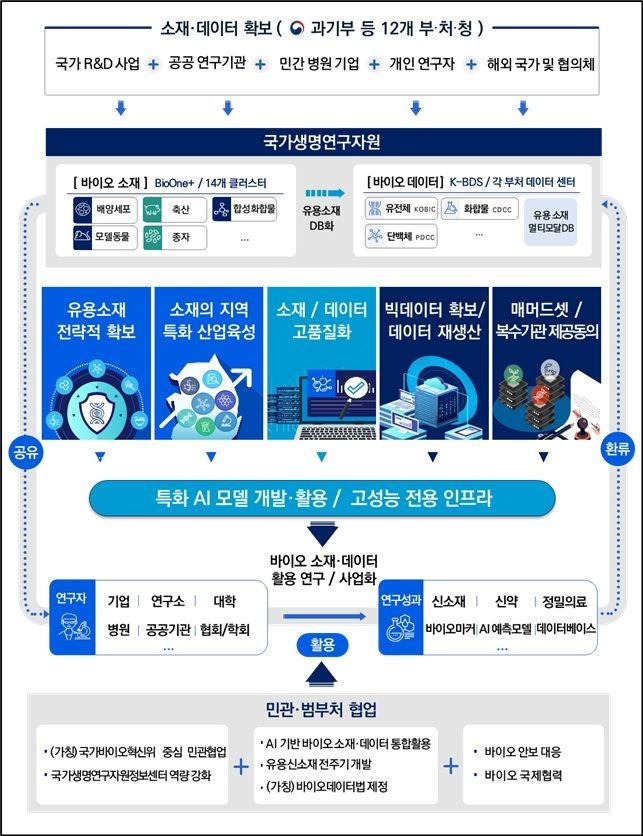 Review No.1. National Biological Research Resources Sharing and Utilization Full-Cycle Promotion System Diagram. Provided by the Ministry of Science and ICT
Turning Point in Bio Policy: From 'Collection' to 'Utilization Ecosystem'
The 4th Basic Plan for National Biological Research Resources Management and Utilization is the highest-level, cross-ministerial plan established under the “Act on Securing, Managing, and Utilizing Biological Research Resources.” It was jointly formulated by the Ministry of Science and ICT and 11 other ministries and agencies.
In response to the spread of AI in bio industries, the government has decided to shift the focus of its biological research resource policy from the traditional “securing and management” to “creating a sharing and utilization ecosystem.” To this end, it will pursue three key strategies and ten major initiatives: ▲bio-materials, ▲bio data, and ▲public-private cooperation.
First, the government will proactively discover bio-materials with high utilization value through AI-based analysis, and will gradually localize key materials that are highly dependent on imports. In addition, it will foster specialized bio-material industries tailored to corporate demand, focusing on key research institutions in each region.
Targeting 7 Million National Bio Data Entries... Expanding AI Analysis Infrastructure
In the field of bio data, the government has set a goal of securing more than 7 million data entries by 2030 by connecting data scattered across national R&D projects and public and private sectors, centered on the National Bio Data Integration Platform (K-BDS).
Sensitive human-derived data will be analyzed in secure environments, and dedicated high-performance computing infrastructure for the development and application of AI models specialized in bio will be expanded in stages. Through inter-ministerial collaboration, a large-scale data set called the “Cross-Ministerial Mammoth Set” will be established, and data search and utilization convenience will also be improved.
At this meeting, the 1st Basic Plan for Innovation in Food and Drug Regulatory Science, which introduces AI and data-driven regulatory science to the food and drug sector, was also approved. The government plans to strengthen the scientific basis for safety management by using AI and big data for the preemptive prediction of risk factors and the construction of approval and review support systems for medical products, while also supporting the rapid market entry of innovative food and drug products.
© The Asia Business Daily(www.asiae.co.kr). All rights reserved.

![Clutching a Stolen Dior Bag, Saying "I Hate Being Poor but Real"... The Grotesque Con of a "Human Knockoff" [Slate]](https://cwcontent.asiae.co.kr/asiaresize/183/2026021902243444107_1771435474.jpg)














