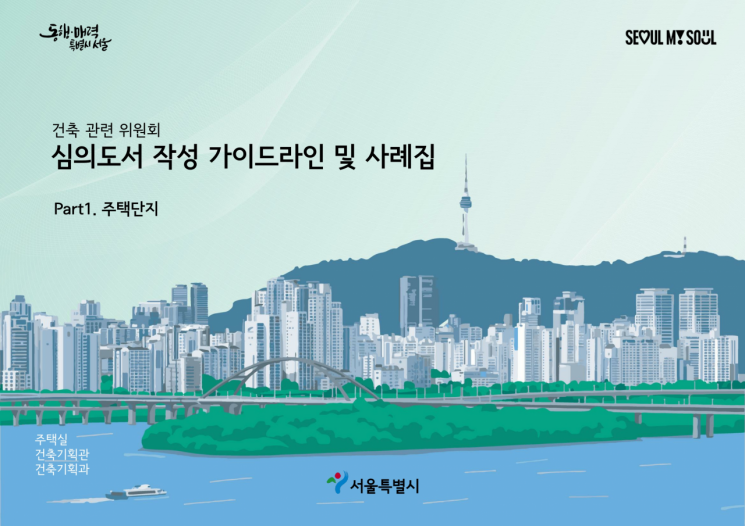
 Architectural Committee Review Document Preparation Guidelines and Casebook Part 1. Residential Complex Cover. Seoul City
On December 30, the Seoul Metropolitan Government announced the publication and release of the "Architectural Committee Review Document Preparation Guidelines and Casebook Part 1: Housing Complex," which includes 65 recurring issues raised during the architectural review process.
Following the implementation of the "Integrated Management Plan for Architectural Committees" in June of last year, the city has compiled important cases over the past year by committee and field, making it easier for practitioners and others to understand the review standards. Through this, the city aims to enhance the consistency and efficiency of the review process and support the smooth progress of subsequent administrative procedures. Starting today, the e-book is available to everyone on the city's official website.
The casebook consists of three chapters: Master Plans, the Architectural Committee, and the Landscape Committee. In particular, the Architectural Committee chapter is subdivided by committee composition areas such as architectural planning, urban design, transportation, and disaster prevention, thereby increasing its practical usability. The casebook contains review cases for a total of 65 major opinions.
Notably, this casebook includes key review issues related to residential environment, resident convenience and safety, and crime prevention, which are highly important when planning "multi-family housing complexes."
The city plans to regularly revise and supplement the casebook in line with changes in laws, related regulations, and architectural review standards. This edition focuses first on multi-family housing complexes, which are most frequently submitted for review, and will gradually expand to cover general buildings and public spaces in the future.
Choi Jinseok, Director of Housing at the Seoul Metropolitan Government, stated, "The review document preparation guide will provide practical assistance to practitioners, business operators, and citizens in establishing systematic plans from the early stages of a project," adding, "By systematizing accumulated review cases, we will establish a rational and predictable architectural review system and support the swift progress of various projects."
© The Asia Business Daily(www.asiae.co.kr). All rights reserved.
![Clutching a Stolen Dior Bag, Saying "I Hate Being Poor but Real"... The Grotesque Con of a "Human Knockoff" [Slate]](https://cwcontent.asiae.co.kr/asiaresize/183/2026021902243444107_1771435474.jpg)











