Elevators Installed at All Stations, with Gajisan Station on Line 5 as the Final Step
Expansion of Installations to All Stations Built Before the 2006 Legal Revision
"Transfers Within 10 Minutes" Initiative to Be Pursued at 13 Stations Including Nowon
Seoul Metro has become the first in the nation to complete the installation of elevators connecting ground-level entrances to platforms at all 338 subway stations. Moving forward, the second phase project, which aims to enable transfers within 10 minutes at every station, will also be pursued.
On December 29, at 2:00 p.m., Seoul Metropolitan Government announced that it held a ceremony at Gajisan Station on Line 5 to commemorate the achievement of "one accessible route per station" across the entire subway network. "One accessible route per station" means that passengers with mobility challenges can travel from the ground to the platform using an elevator without assistance from others.
Until now, some stations did not have elevators connecting the ground and platforms due to aging facilities and construction difficulties. With the completion of the elevator at Gajisan Station on Line 5, the goal of 100% elevator coverage at all stations has been achieved.
After the revision of the Act on Promotion of the Transportation Convenience of Mobility Disadvantaged Persons in 2006, Seoul Metropolitan Government established the "Comprehensive Plan for Expanding Subway Accessibility Facilities" in 2007. This plan included the installation of elevators connecting the ground and platforms at each station, including existing stations.
Since then, from 2008 to this year, Seoul has made concentrated investments, spending 175.1 billion won on 79 stations over approximately 18 years. During the construction of the first-generation subway lines (Lines 1 to 4) in the 1970s and 1980s, the mobility rights of disadvantaged groups were not considered, so costly elevators were not installed. After the law was amended, the city began expanding elevator installations to existing stations built before the revision.
Nevertheless, the construction process remained extremely complex due to aging infrastructure and the need to connect with other metropolitan subway lines. Additionally, 17 stations faced long-standing unresolved issues from the design stage, including complaints from adjacent buildings, conflicts with private property, and ground construction problems.
Seoul Metropolitan Government and Seoul Metro focused all their operational and construction expertise on finding solutions. They adopted new technologies such as special construction methods, conducted both daytime and nighttime work, streamlined processes, and coordinated with building owners and other stakeholders. As a result, sequential openings were achieved, including Bonghwasan Station in December 2023. The following stations completed elevator installations in 2023: Bonghwasan, Saejeol, Gangdong, and Gwangmyeong Sageori. In 2024: Macheon, Suraksan, Jongno 3-ga, Sangwolgok, Cheongdam, Sangil-dong, Namguro, Bokjeong, Daehung, and Gusan. This year, Shinsuldong, Express Bus Terminal, and Gajisan stations completed their elevators.
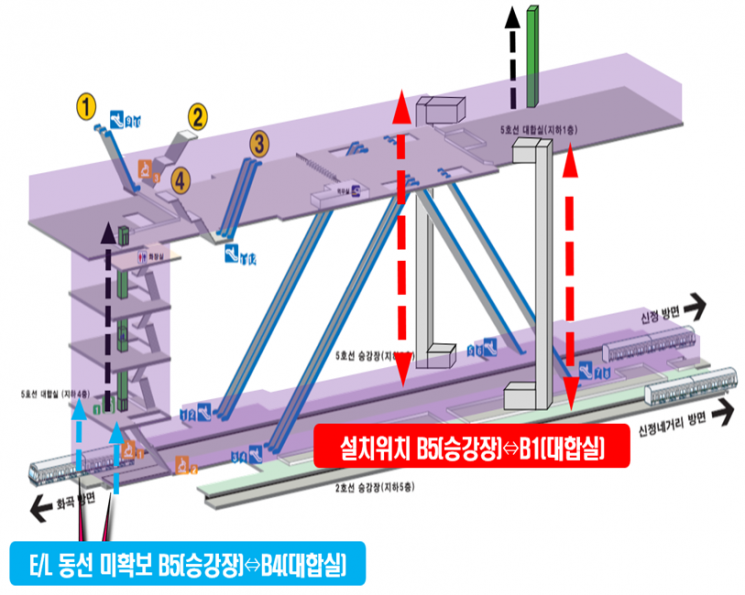
In particular, Gajisan Station on Line 5 was one of the most challenging projects, facing issues such as conflicts with private property, limited ground space, and the discovery of extremely hard bedrock during construction. To overcome these obstacles, a special construction method was used, excavating underground in a "ㄷ"-shaped pattern along both outer walls, and utilizing adjacent elevators as soil and rock removal routes without closing entrances. As a result, it became the first case in Korea where an elevator connects directly from the internal concourse (B1) to the platform (B5) in a subway station.
Looking ahead, the city plans to continue its subway innovation initiatives with the goal of "transfers within 10 minutes at every station." Through public feedback, it identified 13 stations-such as Nowon, Konkuk University, and Express Bus Terminal-where related demands are concentrated, and selected them as project targets. The plan includes installing internal transfer corridors, internal elevators, and providing customized navigation through the Seoul Companion Map.
The 13 major transfer stations targeted by the project are used by 944,000 citizens daily, including metropolitan transfer passengers. Among these, 57.9% are passengers with mobility challenges, while 44.9% are not. The transfer time for users is expected to be reduced by approximately 46.6%, greatly enhancing convenience for citizens.
Seoul Mayor Oh Sehoon stated, "Today marks a meaningful milestone in the 50-year history of Seoul Metro, as we respond to the voices and demands of citizens with concrete policy. Mobility is not a choice but a right that must be guaranteed to everyone, and by ensuring universal accessibility without discrimination, Seoul Metro has achieved another result in our commitment to 'accompanying the disadvantaged.'"
© The Asia Business Daily(www.asiae.co.kr). All rights reserved.
![Clutching a Stolen Dior Bag, Saying "I Hate Being Poor but Real"... The Grotesque Con of a "Human Knockoff" [Slate]](https://cwcontent.asiae.co.kr/asiaresize/183/2026021902243444107_1771435474.jpg)











