Heads of Four Major Economic Organizations Deliver New Year's Addresses
"Era of Great Transformation" Marked by AI Revolution and Spread of Protectionism
Calls for Policies to Enable Economic Leap Forward and Secure Competitiveness
The business community has defined the year 2026, the Year of the Fire Horse, as an "Era of Great Transformation," represented by the AI revolution and the spread of global protectionism, and has called for deregulation to enable the Korean economy to leap forward and secure competitiveness.
On December 29, the heads of the four major economic organizations-Choi Tae-won, Chairman of the Korea Chamber of Commerce and Industry; Ryu Jin, Chairman of the Korea Economic Organization Association; Yoon Jin-sik, Chairman of the Korea International Trade Association; and Sohn Kyung-shik, Chairman of the Korea Employers Federation-delivered this message in their New Year's addresses.
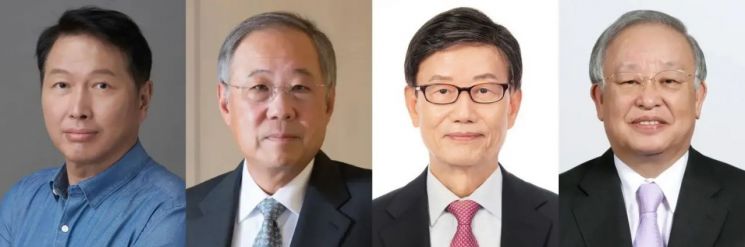 Choi Tae-won, Chairman of the Korea Chamber of Commerce and Industry, Ryu Jin, Chairman of the Korea Economic Organization Association, Yoon Jin-sik, Chairman of the Korea International Trade Association, and Sohn Kyung-shik, Chairman of the Korea Employers Federation, defined the year 2026, the Year of the Fire Horse, as an "Era of Great Transformation" characterized by the AI revolution and the spread of global protectionism in their New Year's addresses on the 29th. They called for deregulation to enable the economy to leap forward and secure competitiveness.
Chairman Choi Tae-won diagnosed the Korean economy as facing complex challenges, including low growth, uncertainty in international affairs, and rapid shifts in technological paradigms, and called for a "comprehensive strategy" to accelerate growth. He emphasized that "close cooperation between the government and businesses, going beyond existing frameworks and methods, is more important than ever" to support large-scale corporate investment and innovation. He reiterated, "We must correct the structure in which the growth of companies leads to increased regulation and burdens," and stressed the need to "create a growth-friendly institutional environment so that innovative companies can scale up and their achievements can lead to job creation and the spread of social value."
Chairman Ryu Jin encapsulated the significance of this era of transformation for the Korean economy by proposing the "New K-Industry Era," stating, "We must boldly abandon outdated systems and revive the dynamism of the private sector." He praised the government and business community for acting as "one team" in response to U.S. tariff policies, and assessed that Korea has emerged as a key axis of the global supply chain, particularly in strategic industries such as semiconductors, shipbuilding, and defense. He further suggested, "Now, as a core nation in the Asia-Pacific economic order, Korea should take the lead in setting global standards for AI, digital, and green industries."
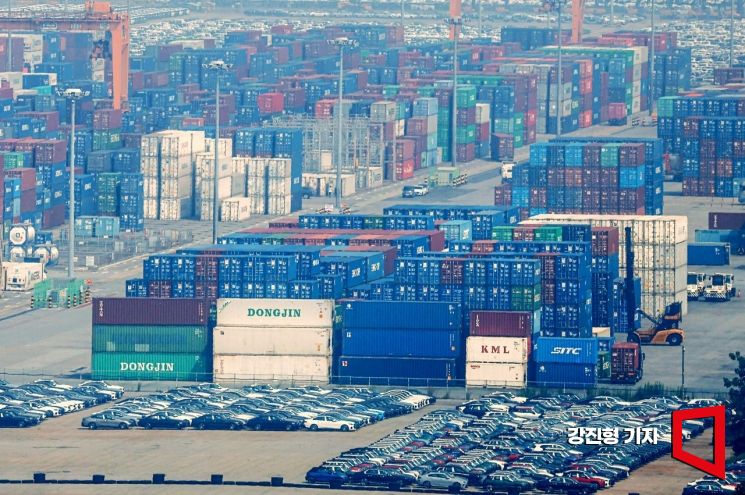 Cars awaiting shipment for export are lined up at the export yard of Pyeongtaek Port, Gyeonggi Province. Photo by Kang Jinhyung
Chairman Yoon Jin-sik announced plans to establish a trade platform to respond to the rise of protectionism as a new trend in the global economic order. He also promised to improve the infrastructure of the Korea International Trade Association in celebration of its 80th anniversary next year.
Chairman Yoon stated, "In an environment where uncertainty has become the norm, our trade sector once again faces a critical test," and highlighted the following key tasks: ▲Proactively responding to the reorganization of the global trade order ▲Upgrading export support infrastructure based on artificial intelligence (AI) ▲Establishing a growth ladder to support corporate growth ▲Innovating trade infrastructure. He added, "By focusing on new trade, new industries, and new markets as core keywords, we will support the overseas expansion of the Korean trade sector."
Chairman Sohn Kyung-shik addressed changes in domestic labor regulations, such as the "Yellow Envelope Act" set to take effect in March next year, urging, "We must urgently resolve rigid labor market regulations and achieve the modernization of labor-management relations." He further emphasized, "The wage system should be transformed from a seniority-based system to a fair compensation system that reflects job value and performance," and added, "By increasing labor market flexibility, we can find a win-win solution where the issue of extending the retirement age does not conflict with youth employment."
© The Asia Business Daily(www.asiae.co.kr). All rights reserved.
![Clutching a Stolen Dior Bag, Saying "I Hate Being Poor but Real"... The Grotesque Con of a "Human Knockoff" [Slate]](https://cwcontent.asiae.co.kr/asiaresize/183/2026021902243444107_1771435474.jpg)

















