Naju Secures National Nuclear Fusion Project
Follow-up Measures Underway: Feasibility Study, Infrastructure, and Public Engagement
Dedicated Task Force Established, Citizen Briefings Begin
Full-scale Effort Planned to Pass Government Review Next Year
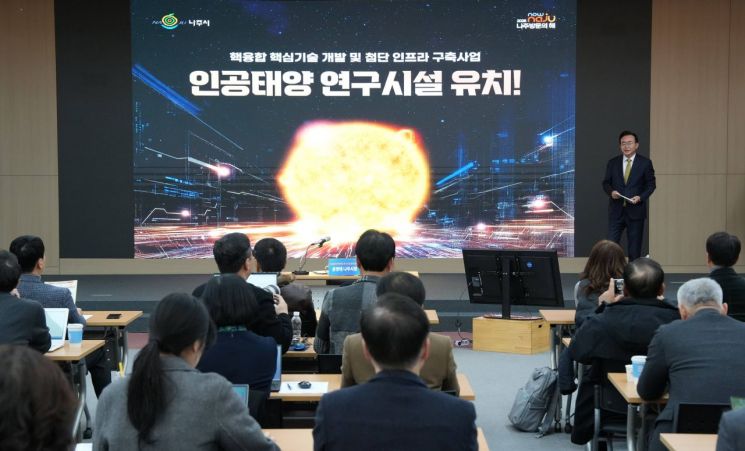 Naju City held a "Briefing Session on Attracting the Artificial Sun Research Facility" for journalists on the 16th at the large conference room of Naju City Hall. Photo by Naju City
Naju City in South Jeolla Province has officially begun follow-up procedures encompassing the preliminary feasibility study response, infrastructure development, and citizen engagement after being confirmed as the site for the national nuclear fusion project, also known as the "Artificial Sun." The city is seen to be accelerating its efforts to become a hub for future clean energy.
On December 10, Naju City was finally selected as the site for the "Core Technology Development and Advanced Infrastructure Construction Project for Nuclear Fusion," which is overseen by the Ministry of Science and ICT.
This project is a large-scale national initiative aimed at securing future energy sources and strengthening national energy security by taking the lead in commercializing nuclear fusion technology amid the global competition for energy dominance. The project will be funded by approximately 1.2 trillion won from the national budget. The project period is set for ten years, from 2027 to 2036, focusing on research and development of core nuclear fusion technologies and the construction of demonstration-based infrastructure.
According to the Ministry of Science and ICT's requirements, local governments must provide a ready-to-build site by the first half of 2028, as well as secure a 250 MVA-class power supply line and an access road with at least four lanes in both directions.
Naju City comprehensively reviewed these requirements and designated part of the Naju Energy National Industrial Complex and its surrounding area as the project site. Since the national industrial complex is already under development, existing infrastructure can be leveraged for rapid site preparation. Additionally, a plan for a four-lane access road has been established, giving the site a competitive edge in terms of accessibility.
The nearby Wang-gok Substation and the industrial complex reservoir enable large-scale power and water supply, and the city also owns adjacent land that allows for future expansion, earning high marks for sustainability and scalability. With the research facility as its centerpiece, Naju Innovation Industrial Complex and the Energy National Industrial Complex are expected to attract related companies, paving the way for an industrial base where research and industry are integrated.
Naju City plans to establish an industry-academia-research cluster anchored by the nuclear fusion research facility and actively utilize the energy sector infrastructure in Naju Innovation City, which is located just ten minutes from the project site. The city envisions building a collaborative system centered on Korea Electric Power Corporation, Korea Power Exchange, and Korea Institute of Energy Technology to foster an energy research ecosystem.
Furthermore, the city aims to attract and support outstanding researchers from Korea and abroad, nurture young nuclear fusion scientists, establish an Energy Gifted Center, and create integrated residential complexes. Through these efforts, Naju City plans to develop into a global-level energy science city that combines education, research, and residential environments.
Naju City will form a dedicated organization to respond to the government’s preliminary feasibility study, with the goal of passing it within next year. At the same time, the city will hold briefing sessions and regional meetings for local residents to provide detailed information on the project’s procedures and future plans, and will ensure transparency and public engagement through information disclosure and feedback collection.
In addition, the city will systematically carry out preliminary procedures for site preparation and infrastructure construction, and strengthen cooperation with the central government, South Jeolla Province, and related agencies to ensure smooth project progress. In the medium to long term, Naju City plans to develop a comprehensive master plan in consultation with South Jeolla Province, covering company attraction, workforce development, research and development, and residential environment.
Meanwhile, this national nuclear fusion project is expected to be a key driver of change not only for site development but also for the overall industrial structure and regional economy of Naju City. The project is anticipated to attract about 2,000 highly skilled professionals and more than 300 related companies, create over 10,000 jobs, and boost population inflow. As positive ripple effects spread across education, housing, and commercial sectors, this project is expected to become a turning point for the city’s collective growth.
© The Asia Business Daily(www.asiae.co.kr). All rights reserved.

















