Repeat Offense Rate for Drunk Driving Reaches 40% in Five Years...
Can Complete Prevention Be Achieved?
New Penalties Introduced for Drug-Impaired Driving
Maximum Fine Raised to 20 Million Won
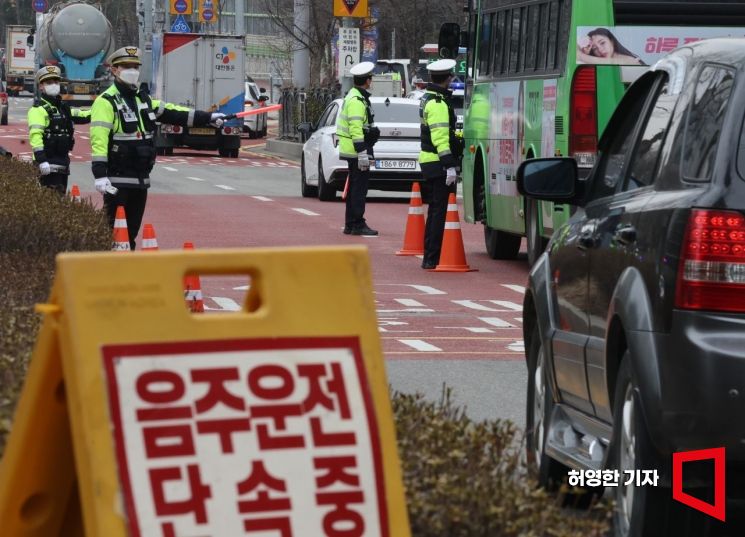 Police are conducting a sobriety checkpoint near an elementary school in Seoul. Photo by Hyung Han Heo
Starting in October next year, habitual drunk drivers who regain their licenses will be required to install ignition interlock devices to prevent drunk driving.
According to the "2026 Changes to Road Traffic Laws" released by the National Police Agency on the 8th, anyone who has committed drunk driving two or more times within the past five years must install an ignition interlock device in their vehicle when reapplying for a license after a two-year disqualification period.
This device prevents the vehicle from starting if alcohol is detected, and the installation cost is about 3 million won. The police are reportedly discussing with the Korea Road Traffic Authority to allow rental options as well.
Driving without installing the device may result in imprisonment for up to one year or a fine of up to 3 million won, and the driver’s license may also be revoked. If another person blows into the device to evade detection and the offender is caught driving, the penalty increases to imprisonment for up to three years or a fine of up to 30 million won.
The police aim to completely block the possibility of repeat offenses, as the recidivism rate among drunk drivers within the past five years has reached about 40 percent.
Penalties for drug-impaired driving will also be strengthened. In response to a series of cases involving driving under the influence of not only narcotics but also psychotropic drugs such as propofol and zolpidem, a new offense for "refusing drug testing" will be introduced. A new provision stipulates that refusal to undergo drug testing may result in imprisonment for up to five years or a fine of 20 million won. The penalty for drug-impaired driving will also be raised from the current "imprisonment for up to three years or a fine of up to 10 million won" to "imprisonment for up to five years or a fine of up to 20 million won."
The issuance of Class 1 licenses will become stricter. Previously, holders of Class 2 licenses could obtain a Class 1 license with only a fitness test if they had seven accident-free years. Starting next year, however, applicants must prove actual driving experience, such as by submitting automobile insurance certificates, before they can receive a Class 1 license after passing the fitness test.
© The Asia Business Daily(www.asiae.co.kr). All rights reserved.

















