Record Broken After Seven Years Despite U.S. Tariffs and Protectionism
Semiconductors, Automobiles, and Ships Drive Growth
Foreign Direct Investment Also Reaches All-Time High
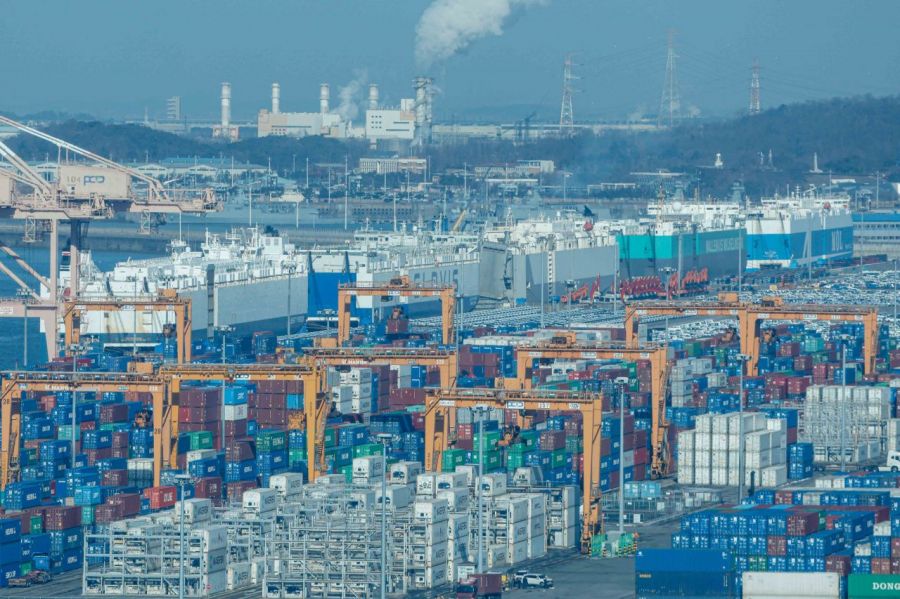
For the first time in history, South Korea's annual exports have surpassed $700 billion, making it the sixth country in the world to join the "700 Billion Dollar Club."
The Ministry of Trade, Industry and Energy and the Korea Customs Service announced on December 29 at 1:03 p.m. that the nation's cumulative exports had exceeded $700 billion. This milestone comes seven years after exports surpassed $600 billion in 2018, and is especially significant as it was achieved amid the global spread of protectionism and tariff pressures from the United States.
The government evaluated this achievement as "evidence of the resilience and capabilities of Korean businesses and citizens, who turned crisis into opportunity despite challenging trade conditions." The government also highlighted that, despite the economy’s high dependence on energy imports, South Korea maintained economic stability through a trade surplus. In fact, from January to December 28 this year, energy imports amounted to $117.4 billion, while the trade balance recorded a surplus of $73 billion.
Exports were sluggish in the first half of the year, but rebounded sharply in the second half as market confidence was restored following the launch of the new administration and the resolution of tariff negotiations with the United States, which eased uncertainties. From June to November, South Korea set new all-time monthly export records for six consecutive months, with September posting an all-time high monthly export figure of $65.9 billion.

By product category, semiconductors led the export increase. Cumulative semiconductor exports from January to November reached $152.6 billion, up 19.8% year-on-year, marking an all-time high. Despite challenges such as U.S. tariffs, automobile exports reached $66 billion, while ship exports exceeded $30 billion for the first time in eight years, driven by increased sales of high value-added liquefied natural gas (LNG) carriers. Biohealth exports also maintained steady growth, thanks to a rise in contract manufacturing (CMO) orders.
Qualitative changes in exports were also notable. Consumer goods and promising items such as cosmetics, agricultural and marine products, and electrical machinery have emerged as new growth engines. The export market has diversified beyond China and the United States to include ASEAN (Association of Southeast Asian Nations), the European Union (EU), and Central and South America. Exports by small and medium-sized enterprises (SMEs) also reached record highs in both export value and the number of exporting companies through September, further broadening the export base.
Alongside strong exports, foreign direct investment (FDI) also set a new record. Although FDI was sluggish in the first half, large-scale investments in advanced industries such as artificial intelligence (AI) and semiconductors flowed in during the second half, pushing annual reported investment over $35 billion. In particular, a significant increase in greenfield investment-building new factories and business sites-is expected to greatly boost regional economies and create jobs.
The government announced plans to maintain the upward trend in exports and foreign investment next year by promoting manufacturing innovation, diversifying export products and markets, and strengthening investment incentives in regional areas. The goal is to achieve $700 billion in exports for a second consecutive year and attract more than $35 billion in foreign investment.
© The Asia Business Daily(www.asiae.co.kr). All rights reserved.


















