Lee Jungmoon: "Not Just Merging Districts, But Transforming National Governance"
Lee Jaemyung Administration's 'Five Axes, Three Special Zones' Put to the Test
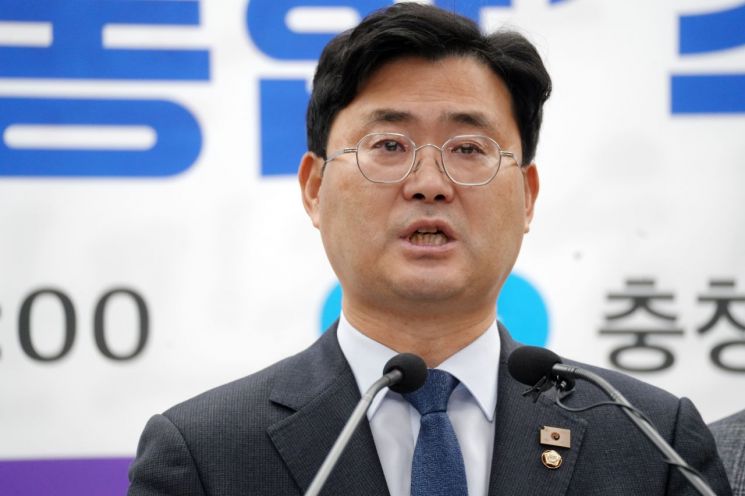
The Chungnam Provincial Party Committee of the Democratic Party of Korea has officially elevated the Daejeon-Chungnam administrative integration as a key agenda item and announced the launch of a dedicated organization for this purpose.
The plan aims to restructure the nation's growth axis beyond the current Seoul metropolitan-centered system. However, concerns are simultaneously being raised within the local community about a potential concentration of benefits in Daejeon and the acceleration of local extinction. The debate has now entered a critical phase, with the pace and precision of the integration process under close scrutiny.
On December 29, the Chungnam Provincial Party Committee held a press conference at the Chungnam Provincial Government briefing room and formalized the establishment of a Special Development Committee within the party to pursue the Daejeon-Chungnam administrative integration.
Jungmoon Lee, Chairman of the Provincial Party Committee, stated, "Until now, Korea's development has been centered around the Gyeongbu axis," adding, "It is now time to shift to an X-shaped national development strategy, where the Gyeongbu and Gangho axes intersect."
He went on to emphasize, "At the heart of this are Chungnam and Daejeon. Chungnam, as the central region of the Korean Peninsula and a key historical and geopolitical location, is destined to become the core of a new national growth axis-this is a demand of the times."
He further explained, "The Daejeon-Chungnam administrative integration is not merely a merger of administrative districts, but a transformation from administration divided by boundaries to administration that consolidates capabilities. It represents a fundamental change in the way the country is governed."
The Chungnam Provincial Party Committee made it clear that the consent of local residents is a prerequisite for advancing integration.
Assemblyman Lee stated, "We will promptly establish a 'Chungnam-Daejeon Integration Special Development Committee' at the party level and widely gather public opinion through forums, public hearings, and town hall meetings."
He added, "Between January and February, we will tour the region to collect genuine, substantive feedback rather than simply going through the motions."
Regarding past internal opposition to integration discussions, he acknowledged, "It is regrettable that there was insufficient communication with Democratic Party lawmakers at the time," and pledged, "Going forward, we will engage in ample persuasion and discussion during the remaining period."
Addressing concerns about the location of the provincial government office and the restructuring of the administrative system, he clarified, "Nothing has been decided yet regarding the location or name of the government office," adding, "We are also considering the possibility of operating multiple government buildings."
He also stated, "We plan to use the integration as an opportunity to secure a significant portion of the second round of public institution relocations to the Naepo area in Daejeon and Chungnam."
He drew a clear line regarding concerns about the reduction of powers for basic local governments.
Assemblyman Lee stressed, "It is important to design the integration so that the functions of basic local governments are not eliminated. On the contrary, we aim to generate a synergy effect."
The issue of integrating educational administration has also emerged as a major point of contention.
Assemblyman Lee stated, "Educational integration is a task that must also be pursued," adding, "We will listen carefully to criticism from the education sector and work to persuade stakeholders."
However, regarding certain political proposals such as changing the method for electing superintendents, he drew a line, saying, "It is difficult to agree with those suggestions."
This debate has gained significant momentum following public remarks by the President.
On December 5, President Lee Jaemyung raised the topic of Daejeon-Chungnam administrative integration during a town hall meeting in Chungnam and expressed a positive stance. He later reaffirmed his commitment to pursuing integration during a meeting with ruling party lawmakers.
On December 19, the Democratic Party officially launched the "Daejeon-Chungnam Integration Chungcheong Development Special Committee" at the National Assembly. Supreme Council member Hwang Myungseon was appointed as the standing committee chair, while Assemblymen Park Beomgye, Park Junghyun, and Jungmoon Lee were named as co-chairs.
However, unlike the political sphere, public sentiment in the local community is divided.
While there are expectations that integration will attract a second round of public institutions and improve administrative efficiency, there are also strong concerns about further concentration of resources in Daejeon, the relative neglect of island and rural areas in Chungnam, and the potential relocation of undesirable facilities.
Although the President's commitment has accelerated the process at an unusual pace, some point out that the structure of the debate and the persuasion process have not yet been sufficient for the local community to truly feel engaged.
© The Asia Business Daily(www.asiae.co.kr). All rights reserved.
![User Who Sold Erroneously Deposited Bitcoins to Repay Debt and Fund Entertainment... What Did the Supreme Court Decide in 2021? [Legal Issue Check]](https://cwcontent.asiae.co.kr/asiaresize/183/2026020910431234020_1770601391.png)
















