Youth Account for 27.7% of Gwangju City's Population
First-Ever "Youth Statistics" in Gyeonggi Province Sheds Light on Quality of Life
Gwangju City in Gyeonggi Province has released the "Gwangju City Youth Statistics," which analyzes various aspects of young people's lives, as part of its efforts to create a city where youth can thrive.
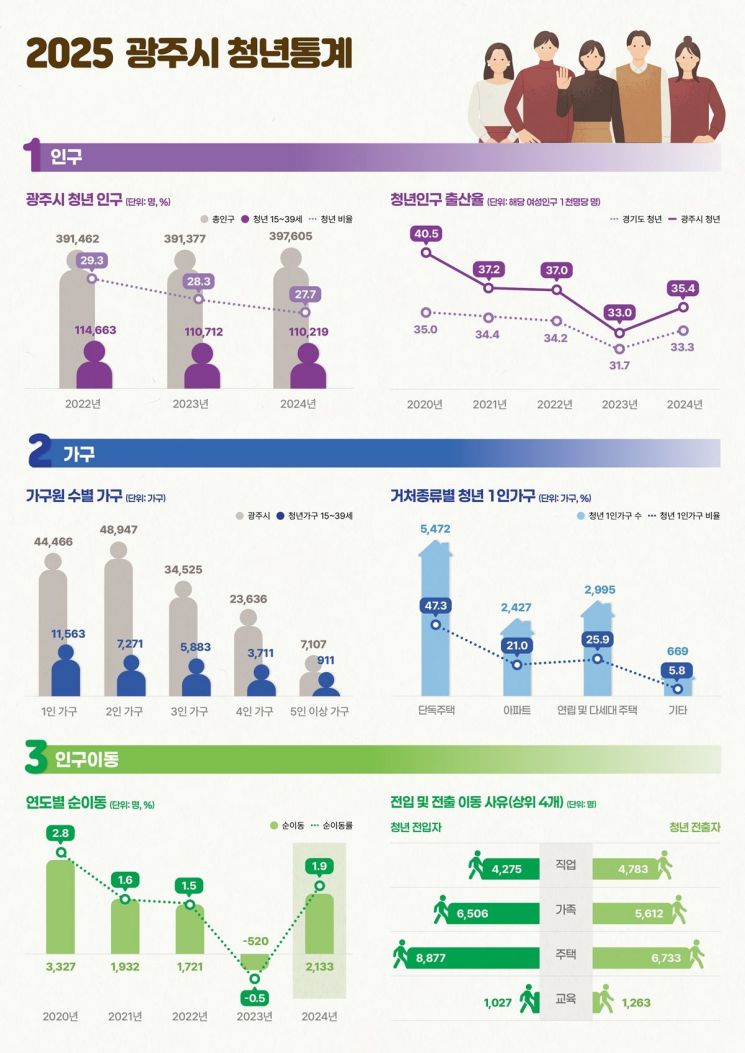 Gwangju City, First in Gyeonggi Province to Release 'Youth Statistics'. Provided by Gwangju City, Gyeonggi Province
This statistical report is a regionally specialized project led by the Digital Information Division to establish a basic plan for youth statistics in the Regional Economy Division. It was developed in collaboration with the Gyeongin Regional Statistics Office and is the first of its kind among the 31 cities and counties in Gyeonggi Province.
The Gwangju City Youth Statistics is an administrative statistical report that links and analyzes administrative records and various statistical data for young people residing in Gwangju City as of November 1, 2024. It covers 79 indicators across nine categories: population, households, population movement, economy, employment, entrepreneurship, welfare and health, and awareness.
According to the statistics, the youth population aged 15 to 39 stands at 110,219, accounting for 27.7% of the total population. There are 29,339 youth households, with single-person households making up the largest share at 39.4%. In terms of youth migration, there was a net inflow of 2,133 people, resulting in a net migration rate of 1.9%.
The youth employment rate among the economically active population was 62.5%, while the unemployment rate was 4.0%. The proportion of economically inactive youth increased year-on-year to 34.8%. There were 14,218 registered youth business owners, representing 12.8% of the youth population.
In the welfare and health sector, the youth health checkup participation rate was 70.8%, and 3.2% of youth reported experiencing depression, a slight increase from the previous year. In the awareness survey, 36.7% responded that "marriage is a necessity," while the most frequently cited causes of low birth rates were the burden of childcare and education costs, as well as housing expenses.
Mayor Bang Sehwan stated, "We will utilize the youth statistics as foundational data for establishing the second basic plan for youth policy and will promote policies tailored to youth needs and local conditions."
Meanwhile, the Gwangju City Youth Statistics can be found in the statistical information section under information disclosure on the Gwangju City website.
© The Asia Business Daily(www.asiae.co.kr). All rights reserved.
![Clutching a Stolen Dior Bag, Saying "I Hate Being Poor but Real"... The Grotesque Con of a "Human Knockoff" [Slate]](https://cwcontent.asiae.co.kr/asiaresize/183/2026021902243444107_1771435474.jpg)
















