241 Passengers and 9 Crew Members on Board
Casualties Estimated to Exceed 100
A passenger train derailment occurred on a railway line in Mexico, resulting in over 100 casualties.
On December 28 (local time), the Mexican Navy (SEMAR) announced on X (formerly Twitter) that a train had derailed on the Z line, which passes through the Isthmus of Tehuantepec. The Navy added, "We are cooperating with local authorities to assist passengers and carry out recovery operations."
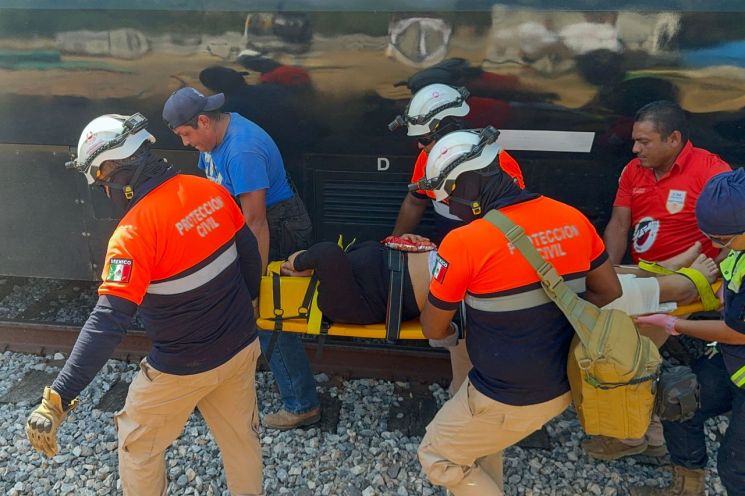
According to the report, the train, carrying 241 passengers and 9 crew members, departed from Salina Cruz in Oaxaca State on the morning of the incident and was heading to Coatzacoalcos in Veracruz State when it derailed near the village of Nizanda in Oaxaca.
On local social media, videos were shared showing passengers evacuating from the derailed cars and moving to safety.
Initially, the number of victims was reported to be around 10 injured. However, after further investigation by the authorities, the number of casualties was estimated to have exceeded 100.
At around 6 p.m. that day, the Mexican Navy issued a press release stating, "Unfortunately, we have confirmed that 13 people have died," and "98 people have been identified as injured, with 36 of them hospitalized." President Claudia Sheinbaum of Mexico posted on X, "I have instructed the Ministry of the Interior and the Navy to take care of the bereaved families," adding that efforts are underway to manage the aftermath of the accident.
The Isthmus of Tehuantepec Interoceanic Corridor Train (ICCT), which connects port cities on the Pacific side and port cities on the Gulf of Mexico (Atlantic side), covers a distance of about 300 kilometers. It is operated as part of an infrastructure development project prioritized by the previous administration of Andres Manuel Lopez Obrador and the current Sheinbaum government.
The Mexican government is especially working to expand its international logistics transport influence between the Americas and Asia based on this railway system. Furthermore, it is analyzing the feasibility of the route as an alternative to the Panama Canal. However, following the derailment, it is expected that the integrated land and sea logistics transport route will not be fully operational until concerns about the adequacy of local safety systems are resolved.
© The Asia Business Daily(www.asiae.co.kr). All rights reserved.
![Clutching a Stolen Dior Bag, Saying "I Hate Being Poor but Real"... The Grotesque Con of a "Human Knockoff" [Slate]](https://cwcontent.asiae.co.kr/asiaresize/183/2026021902243444107_1771435474.jpg)











