Professors Myunghun Song and Seunggeol Lee's Team Develops Perovskite Device PeLED Emitting Circularly Polarized Light
Next-Generation 3D Displays and Applications in Communication and Security Technologies Expected
Published in Advanced Functional Materials
The persistent darkness that has plagued 3D imaging is expected to disappear.
3D movies tend to feel much darker than regular films. This is because they use filters that only allow a specific component of light, known as circular polarization, to pass through.
A next-generation light-emitting device has now been developed that can produce highly pure circularly polarized light without the need for such filters. This breakthrough is expected to benefit brighter next-generation 3D displays, as well as security and communication technologies that utilize pure light components as binary information (0 and 1).
The team led by Professors Myunghun Song and Seunggeol Lee from the Department of Materials Science and Engineering at UNIST has developed a perovskite LED (PeLED) that selectively emits highly pure circularly polarized light without an external filter, by incorporating two types of special molecules into the perovskite light-emitting layer structure.
 Research team, (from left) Professor Myunghun Song, Professor Seunggeol Lee, Researcher Yongjun Choi. Provided by UNIST
Circular polarization refers to a component of light that rotates in a specific direction. In conventional LEDs, light is emitted in all directions, so a filter is used to separate only the circularly polarized component. However, this process significantly reduces brightness, as light that cannot pass through the polarization filter is lost.
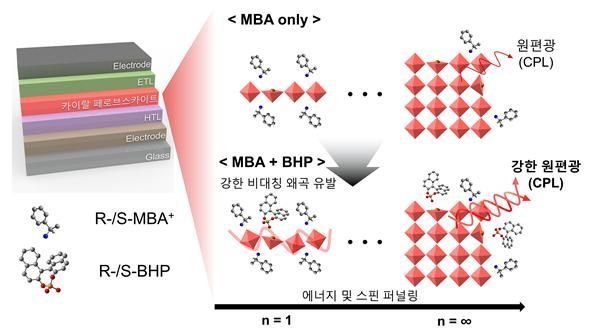
The PeLED developed by the research team emits circularly polarized light directly from the LED itself. This is thanks to 'chiral' molecules inside the light-emitting material, perovskite. Chiral molecules have an asymmetric structure, like left and right hands, that cannot be superimposed on each other when reflected in a mirror. When chiral molecules are introduced, the internal structure becomes biased in one direction, causing the light generated within to rotate in that direction as well.
Previously, the standard approach was to add only a single type of chiral molecule. However, this led to non-uniform twisting of the structure, resulting in a sharp decline in the purity and brightness of the polarized direction. The research team addressed this by mixing two types of chiral molecules that serve different functions.
These are 'methylbenzylammonium (MBAI)' and 'binaphthyl phosphate (BHP)'. Methylbenzylammonium induces an overall twisted structure between the perovskite layers, while binaphthyl phosphate mitigates defects caused by structural twisting, thereby increasing stability.
The team confirmed through theoretical calculations that these structural changes directly affect the rotation direction and brightness of the emitted light.
Experimental results also showed that the developed PeLED achieved high purity in the polarization direction and significantly improved luminous efficiency. The degree of circular polarization, measured as the electroluminescence dissymmetry factor (g_CP-EL), increased up to 7.5×10?², nearly three times higher than when only a single chiral molecule was used. The external quantum efficiency (EQE), which indicates luminous efficiency, also improved dramatically from 1.28% to 6.9%, while the maximum luminance (brightness) increased from 742 cd/m² to 1,753 cd/m².
In particular, the improvement in the purity of the polarization direction demonstrates the potential of the developed PeLED for use in security and quantum information communication. The higher the purity of the polarization direction, the more accurately information can be distinguished in security or communication technologies that use left- or right-rotating light as binary information (0 and 1).
Professor Myunghun Song stated, "Perovskite LEDs are advantageous for producing circularly polarized light-emitting LEDs in terms of manufacturing cost and optical efficiency compared to already commercialized OLEDs," adding, "This newly developed technology will not only enable high-brightness displays without filters, but also become a key technology to lead high-value-added future markets such as quantum cryptographic communication."
The research was supported by the National Research Foundation of Korea, and the results were published online in the international journal 'Advanced Functional Materials' on December 3, with official publication forthcoming.
© The Asia Business Daily(www.asiae.co.kr). All rights reserved.


















