Enhancing Citizen Mobility with Beomseo Hi-Pass Interchange and More This Year
2.094 Billion Won Investment Planned for Next Year: Construction of Second Myeongchon Bridge and New Banguchon Access Road
"Shorter commutes, stronger connectivity"-Ulsan City continues its road infrastructure blueprint into 2026.
Following this year’s efforts, the city will accelerate the expansion of its road network in the new year to support regional connectivity and innovative growth.
The city plans to continuously promote road construction projects that citizens can tangibly experience, aiming to improve both residential conditions and regional competitiveness.
Over the past year, Ulsan completed several projects to enhance citizen mobility, including the construction of the Beomseo Hi-Pass Interchange, the expansion of the road from Beomseo Hi-Pass Interchange to Cheonsang Lower Ramp, the widening of the Deokjeong Intersection to Onsan-ro, and the opening of the Deokha Market to Petrochemical Complex road.
New initiatives include five projects launched in May, such as the detailed design for the Seonam-dong Daenari Village bypass road and a feasibility study to improve road systems at congested intersections. These projects are currently undergoing detailed design and feasibility reviews.
In particular, Ulsan is actively working to ensure its metropolitan road network projects are included in national plans, in line with the current administration’s "Five Axes, Three Special Zones" national territorial framework. This includes the 3rd Expressway Construction Plan, the 6th National Road and Local Road Construction Plan, the 5th Metropolitan Area Traffic Congestion Road Improvement Plan, and the 5th Metropolitan Transportation Implementation Plan.
The 3rd Expressway Construction Plan involves projects such as Ulsan-Gyeongsan (50 km, 3.4 trillion won), the undergrounding of the Ulsan Expressway through the city center (11.5 km, 1.2 trillion won), and Ulsan-Yangsan (34.6 km, 1.499 trillion won). The city is in discussions with the central government to have these included in national plans.
The 6th National Road and Local Road Construction Plan includes new national roads such as Eonyang-Down (13.6 km, 548.1 billion won) and Cheongnyang-Down (7.6 km, 385.3 billion won). These projects were selected for the Ministry of Economy and Finance’s preliminary feasibility study in February, with site inspections conducted in May, and are now under review for inclusion in national plans.
For the 5th Metropolitan Area Traffic Congestion Road Improvement Plan, the city is negotiating the inclusion of new bypass roads such as Munsu-ro (2.71 km, 136 billion won), Yeocheon Five-Way Intersection (1.0 km, 48.6 billion won), and Down-Gulhwa (0.75 km, 91 billion won).
Regarding the 5th Metropolitan Transportation Implementation Plan, the city has discussed with the central government the need to modify the project for the expansion of the road from Ungchon to Yongdang (3.43 km, 39.9 billion won).
In the coming year, Ulsan City will invest a total of 209.4 billion won in various road projects designed to enhance residential conditions and regional competitiveness through citizen-focused road network expansion.
The city plans to promote a total of 33 projects, including four road opening projects, eight construction projects, one new project, ten design projects, three compensation projects, and seven projects implemented by the national government.
The road opening projects-such as the expansion of the road from Sinhyeon Intersection to the former Gangdong Middle School, the expansion of Daegongwon-ro in the Olympus Apartment area, and the construction of the access road to the Autonomous Navigation Vessel Performance Verification Center-are expected to improve mobility for citizens and revitalize the Gangdong Tourism Complex.
The eight construction projects, which will receive a total investment of 22 billion won, include the second Myeongchon Bridge (second half of the year, 4.3 billion won), Samdong-KTX Ulsan Station road (second half, 4 billion won), improvement of curves on Local Road No. 69 (second half, 7.8 billion won), and the Gilcheon Industrial Complex connecting road (first half, 4 billion won).
The ten projects currently undergoing detailed design and feasibility reviews include the Dongcheongang pedestrian bridge, the Seonam-dong Daenari Village bypass road, and a study to improve road systems at congested intersections. The city aims to select optimal routes and ensure these projects are incorporated into national plans through thorough studies.
As a new initiative, following the inscription of the Banguchon petroglyphs as a UNESCO World Heritage Site, the city will implement a feasibility evaluation and basic planning study (400 million won) for the construction of an access road to the Banguchon petroglyphs to improve visitor accessibility.
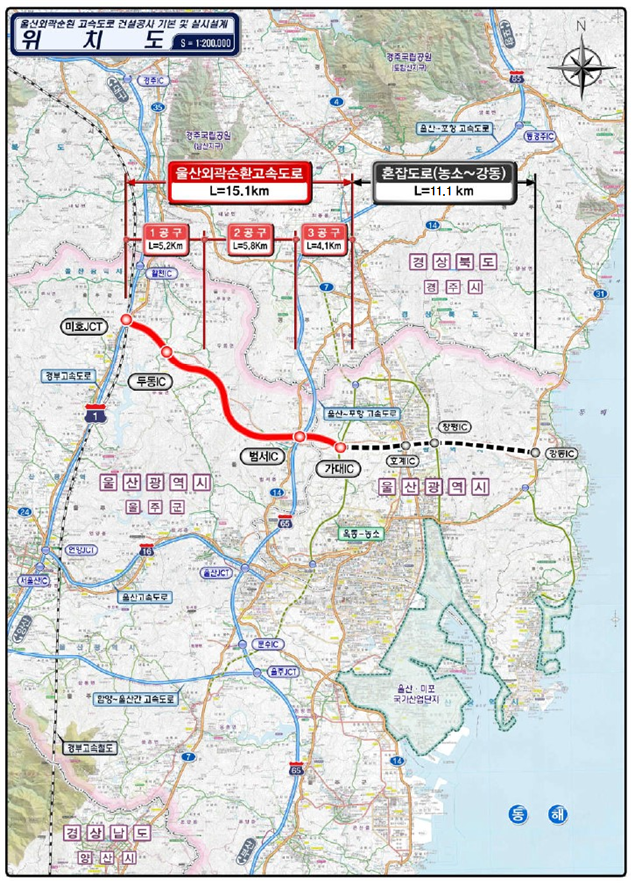
National projects include the Ulsan Outer Ring Expressway (15.1 km, four lanes), the construction of the Nongso-Oedong national road (5.9 km, four lanes), and the Ulju Beomseo-Gyeongju city boundary road (6.43 km, four lanes), among seven projects. Compensation and construction will proceed according to project plans.
Next year is especially significant, as the 3rd Expressway Construction Plan (first half of 2026), the 6th National Road and Local Road Construction Plan (second half of 2026), the 5th Metropolitan Area Traffic Congestion Road Improvement Plan (first half of 2026), and the 5th Metropolitan Transportation Implementation Plan (second half of 2026) will all be finalized. The city will make every effort to ensure its proposed projects are included in these national plans.
An Ulsan City official stated, "We will focus our capabilities on creating tangible changes for citizens and a business-friendly environment through road construction," adding, "We will continue to promote citizen-focused road projects by establishing close cooperation with the central government and prioritizing the opening of disconnected or unexpanded roads."
© The Asia Business Daily(www.asiae.co.kr). All rights reserved.
!["The Woman Who Threw Herself into the Water Clutching a Stolen Dior Bag"...A Grotesque Success Story That Shakes the Korean Psyche [Slate]](https://cwcontent.asiae.co.kr/asiaresize/183/2026021902243444107_1771435474.jpg)
















