A "next-generation powder hemostatic agent" that can stop bleeding within one second when sprayed on an injured area has been developed. This innovative technology is expected to increase the survival chances of patients at risk of severe bleeding.
On December 29, KAIST announced that a joint research team led by Professor Steve Park from the Department of Materials Science and Engineering and Professor Jeon Sangyong from the Department of Biological Sciences has developed a powder-type hemostatic agent (AGCL powder) that forms a strong hydrogel barrier and stops bleeding within one second simply by being applied to a wound.
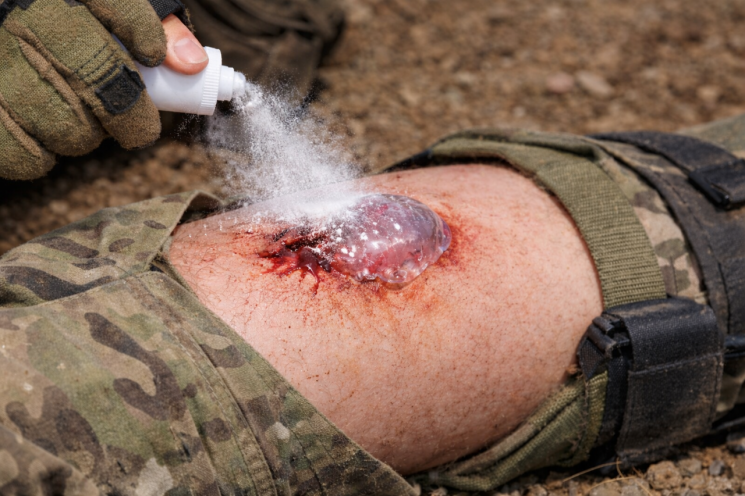 Image of hemostatic agent usage developed by a joint research team (AI generated). Provided by KAIST
The AGCL powder was completed as a field-ready technology, with direct participation from Army Major-level researchers, taking into account actual combat environments. Thanks to its high usability and storability, the powder can instantly harden even under extreme conditions such as war zones and disaster sites, enabling effective emergency treatment.
Previously, patch-type hemostatic agents commonly used in medical settings had a flat structure, making them difficult to apply to deep and complex wounds, and their sensitivity to temperature and humidity posed limitations for storage and use.
In contrast, the joint research team developed a next-generation powder-type hemostatic agent that can be freely applied to deep and irregular wounds. This achieves versatility, enabling a single powder to respond to various types of injuries.
The AGCL powder combines biocompatible natural materials such as alginate and gellan gum (which react with calcium to achieve ultra-fast gelation and physical sealing), and chitosan (which binds with blood components to enhance chemical and biological hemostasis). When the powder comes into contact with blood, it reacts with cations such as calcium and transforms into a gel within one second, instantly sealing the wound.
Inside the powder, a three-dimensional structure is formed, allowing it to absorb more than seven times its own weight (725%) in blood. As a result, it can rapidly block blood flow even under high-pressure and severe bleeding conditions, and it exhibits an adhesive force of over 40 kPa-enough to withstand strong manual pressure-demonstrating far superior sealing performance compared to commercial hemostatic agents.
AGCL powder is composed entirely of natural substances, making it safe for contact with blood. When using AGCL powder, the hemolysis rate is less than 3%, cell viability exceeds 99%, and it provides 99.9% antibacterial effectiveness. Animal experiments also confirmed excellent tissue regeneration effects, including rapid wound healing and promotion of blood vessel and collagen regeneration.
In surgical experiments involving liver injury, both the amount of bleeding and the time required for hemostasis were significantly reduced compared to commercial hemostatic agents, and liver function returned to normal levels two weeks after surgery. No abnormalities were observed in systemic toxicity evaluations.
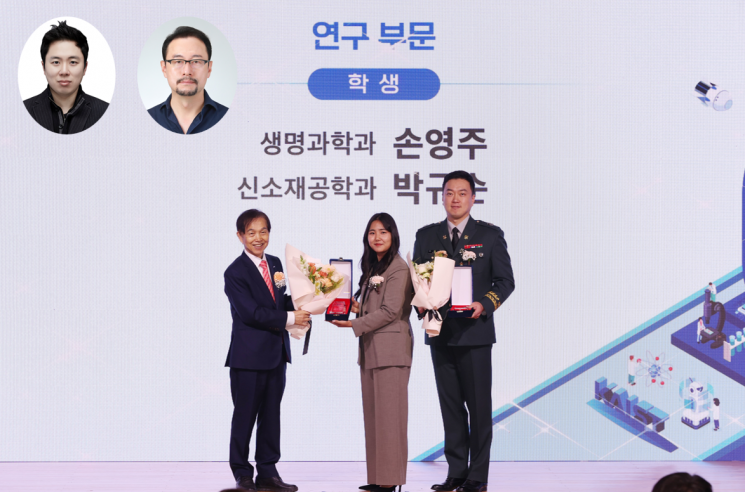 (Top left to right) Professor Steve Park, Professor Jeon Sangyong, (Bottom left to right) President Kwanghyung Lee, Integrated Master's and Doctoral Course Student Youngjoo Son, Doctoral Course Student Kyusun Park. Courtesy of KAIST
Notably, AGCL powder maintains its performance for two years even in room temperature and high-humidity environments, allowing for immediate use in harsh conditions such as military operations or disaster areas.
Although this advanced new material technology was developed with defense applications in mind, it is expected to be widely used across emergency medical fields, including disaster sites, developing countries, and medically underserved regions.
The fact that it can be used for both emergency treatment on the battlefield and internal surgical hemostasis is regarded as a representative case of "spin-off," where defense science and technology is expanded and transferred to the civilian sector. Examples of such spin-offs include computers, GPS, and microwave ovens.
Kyusun Park, a KAIST doctoral student (Army Major) who participated in the research, said, "Minimizing casualties is the key in modern warfare. I hope this technology will be practically used to save lives in both defense and civilian medical settings."
This research was recognized for both its scientific innovation and defense applicability, winning the President's Award at the "2025 KAIST Q-Day" and the Minister of National Defense Award at the "2024 KAIST·KNDU Defense Academic Conference."
© The Asia Business Daily(www.asiae.co.kr). All rights reserved.


















