Population Recovers to Around 70 Tigers
Known to Give Birth to 1 to 4 Cubs at a Time
An unmanned camera installed in the Northeast China Tiger and Leopard National Park (NCTLNP) captured footage of a wild mother Baekdusan tiger with her five cubs. On the 28th, Yonhap News TV, citing China’s state-run Global Times, reported that the sighting of this large tiger family together in the NCTLNP has become a topic of great interest.
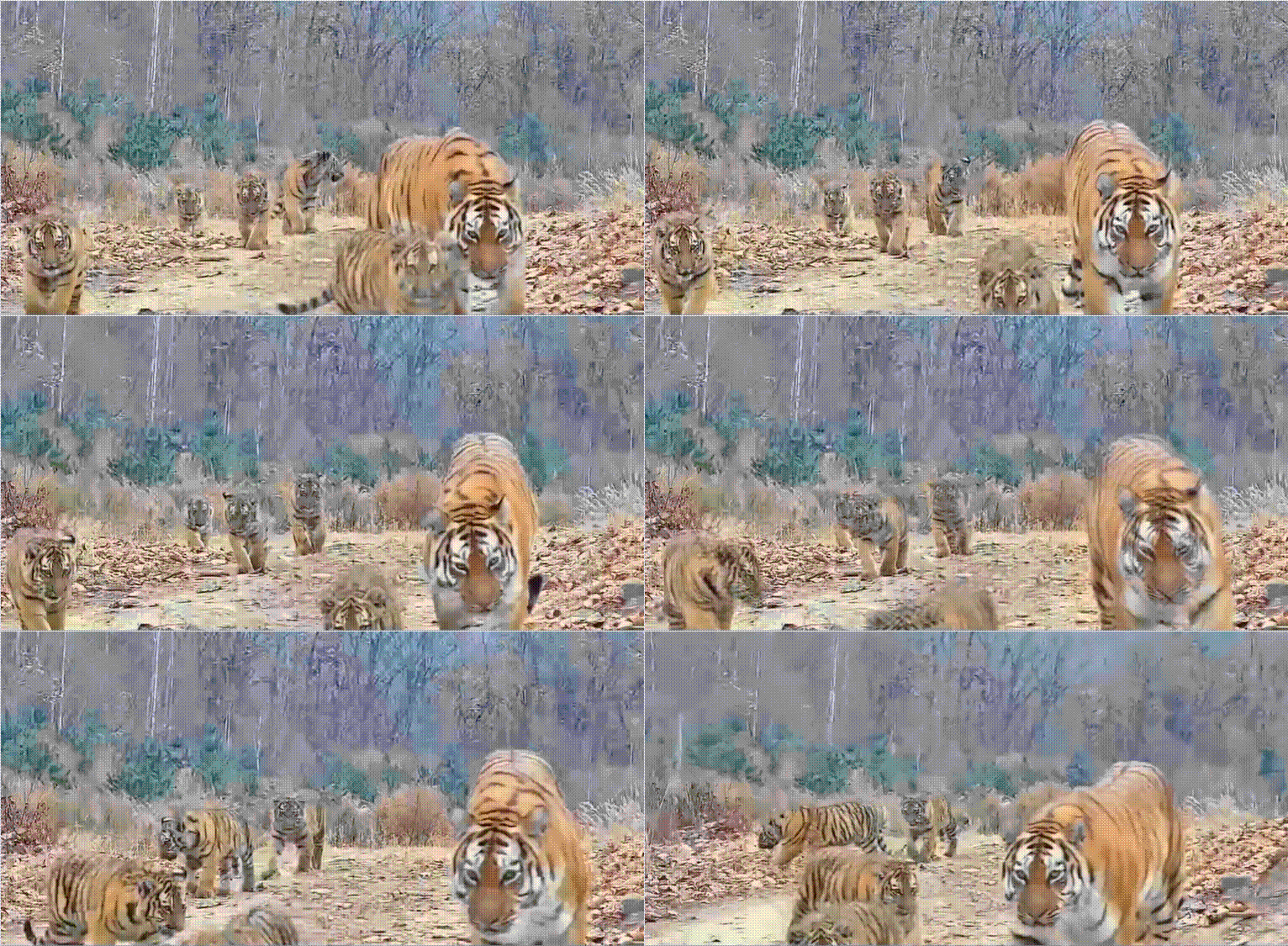
Wild Baekdusan tigers are generally known to give birth to 1 to 4 cubs at a time, and this is the first official confirmation in China of a case where five cubs were born. Experts have called this an extremely rare achievement, especially since all five cubs are surviving in an environment where food resources have not yet fully recovered.
The World Wide Fund for Nature (WWF) stated that this footage is not only valuable data on tiger breeding and rearing but also serves as a symbolic sign that the Baekdusan tiger population is steadily recovering in northeastern China. The mother tiger captured this time is estimated to be about nine years old, and the cubs are believed to be around six to eight months old. In the same region, another mother tiger with four cubs was recently observed, but it has been confirmed that this is a different individual from the current case.
 Wild Baekdusan tigers are generally known to give birth to 1 to 4 cubs at a time, and this is the first official confirmation of a case where five cubs were born in China. Photo by CCTV13
Stuart Chapman, who leads WWF’s global tiger conservation program ‘Tigers Alive,’ said, “This footage was literally breathtaking,” adding, “It is extremely rare worldwide to capture a wild mother tiger with five cubs on camera.” He further commented, “China’s tiger conservation efforts are producing real results, creating a brighter future for these magnificent animals.”
Zhou Fei, Chief Program Officer at WWF China, also emphasized, “Years of conservation activities prove that saving tigers is absolutely possible,” and added, “In a world where environmental degradation is accelerating, the message ‘Save the Roar’ gives hope and strength to the protection of other endangered species as well.”
Meanwhile, China officially launched the NCTLNP in 2017 and has implemented large-scale protection policies, while also working to restore ecological corridors that cross the border with Russia. Experts interpret the increase in tiger numbers as a sign of the recovery of the ecosystem’s apex predator, which in turn indicates improved health of the overall forest and grassland ecosystems.
The population of wild Baekdusan tigers, which stood at only 12 to 16 individuals in 1998, is now known to have recovered to around 70. The Baekdusan tiger is the largest tiger subspecies in the world and was once widely distributed across the Korean Peninsula, northeastern China, and the Russian Far East. Due to habitat destruction and poaching, its numbers declined sharply in the late 20th century, and it is currently classified as Endangered (EN) by the International Union for Conservation of Nature (IUCN).
© The Asia Business Daily(www.asiae.co.kr). All rights reserved.


















