#Person A became acquainted with Person B, who claimed to be a member of the US Forces Korea, through social media and maintained contact for several months, eventually promising marriage. Later, Person B said, "I sent a bag containing money for wedding preparations and wedding gifts to Korea, but there was a problem with customs clearance," and requested 10 million won as a customs clearance fee, which Person A actually transferred. However, as Person B repeatedly demanded more money, Person A visited the customs office to verify the authenticity of the customs issue.
Cases like Person A's, where someone befriends a person through social media and is then asked to pay taxes or customs clearance fees under the pretense of customs procedures, are rapidly increasing, prompting a need for caution.
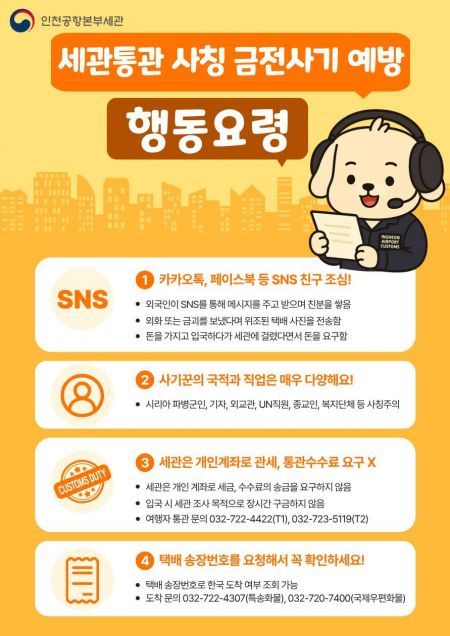 Customs Clearance Impersonation Financial Scam Prevention Poster. Provided by Incheon Airport Customs, Korea Customs Service
According to Incheon Airport Customs, Korea Customs Service, on December 26, there has been a recent surge in phone inquiries about whether goods being brought into Korea from overseas have been seized by customs. Most of these inquiries are believed to be related to so-called "romance scams."
A romance scam is a compound term combining "romance" (meaning a romantic relationship) and "scam" (meaning a fraudulent scheme). It refers to a new type of fraud in which perpetrators build relationships through social media platforms such as KakaoTalk and Facebook and then steal money from the victim.
The perpetrators often impersonate certain professions such as deployed soldiers, diplomats, United Nations employees, or religious figures. After establishing contact, they claim, "I sent gold bars or cash to Korea, but there was a problem with customs clearance, so a customs clearance fee is needed," thereby inducing the victim to transfer money.
For example, a religious figure who befriended the victim through social media may claim to have sent investment funds for a domestic welfare center to Korea, but say that the funds are blocked in customs and a clearance fee is required. In such cases, the victim may transfer the initial requested amount-such as $2,900-and only become suspicious after a second demand for money, at which point they visit customs and discover it was a financial scam.
Incheon Airport Customs emphasizes that, to avoid falling victim to such financial scams, one should never transfer customs clearance fees to a personal account and must always verify the facts first. If you are asked to pay a fee for customs issues, you should confirm the actual import status by contacting customs or checking the tracking number.
They also advise that if you have already sent money after being deceived by such scams, you should report it to the relevant authorities immediately.
An official from Incheon Airport Customs stated, "If someone you met through social media asks for money in connection with customs clearance for goods sent from overseas, it is highly likely to be a scam. If you suspect the possibility of fraud, you must check with customs and confirm the facts before responding to any monetary requests."
© The Asia Business Daily(www.asiae.co.kr). All rights reserved.

![Clutching a Stolen Dior Bag, Saying "I Hate Being Poor but Real"... The Grotesque Con of a "Human Knockoff" [Slate]](https://cwcontent.asiae.co.kr/asiaresize/183/2026021902243444107_1771435474.jpg)















