Bank of Korea Approves "2026 Monetary and Credit Policy Operational Guidelines"
The Bank of Korea announced that it will decide whether to make additional cuts to the base interest rate next year by comprehensively considering inflation, growth trends, and financial stability risks. This suggests that the rate-cutting cycle could end within the coming year, depending on economic conditions.
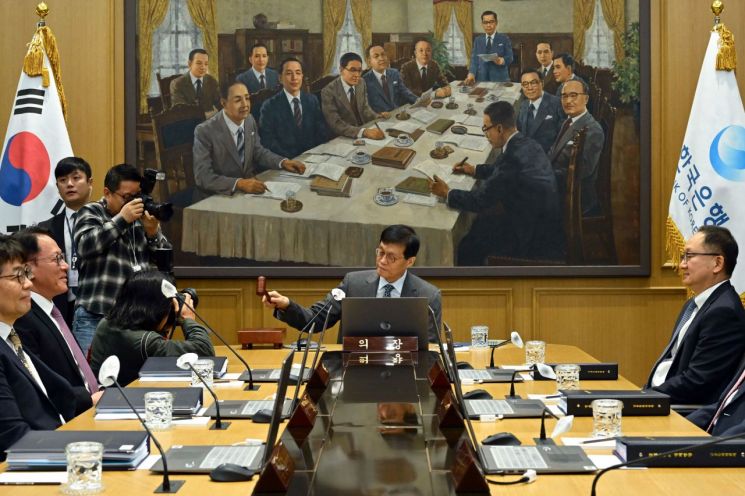 Lee Changyong, Governor of the Bank of Korea, is striking the gavel at the Monetary Policy Committee meeting held at the Bank of Korea headquarters in Jung-gu, Seoul on November 27. Photo by Yonhap News Agency Joint Press Corps
On December 25, the Monetary Policy Committee of the Bank of Korea announced that it had approved the "2026 Monetary and Credit Policy Operational Guidelines," which includes these details.
Regarding the base rate for next year, the Bank of Korea explained that it will determine both the timing and necessity of further cuts by comprehensively considering future inflation and growth trends, uncertainties in the projected path, and risks to financial stability.
This represents a somewhat more reserved stance compared to this year’s operational direction, which emphasized rate cuts by stating that the base rate would be lowered in line with changes in economic conditions.
The Bank of Korea explained that while the inflation rate is expected to fluctuate near the target level, it took into account that upward pressures have increased more than anticipated due to a higher exchange rate and the recovery of domestic demand.
Although growth is projected to rise to the level of potential growth next year, the Bank stressed that there are significant upside and downside risks in the outlook, including the global trade environment, the semiconductor cycle, and the pace of domestic demand recovery.
From a financial stability perspective, the Bank pointed out that it is necessary to continue monitoring the situation regarding housing prices in the Seoul metropolitan area, household debt risks, and increased exchange rate volatility.
To promote financial stability, the Bank stated it will strengthen monitoring and early warning functions for the asset and financial markets, and will implement market stabilization measures in a timely manner if necessary.
In particular, as caution is heightened in the domestic foreign exchange sector, the Bank decided to actively implement market stabilization measures in response to excessive herd behavior.
To ensure the stability of the financial system, the Bank of Korea will continue to improve its lending system. Starting in January next year, it will implement an emergency lending support system that allows banks to use their loan receivables as collateral in times of need, and will continue efforts to establish an institutional foundation to supply liquidity in a timely manner to non-bank depository institutions as needed.
The Bank also announced ongoing efforts to improve infrastructure in response to the advancement and internationalization of won-denominated securities. The operating hours of the Bank of Korea Financial Network will be extended in April next year, and a new offshore won settlement system (tentative name) operating 24 hours a day will be established and piloted by the end of next year.
The Bank will also proceed with the second phase of "Project Hangang" real transaction and a pilot project for treasury fund execution. To establish a governance framework for stablecoins that takes macroeconomic stability into account, the Bank plans to actively participate in legislative discussions on stablecoins in the National Assembly and the government.
© The Asia Business Daily(www.asiae.co.kr). All rights reserved.












