Weekly trading on the 24th closes at 1,449.8 won, down 33.8 won
Authorities deploy strong verbal intervention and policy measures
Largest drop since November 11, 2022 (59.1 won)
On the 24th, the won-dollar exchange rate plunged by 33.8 won, dropping sharply below the 1,450-won mark. As the foreign exchange authorities took the unusual step of deploying strong verbal intervention and policy measures to curb the year-end rise in the exchange rate, the won-dollar rate recorded its largest single-day drop in three years and one month.
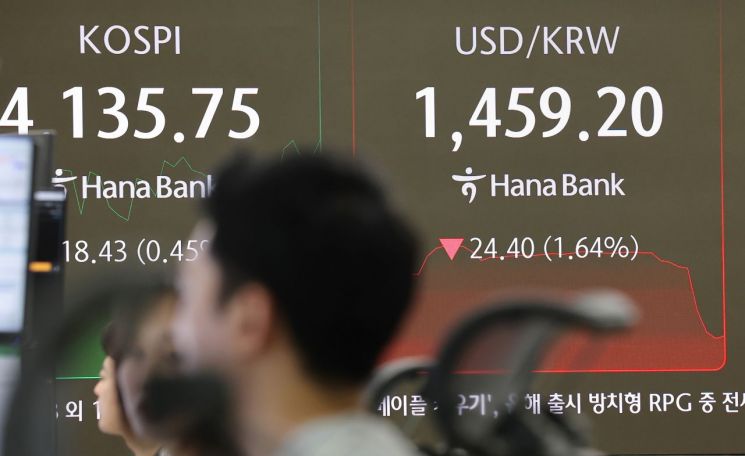 On the morning of the 24th, the won-dollar exchange rate is displayed on the status board in the dealing room at the headquarters of Hana Bank in Jung-gu, Seoul. Photo by Yonhap News.
Down 33.8 won to close at 1,449.8 won... Largest drop in three years and one month
On this day, in the Seoul foreign exchange market, the weekly trading of the won-dollar exchange rate (as of 3:30 p.m.) closed at 1,449.8 won, down 33.8 won from the previous trading day. This is the first time in about a month and a half that the weekly closing price of the won-dollar exchange rate has fallen below the 1,450-won level since November 6 (1,447.7 won). The drop recorded on this day (33.8 won) is the largest since November 11, 2022, when it fell by 59.1 won.
The won-dollar exchange rate opened at 1,484.9 won, setting a new yearly high at the opening price. However, in the early session, strong verbal intervention by the foreign exchange authorities sharply lowered the level to the 1,460-won range.
Yoon Kyungsoo, Director General of the International Department at the Bank of Korea, and Kim Jaehwan, Director General of the International Finance Bureau at the Ministry of Economy and Finance, delivered a "foreign exchange authorities' market message" immediately after the market opened, emphasizing that "an excessive weakening of the won is undesirable." They warned, "You will soon see that the series of meetings held over the past one to two weeks and the announcement of measures by each ministry and agency were part of the government's process to demonstrate its strong will and comprehensive policy execution capabilities." This was considered a stronger level of verbal intervention than during the financial crisis.
Immediately after the verbal intervention, the Ministry of Economy and Finance announced the "Domestic Investment and Foreign Exchange Stabilization Tax Support Plan," which centers on exempting individual investors who sell overseas stocks and make long-term investments in domestic stocks from capital gains tax (20%) for one year. During the morning session, foreign media also reported that the National Pension Service had begun strategic currency hedging through a foreign exchange swap with the Bank of Korea. Amid this all-out effort, the decline widened in the afternoon. The exchange rate, which had dropped to the 1,450-won level, fell further to 1,449.30 won at around 3:15 p.m., just before the close of the weekly session.
Verbal intervention and policy measures deployed... "Authorities' resolve confirmed, market sentiment will shift"
Experts predicted that the strong verbal intervention and policy measures would significantly shift market sentiment, which had previously remained focused on a continued high exchange rate despite a series of stabilization measures by the authorities. Park Sanghyun, a researcher at iM Securities, noted, "The government's swift use of tax policy for foreign exchange market stabilization, despite the tax revenue burden, is expected to not only improve the actual foreign exchange supply and demand but also weaken the previously one-sided sentiment toward a weaker won."
Recently, the government and the Bank of Korea have successively announced rational adjustments to the forward exchange position system, relief of the burden of foreign currency liquidity stress tests, expansion of the permitted use of foreign currency loans by residents for won purposes, and new frameworks related to the National Pension Service. In preparation for large-scale currency hedging by the National Pension Service, the foreign exchange authorities have decided to exempt financial institutions from the foreign exchange soundness levy and pay interest on excess reserves for foreign currency deposits for six months starting next month. The market also expects these measures to help lower the exchange rate level over time.
© The Asia Business Daily(www.asiae.co.kr). All rights reserved.












