Record-High 185.8 Billion Won Allocated for 2026
11.35% Budget Increase Accelerates Agricultural Innovation
Comprehensive Reforms Across Food, Livestock, and Forestry Sectors
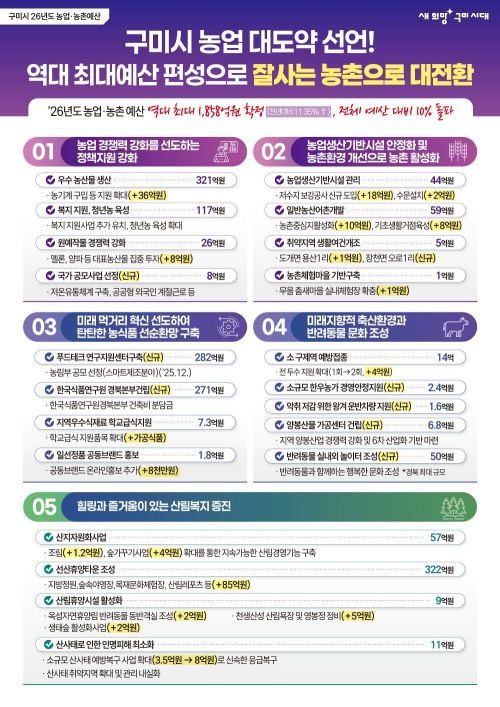
Gumi City in North Gyeongsang Province has allocated 185.8 billion won for the agriculture and rural sector in its 2026 main budget.
This represents an increase of 19 billion won, or 11.35%, compared to the 166.8 billion won allocated in 2025.
Gumi City, building upon its foundation as an industrial city, is positioning agricultural innovation as a key pillar of its urban strategy and will actively promote strengthening rural competitiveness and the structural transformation of agriculture and rural areas.
Through this budget allocation, the city plans to accelerate the realization of a "prosperous rural community" by establishing a sustainable agricultural foundation while simultaneously improving income stability for farmers and enhancing rural living conditions.
This approach clarifies the role of agriculture as a key driver of future urban development and aims to achieve balanced growth across all industries.
 Strengthening rural competitiveness and actively promoting structural transformation of agriculture and rural areas. / Photo by Gumi City Hall
In particular, the city will focus investments on creating a stable farming environment, expanding the agricultural production base, innovating food distribution structures, establishing a future-oriented livestock environment, and strengthening the recreational and healing functions of forests, thereby driving fundamental improvements across agriculture and rural areas. The main projects are as follows:
◆ Strengthening Agricultural Competitiveness
Continuous support will be provided for the joint growth of farmers and the local community, including support for the production of high-quality agricultural products (32.1 billion won), rural welfare and nurturing young farmers (11.7 billion won), and enhancing the competitiveness of horticultural crops such as melons (2.6 billion won).
◆ Stabilizing Agricultural Production Infrastructure
Projects include strengthening disaster prevention and repair facilities (4.4 billion won), revitalizing rural central areas (3.6 billion won), creating basic living hubs (2.3 billion won), improving living conditions in vulnerable areas (500 million won), and establishing rural experience and recreational villages (100 million won).
◆ Establishing a Virtuous Cycle in Agri-food Systems
Various initiatives will be promoted to drive innovation in future food sources, such as establishing a Food Tech Research Support Center (28.2 billion won, 2026-2028), constructing the Gyeongbuk branch of the Korea Food Research Institute (27.1 billion won), expanding school meal programs (730 million won), and promoting the Ilseonjeongpum joint brand (180 million won).
◆ Enhancing Livestock Competitiveness and Expanding Welfare for Companion Animals
The city will actively invest in the sustainable development of the livestock sector through projects such as foot-and-mouth disease vaccinations for cattle (1.4 billion won), management stabilization for Korean beef farms (240 million won), support for rice husk transport vehicles (160 million won), establishing a beekeeping product processing center (680 million won), and creating indoor and outdoor playgrounds for companion animals (5 billion won).
◆ Promoting Forest Welfare for Healing and Enjoyment
Efforts will be made to establish a sound forest management foundation through projects such as afforestation and forest management (5.7 billion won), creating the Seonsan Forest Recreation Town (32.2 billion won, 2025-2027), revitalizing forest recreation facilities (900 million won), and restoring areas affected by landslides (1.1 billion won).
With this expansion of the agriculture and rural budget, the city has made clear its goal to transform rural areas from mere recipients of support to active agents of growth, and to establish a balanced development model where both urban and rural areas grow together.
To this end, the city plans to thoroughly prepare for the execution of the 2026 budget by swiftly implementing project procedures so that the allocated funds can be delivered to the field in a timely manner.
Gumi City Mayor Kim Jangho stated, "Agriculture and rural areas are a crucial foundation supporting Gumi's sustainable growth," and added, "We hope this budget will provide tangible support for stabilizing farmers' operations and strengthening rural competitiveness."
© The Asia Business Daily(www.asiae.co.kr). All rights reserved.

















