MOU Signed for Carbon Neutrality Implementation
Demonstration Project at Nakdong River Salt Marsh
Expanding Blue Carbon and Restoring Salt Marshes
LG Electronics is working together with Busan Metropolitan City to verify the effectiveness of its new material, "marine glass," which promotes the growth of marine algae, and to collaborate on ecosystem conservation.
On the 23rd, LG Electronics signed a Memorandum of Understanding (MOU) with Busan Metropolitan City at Busan City Hall to promote carbon neutrality through the creation and preservation of a blue carbon ecosystem. The signing ceremony was attended by Choi Seongbong, Executive Vice President and Head of Built-in Cooking Solutions Division at LG Electronics; Yoon Daesik, Executive Vice President and Head of External Cooperation; Kim Youngseok, Head of Functional Materials Business Unit in Home Solutions (HS); and Park Hyungjun, Mayor of Busan.
Under this agreement, LG Electronics and Busan Metropolitan City will conduct a demonstration project to verify the growth and carbon absorption efficiency of halophytes when marine glass is applied to a 1,500-square-meter salt marsh at the Nakdong River estuary.
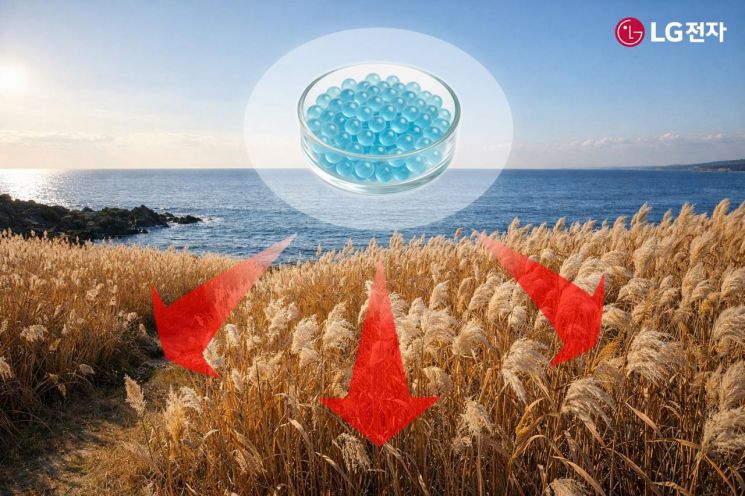
Marine glass is a functional glass material that transforms into mineral ions upon contact with water. It precisely releases mineral ions into the water at a controlled rate, supplying essential minerals for the growth of marine algae, microalgae, and halophytes.
Based on this, the two organizations will seek cooperation in various areas, including: implementing carbon neutrality through the creation and preservation of blue carbon ecosystems; establishing the Nakdong River Garden and restoring the Nakdong River salt marsh in Busan; and verifying the potential to expand blue carbon through the creation of marine forests.
Halophytes such as reeds and Suaeda japonica have recently gained attention as blue carbon, a carbon sink. Blue carbon absorbs and stores carbon at a faster rate and in greater quantities than terrestrial ecosystems, emerging as a solution for responding to climate change.
LG Electronics expects marine glass to help restore blue carbon and create marine forests. Previously, a third-party testing agency (Neo & Biz) confirmed that reeds grown in a culture solution containing marine glass exhibited a faster initial growth rate compared to those grown in a standard solution.
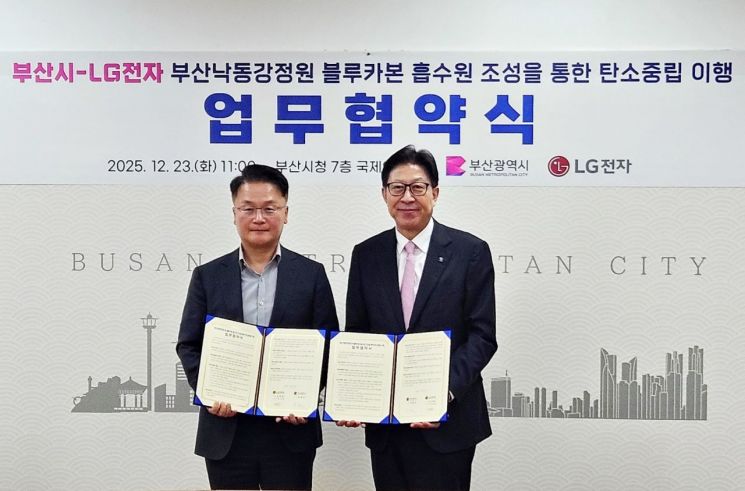 LG Electronics signed a Memorandum of Understanding (MOU) with Busan Metropolitan City on the 23rd at Busan City Hall to promote carbon neutrality through the creation and preservation of a blue carbon ecosystem. In the commemorative photo at the signing ceremony are Choi Seongbong, Executive Vice President of LG Electronics Built-in Cooking Solutions Division (left), and Park Hyungjun, Mayor of Busan Metropolitan City. LG Electronics. Photo by LG Electronics.
Meanwhile, LG Electronics is focusing on research, development, and commercialization of new materials as a new B2B growth area.
This year, the company signed an MOU with the Seoul National University Blue Carbon Project Group to discover new businesses and jointly develop technologies to promote the blue carbon industry both domestically and internationally. LG Electronics also conducted a project with the National Water Industry Cluster Project Group and the Korea Water Forum to verify the washing performance and water and electricity saving effects of detergents containing "Mineral Wash."
Beyond marine glass, LG Electronics has expanded its portfolio of glass powder-based new materials to include "Purotec," an antibacterial and antifungal functional material that suppresses odor and contamination caused by microorganisms when added in small amounts to plastics, paint, or rubber; and "Mineral Wash," a laundry functional material that can replace surfactants in detergents.
To date, the company has filed 420 patents related to glass powder and has established production facilities with an annual capacity of 4,500 tons at its Smart Park in Changwon, Gyeongnam.
Baek Seungtae, Executive Vice President and Head of the HS Business Division at LG Electronics, stated, "We will continue to pursue diverse collaborations to contribute to ecosystem conservation and address carbon issues through new material technology, while seeking new business opportunities."
© The Asia Business Daily(www.asiae.co.kr). All rights reserved.
![Clutching a Stolen Dior Bag, Saying "I Hate Being Poor but Real"... The Grotesque Con of a "Human Knockoff" [Slate]](https://cwcontent.asiae.co.kr/asiaresize/183/2026021902243444107_1771435474.jpg)

















