As President Donald Trump continues to intensify pressure on the Nicolas Maduro regime in Venezuela, the Wall Street Journal (WSJ) reported on December 23 (local time) that the US military has deployed special operations aircraft and other forces and equipment in the Caribbean region.
According to the report, at least 10 CV-22 Osprey transport aircraft, used by special forces, moved from Cannon Air Force Base in New Mexico to the Caribbean region the previous night. C-17 transport aircraft, which departed from Fort Stewart and Fort Campbell Army bases, were also confirmed to have arrived in Puerto Rico, a US territory, the previous day.
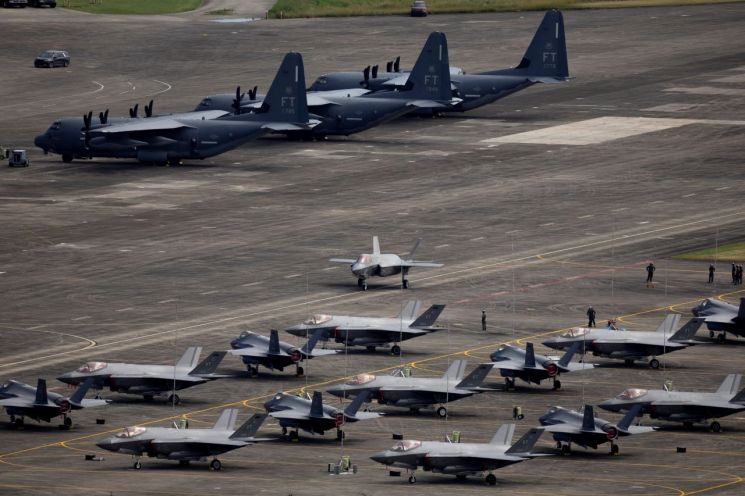 Aircraft belonging to the U.S. Air Force and Marine Corps parked in Ceiba, Puerto Rico, U.S. Photo by Reuters Yonhap News
A US official stated that these aircraft transported military personnel and equipment. However, it remains unclear exactly what type of forces and equipment were transported.
Cannon Air Force Base is home to the 27th Special Operations Wing, while Fort Campbell houses the elite 160th Special Operations Aviation Regiment and the 101st Airborne Division. Fort Stewart is home to the 1st Battalion of the 75th Ranger Regiment.
The 27th Special Operations Wing and the 160th Special Operations Aviation Regiment are trained to support high-risk infiltration and extraction missions, as well as to provide close air and combat support. Army Rangers are trained to seize airfields and provide security when special forces such as SEAL Team 6 or Delta Force conduct precision kill or capture missions.
David Deptula, a retired Air Force lieutenant general and dean of the Mitchell Institute for Aerospace Studies (MIAS), told the WSJ, "They are pre-positioning forces in order to act." He added that the deployment of special operations assets suggests the administration has already decided on a course of action against Venezuela, saying, "The remaining question is what they intend to achieve with this."
The WSJ assessed that this deployment provides additional options for possible military action that could be taken against Venezuela.
A spokesperson for US Southern Command, which oversees US forces stationed in Central and South America, declined to answer WSJ's questions regarding specific troop movements, stating, "It is standard practice to routinely rotate equipment and personnel at any military facility." The spokesperson also said that, for security reasons, details about the operational movement and activities of US military assets or personnel are not disclosed.
The Trump administration has recently stepped up pressure on the Maduro regime. After sinking drug cartel vessels operating in the Caribbean, it began seizing oil tankers to block crude oil exports, which are a major source of revenue for the Maduro regime. The administration has also mentioned the possibility of launching military operations against drug cartels on Venezuelan soil.
Venezuela has strongly protested, claiming that the Trump administration is attempting to overthrow the Venezuelan government and plunder its natural resources.
© The Asia Business Daily(www.asiae.co.kr). All rights reserved.












