McDonald's Korea Releases "National Perception Survey on Happiness"
Preference for Shared Meals and Conversation Over Eating Alone
"Willing to Buy" Products from Socially Responsible Companies, Even at Higher Prices
One in two Koreans currently feels happy with their life, according to a recent survey. The findings show that Koreans derive the greatest happiness from close relationships, such as with family, and tend to build overall life satisfaction through small, everyday experiences like sharing meals with others. Acts of sharing, such as donations and volunteering, were also recognized as important components of personal happiness.
McDonald's Korea announced the main results of its "National Perception Survey on Happiness" on December 23. The survey was conducted by Gallup Korea from November 27 to December 3, targeting 1,034 adults aged 20 to 69 nationwide.
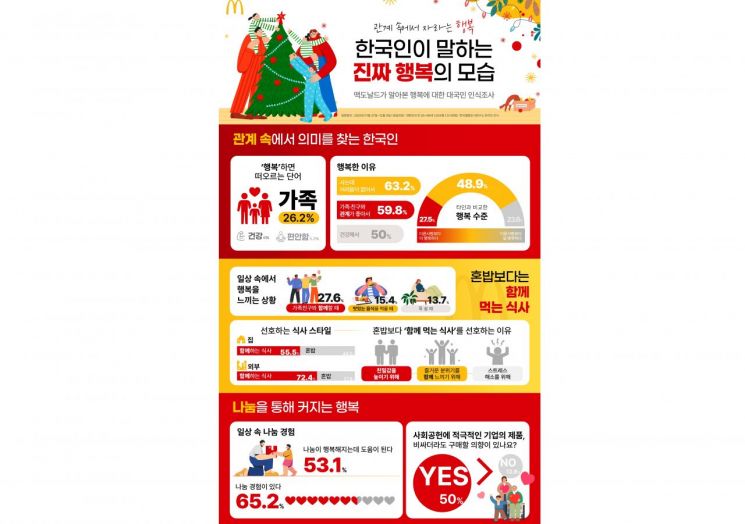 Infographic of the "National Perception Survey on Happiness" by McDonald's Korea. Provided by McDonald's Korea.
The survey found that 48.6% of respondents described themselves as "happy" with their current life. Another 34.0% answered "average," while 17.3% said they were "not happy."
The image of happiness most commonly evoked for Koreans centered on close relationships, especially family. When asked what first comes to mind when hearing the word "happiness," 26.2% cited "family," making it the most frequent response. This was followed by "health" (6.0%) and "comfort" (5.2%).
When asked with whom they feel happiest, "with family" was the top answer at 58.1%, followed by "with a romantic partner" (19.0%) and "with friends" (12.2%). Activities that brought happiness when shared included travel or outings, hobbies, and meals.
Questions about the reasons for happiness revealed that both practical circumstances and relationships play a role. Allowing multiple responses, 63.2% said "because there are no major difficulties in my current life," while 59.8% cited "because I have good relationships with family, friends, or colleagues."
However, while nearly half of respondents rated themselves as happy, a gap emerged when comparing themselves to others. The proportion who felt "happier than others" was 27.5%, while those who felt "less happy than others" was 23.6%, showing similar rates.
Social interaction stood out as a key scene of everyday happiness. A total of 77.9% agreed that "the happiness felt in daily life affects overall happiness." The most common moment of daily happiness was "chatting with family or friends" (27.6%), followed by "eating delicious food" (15.4%) and "getting enough rest" (13.7%).
Meals, in particular, were recognized as an important point of connection for happiness. Respondents tended to prefer eating with others rather than alone. While 55.5% wanted to share meals at home with others, this figure rose to 72.4% for dining out. The main reasons for eating together were "to enjoy a pleasant atmosphere together" (29.1%) and "to enhance intimacy through conversation" (25.2%).
Preferred dining styles also influenced actual feelings of happiness. Among those who preferred eating with others, 68.2% said they actually felt happier when sharing a meal. This suggests that meals function not just as a physical act, but as a social experience that builds relationships and shares emotions.
There was also strong empathy for sharing and social value. Some 65.2% of respondents said they had experience with sharing activities such as donations or volunteering. The proportion who believed sharing contributes to personal happiness was 53.1%, far exceeding those who thought it does not (10.7%). Regarding corporate social responsibility, 71.2% agreed that such activities help the happiness of society as a whole.
Half of the respondents (50.0%) said they would be willing to purchase products from companies active in social contribution, even if the price was somewhat higher. A McDonald's Korea representative stated, "This survey confirmed that, for Koreans, happiness comes from everyday experiences and relationships with those around them," adding, "We plan to continue social contribution activities that connect with local communities."
© The Asia Business Daily(www.asiae.co.kr). All rights reserved.

















