Release of "International Comparison of Wages in Korea, Japan, and Taiwan"
An analysis has found that wage levels in South Korea are about 20% higher than those in Japan or Taiwan, even after accounting for differences in cost of living. In the core competitive sector of manufacturing, wages for Korean workers were found to be more than 25% higher.
According to the Korea Employers Federation's report, "International Comparison and Implications of Wage Status in Korea, Japan, and Taiwan," released on December 23, the annual total wage for regular employees in South Korea was $65,267 last year, which is 23.7% higher than Japan's $52,782. These figures are calculated using purchasing power parity to reflect price differences among the countries.
When compared with Taiwan, the annual total wage for wage earners in South Korea (including overtime) was $62,305, which is 16.2% higher than Taiwan's $53,605.
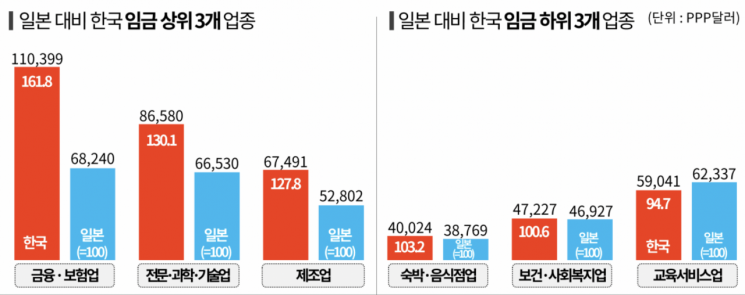
The wage gap was even more pronounced in the manufacturing sector, which is globally competitive. The annual total wage for regular employees in Korea's manufacturing sector was $67,491, 27.8% higher than Japan's $52,802. Compared to Taiwan, Korean wage earners in manufacturing received $72,623 annually, 25.9% higher than Taiwan's $57,664.
Among 11 industries that can be directly compared with Japan, wages in 10 sectors were higher in Korea. The gaps were particularly large in financial and insurance services (161.8% of Japan's level) and in professional, scientific, and technical services (130.1%). In health and social welfare services (100.6%) and educational services (94.7%), the wage levels were similar to or slightly lower than those in Japan.
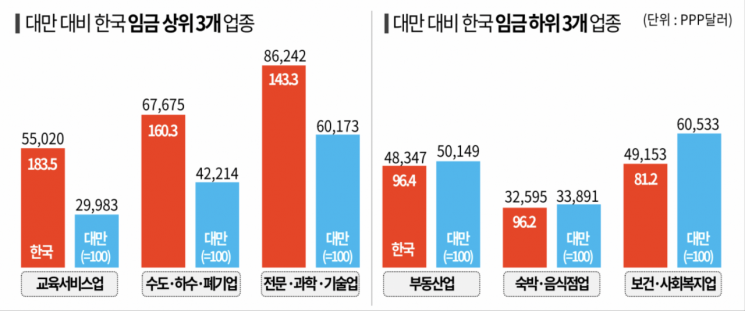
When compared with Taiwan, wages in Korea were higher in 14 out of 17 sectors. The gaps were most notable in educational services (183.5% of Taiwan's level), water supply, sewage, and waste management (160.3%), and professional, scientific, and technical services (143.3%). In contrast, Taiwan had higher wages in real estate (96.4% of Korea's level), accommodation and food services (96.2%), and health and social welfare services (81.2%).
For the Korea-Japan comparison, the Korea Employers Federation used statistics on regular employees at establishments with 10 or more employees from the Ministry of Employment and Labor’s Survey on Working Conditions by Employment Type (Wage Structure section). For the Korea-Taiwan comparison, statistics on wage earners at establishments with one or more employees were taken from the Ministry of Labor’s Establishment Workforce Survey raw data.
Ha Sangwoo, Head of Economic Research at the Korea Employers Federation, stated, "A high-wage structure that is not supported by productivity is unsustainable, so it is urgent to improve productivity and shift to a job- and performance-based wage system. Already, Korean companies are under considerable pressure from labor costs, so policies that could further deepen dual labor market structures and worsen youth employment, such as extending the statutory retirement age, should be approached with caution."
© The Asia Business Daily(www.asiae.co.kr). All rights reserved.













