Seo-Won Dam of Orion, Sang-Yeol Shin of Nongshim, and Byung-Woo Jeon of Samyang Foods Promoted
Assigned to New Businesses Instead of Core Operations
Tasked with Discovering and Evaluating Next-Generation Growth Drivers
The third-generation heirs of major domestic food companies are now being put to the test. After their rapid promotions in recent years and their leadership over new businesses that will shape the next 100 years of the industry, the main point of interest is who will be the first to prove themselves through tangible results.
According to the food industry on December 25, companies such as Orion, Nongshim, and Samyang Foods have recently announced promotions for their third-generation owners. Seo-Won Dam (36), the eldest son of Orion Chairman Dam Chul-Gon and Vice Chairwoman Lee Hwa-Kyung, and Sang-Yeol Shin (32), the eldest son of Nongshim Chairman Shin Dong-Won, have both been promoted to Executive Vice President. Byung-Woo Jeon (31), the eldest son of Samyang Foods Vice Chairman Kim Jung-Soo, has been promoted to Senior Executive Director.
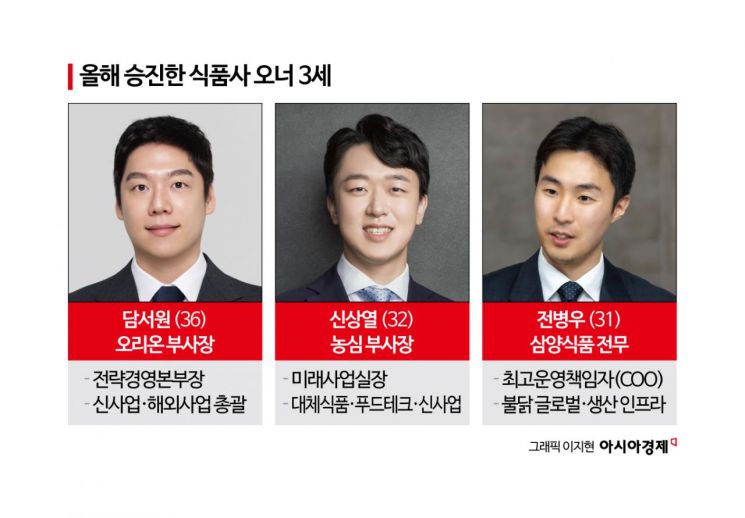
Orion has established a Strategic Management Division within its Korean subsidiary, which serves as the global headquarters, and appointed Executive Vice President Seo-Won Dam as its head. The Strategic Management Division oversees new businesses, overseas operations, management support, and corporate social responsibility (CSR), taking charge of the group’s mid- to long-term strategy and management diagnostics. Unlike existing organizations that manage confectionery operations, this division acts as a control tower responsible for new businesses and the restructuring of the global portfolio. Executive Vice President Dam is also serving as an internal director at the group’s new bio-business affiliate, directly overseeing the group’s future growth initiatives. Since joining the company in 2021 as Senior Manager of the Management Support Team, Seo-Won Dam has been responsible for business strategy and global business support. He was promoted to Director just one year and five months after joining, then to Senior Executive Director after two years, and now, only one year after that, to Executive Vice President.
Sang-Yeol Shin, Executive Vice President of Nongshim, is leading the Future Business Division, overseeing alternative foods, food technology, and new growth businesses. These areas are distinct from Nongshim’s core revenue-generating ramen business. Alternative foods and food tech are fields where the market has yet to be fully established, making it difficult to guarantee short-term results. Sang-Yeol Shin joined the company as an entry-level employee in 2019, was promoted to Director in 2022, then to Senior Executive Director last year, and now to Executive Vice President after just one year.
Byung-Woo Jeon, Senior Executive Director at Samyang Foods, has served as Chief Operating Officer (COO), overseeing the global expansion of the Buldak brand and the expansion of overseas production infrastructure. He has personally managed the establishment of a factory in China, building a global production base, and is responsible for maintaining the stable popularity of Buldak across the United States, Southeast Asia, and Europe. As the brand enters its post-success phase, operational and production efficiency will become the key criteria for performance evaluation. Byung-Woo Jeon joined the company in 2019 as Head of the Overseas Business Division, was promoted to Executive Director the following year, advanced to Director in 2023, and has now been promoted to Senior Executive Director.
There is a common thread in these corporate appointments: the positions assigned to third-generation owners are far from stable roles that guarantee short-term results. New businesses, alternative foods, and global production expansion are areas where failure can be costly and performance verification takes time. Ultimately, this means they have been placed in positions where they must discover and nurture the next generation of growth drivers themselves.
These personnel decisions are influenced by changes in the environment surrounding the food industry. As growth in the domestic food market slows, there is a growing recognition that relying solely on existing core products is not enough to secure mid- to long-term growth. The belief that it is difficult to transform a company’s structure without securing long-term growth engines is reflected in these owner-driven personnel decisions.
Whereas the core of owner management in the past was hit products and brand management, the ability to generate new growth engines has now become more important. Although it takes time for new business development and overseas expansion to yield visible results, a company’s long-term competitiveness depends on their success. Assigning the most uncertain areas to the third-generation owners can be interpreted as a clear message about their responsibilities and roles.
An industry insider commented, "These promotions not only highlight the presence of the third-generation owners but also clearly define their responsibilities. If their efforts yield visible results, it will provide justification for their management capabilities."
© The Asia Business Daily(www.asiae.co.kr). All rights reserved.
![Clutching a Stolen Dior Bag, Saying "I Hate Being Poor but Real"... The Grotesque Con of a "Human Knockoff" [Slate]](https://cwcontent.asiae.co.kr/asiaresize/183/2026021902243444107_1771435474.jpg)
















