A technology that can maintain tap water quality while reducing the amount of chemicals used at water purification plants has been developed.
The Korea Institute of Civil Engineering and Building Technology (KICT) announced on December 22 that its Environmental Research Division has developed and demonstrated an "autonomous water treatment control technology" that improves water purification plant operation efficiency and maintains tap water quality by leveraging artificial intelligence (AI) and digital transformation technologies.
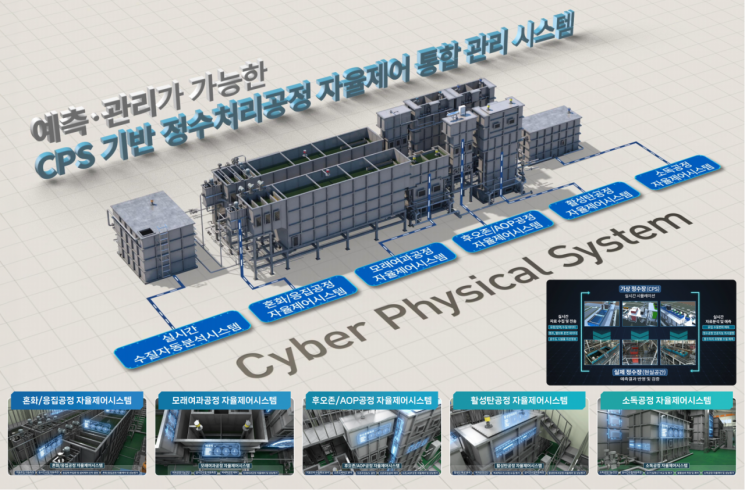 Core configuration diagram of the CPS-based integer processing autonomous control system. Provided by Korea Institute of Civil Engineering and Building Technology
This technology is based on a cyber-physical system (CPS), where seven AI models predict the optimal dosage of coagulants (chemicals) at one-hour intervals. Before the predicted values are applied in the real world, they are first validated in a virtual water purification plant (digital twin) environment. The results of this validation are then reflected in the actual control of the water purification plant.
Through this approach, KICT emphasizes that it can proactively respond to changes in raw water quality, reduce the amount of chemicals used in the purification process, and consistently maintain the quality of the treated water.
The AI-powered water purification plant operation and management technology passed official performance verification and received a water technology performance certificate from the Korea Water Technology Certification Institute. During the 12-week verification process, the amount of chemicals used for water purification was reduced by an average of 6.88% compared to previous methods, while the treated water remained consistently clear and stable.
According to KICT, the clarity of the water achieved during the verification was a turbidity of 1 NTU (Nephelometric Turbidity Unit, an international standard unit for turbidity measured by a turbidimeter, where a lower value indicates clearer and cleaner water) or less. By applying a digital twin-based pre-verification system, both the reliability of control and operational efficiency were enhanced.
Based on these results, KICT plans to gradually expand the scope of demonstration to further verify applicability under various raw water conditions and to enhance the consistency of prediction, diagnosis, and autonomous control functions, thereby advancing the integrated management system for the entire water treatment process.
Park Seongyu, President of KICT, stated, "The CPS-based autonomous water treatment control technology is a strategic technology that can elevate water safety, which is directly linked to people's daily lives." He added, "KICT will work in collaboration with local governments and operating agencies to spread the benefits of water quality stability and chemical reduction nationwide."
© The Asia Business Daily(www.asiae.co.kr). All rights reserved.
![Clutching a Stolen Dior Bag, Saying "I Hate Being Poor but Real"... The Grotesque Con of a "Human Knockoff" [Slate]](https://cwcontent.asiae.co.kr/asiaresize/183/2026021902243444107_1771435474.jpg)
















