Oxford Insights Government AI Readiness Index: South Korea Drops to 8th Place
China Surges to 6th, Driven by Infrastructure Competitiveness
There is growing concern that South Korea's national competitiveness in artificial intelligence (AI) is falling behind global leaders, particularly in terms of practical computing infrastructure and public sector adoption. Notably, China, which until last year lagged significantly behind South Korea, has now surpassed it by leveraging its self-sufficient infrastructure, rapidly reshaping the landscape of leading AI nations.

According to the "2025 Government AI Readiness Index" by the UK technology policy institute Oxford Insights, released on December 22, South Korea ranked 8th out of 195 countries worldwide. This marks a drop of five places in just one year, compared to last year when South Korea scored an average of 79.98 points and ranked third globally after the United States and Singapore.
The Oxford Insights Government AI Readiness Index is considered one of the world's top three AI indicators, alongside the "AI Index" from the Stanford University Institute for Human-Centered Artificial Intelligence (HAI) in the United States and the "Global AI Index" by Tortoise Media in the UK. This index is particularly valuable as a policy reference because it evaluates the government's capability to design and operate AI at the national system level, rather than focusing on AI technology or private investment scale.
Until last year, the index primarily assessed how prepared governments were to introduce and utilize AI in public services. However, this year, the evaluation framework was significantly revised to comprehensively examine the government's overall role, including AI infrastructure, public sector adoption, industrial diffusion, and resilience. As a result, it became clear that South Korea needs to shift its AI strategy from being centered on systems and vision to focusing on national infrastructure and execution capabilities.
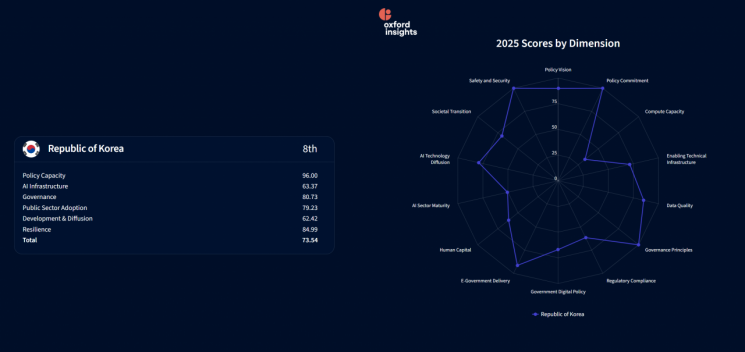 According to the "2025 Government AI Readiness Index" by the UK technology policy institute Oxford Insights, South Korea remained in 8th place, dropping five ranks from the previous year. Image source=Oxford Insights
A closer look at the detailed categories reveals the "light and shadow" of South Korea's AI landscape. South Korea received an outstanding score of 96 points in the "policy capability" category. This is higher than the United States, which ranked first overall with 92.50 points, and is the second-highest among the top-ranking countries, following the United Kingdom, which scored a perfect 100. In the "resilience" category, which measures social risk management and stability, South Korea scored 84.99 points (third globally), earning recognition for having one of the highest levels of stability worldwide. The "development and diffusion" category, which reflects industrial maturity, also saw South Korea maintain a top-tier position with 62.49 points (sixth globally).
However, in the "AI infrastructure" category, which gauges practical capabilities, South Korea ranked 17th globally (63.37 points), the lowest among the countries ranked 1st to 8th overall. While competitors such as the United States (89.27 points), China (76.92 points), and Singapore (73.28 points) have made massive investments in computing power and data quality, South Korea's infrastructure competitiveness has relatively lagged behind. The "public sector adoption" category, which refers to the practical application of AI in government services, also dropped to 30th place globally (79.23 points), becoming a decisive factor in lowering the overall ranking. This suggests that while South Korea has mastered the strategic phase of setting AI as a national agenda and managing risks, it has yet to secure the core computing resources and achieve substantial diffusion in public service environments to catch up with the global leaders.
The most notable aspect of this report is the rise of China. China, which ranked 23rd overall last year, surged to 6th place this year, overtaking South Korea. China received high marks in infrastructure and development for building its own "sovereign AI stack" through the Huawei Ascend chip ecosystem and more than $140 billion in national fund investments. European countries also made significant advances. The United Kingdom (2nd), France (3rd), the Netherlands (4th), and Germany (5th) swept the top ranks, achieving scores around 90 points in the newly strengthened governance and public sector adoption indicators.
Oxford Insights emphasized, "Governments must deploy concrete measures to secure AI infrastructure in order to ensure long-term stability in national AI utilization," adding, "Such success does not happen overnight."
© The Asia Business Daily(www.asiae.co.kr). All rights reserved.


















