Joint Development Plan by Hanwha Ocean and HD Hyundai Heavy Industries
Likely to Be Approved at Defense Project Promotion Committee
The selection method for the lead ship builder of the next-generation Korean destroyer (KDDX) will be decided on December 22. Instead of the previously discussed private contract or competitive bidding, a joint development approach between HD Hyundai Heavy Industries and Hanwha Ocean is now considered the most likely option.
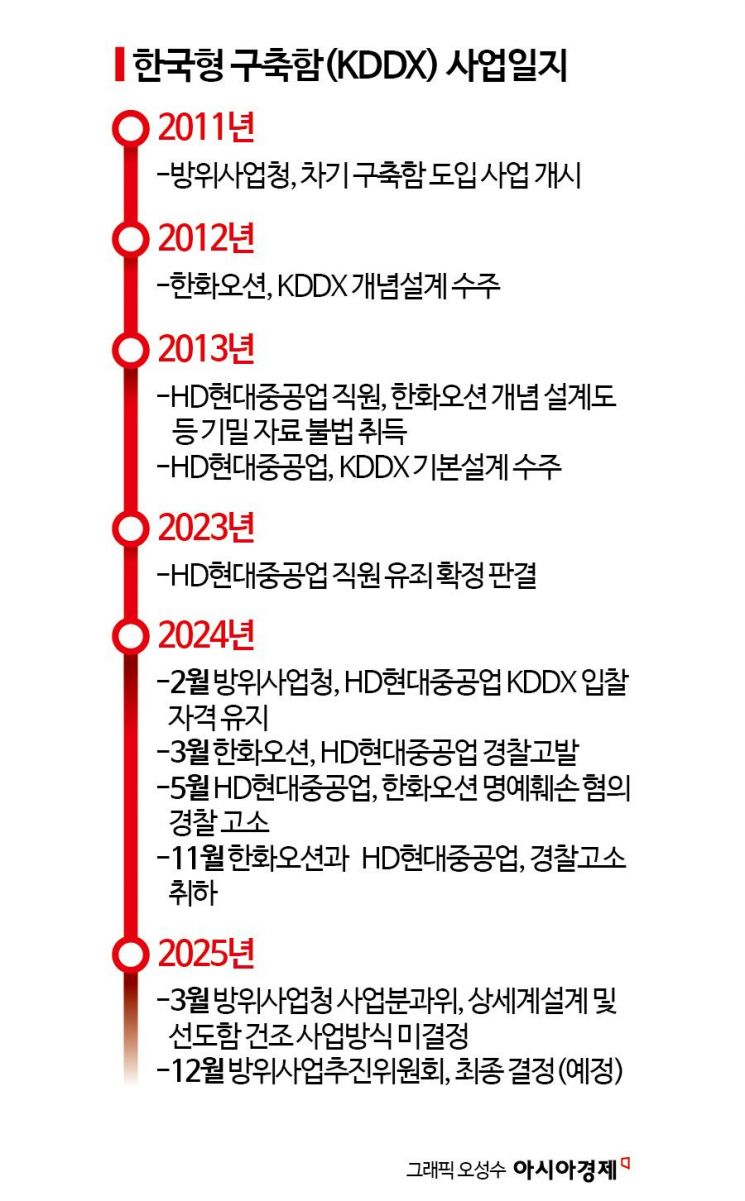
According to government officials, the Defense Acquisition Program Administration (DAPA) is scheduled to hold a Defense Project Promotion Committee meeting at the Ministry of National Defense in Yongsan, Seoul, on the afternoon of December 22. During this meeting, the committee is expected to approve the KDDX project implementation plan, as well as the basic plan for detailed design and construction of the lead ship. Since the selection process has been delayed for two years due to disputes over the contractor selection method, DAPA has stated its intention to finalize the contractor by the end of the year.
HD Hyundai Heavy Industries and Hanwha Ocean have been at odds over whether to proceed with a private contract or competitive bidding. The warship construction process consists of concept design, basic design, detailed design and construction of the lead ship, followed by construction of subsequent ships. HD Hyundai Heavy Industries argues that, according to established practice, they should be awarded the contract for detailed design since they have already completed the basic design. The KDDX project aims to secure six 6,000-ton Aegis destroyers by 2030. If a private contract is chosen, the Navy asserts that it can fill the operational gap created by the retirement of three Gwanggaeto the Great-class destroyers (DDH-I) currently in service, by aligning the introduction of new vessels with the decommissioning schedule.
On the other hand, Hanwha Ocean has advocated for competitive bidding. In this scenario, HD Hyundai Heavy Industries and Hanwha Ocean would compete sequentially from the initial bid announcement stage to win the final project rights. However, if competitive bidding is conducted, HD Hyundai Heavy Industries would be at a disadvantage due to a "security penalty." This penalty stems from an incident in which HD Hyundai Heavy Industries employees were convicted of secretly photographing and leaking Daewoo Shipbuilding & Marine Engineering's concept design materials during the KDDX basic design process. As a result, the security penalty will remain in effect until December 2026.
If the KDDX contractor selection ultimately results in joint development, two lead ships would be ordered simultaneously, with each company building one vessel. This approach is expected to help reduce costs if additional ships are needed in the future. However, it also has drawbacks, such as the need to establish new regulations and systems, and the difficulty of determining responsibility in the event of technical defects or other issues with subsequent ships. Notably, DAPA recently requested an authoritative interpretation from the Fair Trade Commission on whether this approach could constitute "collusion" under the Fair Trade Act. The Fair Trade Commission reportedly responded that this would be a matter for post-factum judgment, suggesting that the potential for conflict remains unresolved.
© The Asia Business Daily(www.asiae.co.kr). All rights reserved.
![Clutching a Stolen Dior Bag, Saying "I Hate Being Poor but Real"... The Grotesque Con of a "Human Knockoff" [Slate]](https://cwcontent.asiae.co.kr/asiaresize/183/2026021902243444107_1771435474.jpg)
















