Request for Quota Expansion and Exemptions at Trade Ministers' Meeting
Agreement on Ongoing Communication for Cooperation in Steel, EVs, Batteries, Energy, and Critical Minerals
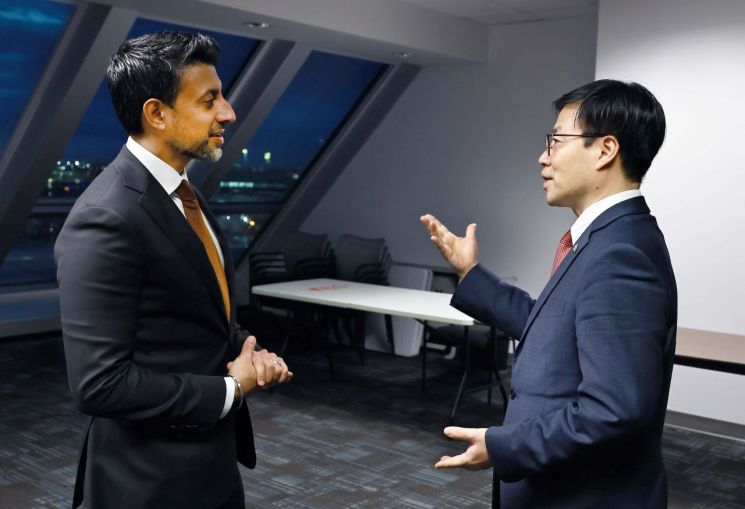
As Canada decided to significantly tighten its steel tariff rate quota (TRQ) starting next week, the Korean government immediately launched high-level trade diplomacy, officially requesting an exemption for Korean steel products.
On December 18 (local time) in Toronto, Ye Han-koo, Trade Minister at the Ministry of Trade, Industry and Energy, held consecutive meetings with Mary Ng, Canada’s Minister of International Trade, and Ali Ehsassi, Parliamentary Secretary to the Minister of Foreign Affairs. During these meetings, he conveyed the concerns of Korean industries regarding Canada’s strengthened steel TRQ measures, which are set to take effect on December 26.
Canada’s latest measures will reduce the quota for free trade agreement (FTA) partner countries from the current 100% to 75%, and for non-FTA countries from 50% to 20%, based on 2024 steel import volumes. If imports exceed these quotas, a high tariff rate of 50% will be imposed. In addition, a new 25% tariff will be applied to steel derivatives.
Minister Ye emphasized that numerous Korean companies, including battery manufacturers, are making large-scale investments in Canada, and that there is significant potential for bilateral cooperation in strategic sectors such as steel, electric vehicles (EVs), batteries, energy, and critical minerals. He particularly pointed out that certain steel products, such as pipelines essential for oil sands production in Canada, are difficult to produce domestically, making Canadian industries highly dependent on high-quality Korean steel. He explained that the TRQ tightening could negatively impact not only Korea but also the broader Canadian industry.
The two sides also agreed to establish a 'Ministerial Dialogue on Strategic Sectors' between their trade ministers, marking the 10th anniversary of the Korea-Canada FTA. They will also set up a hotline to enable ongoing communication on key issues, including steel, electric vehicles, batteries, energy, and critical minerals.
The Canadian side noted that it operates a tariff remission system for steel products that cannot be produced domestically, which will be available until the end of January 2026, and suggested that Korean companies could take advantage of this system. The Korean government plans to continue coordinating the details of TRQ application through ongoing high-level and working-level consultations.
Meanwhile, during his trip, Minister Ye visited Toronto and Detroit, holding meetings with Korean companies operating locally in the steel, automotive, home appliance, and mineral sectors to listen to their concerns regarding recent changes in the North American trade environment. He also visited the LG Energy Solution battery plant in Windsor, Canada, to inspect production facilities, and in Detroit, met with automotive parts companies to assess the impact of the U.S. Section 232 tariffs on automobiles, Mexico’s announced tariff increases for non-FTA countries, and trends in the revision of the USMCA.
Minister Ye stated, "As the trade environment in North America-including the United States, Canada, and Mexico-changes rapidly, Korean companies operating locally are facing challenges, but there are also new opportunities. The government will actively seek support measures to help our companies seize opportunities as the North American supply chain is reorganized."
© The Asia Business Daily(www.asiae.co.kr). All rights reserved.
![Clutching a Stolen Dior Bag, Saying "I Hate Being Poor but Real"... The Grotesque Con of a "Human Knockoff" [Slate]](https://cwcontent.asiae.co.kr/asiaresize/183/2026021902243444107_1771435474.jpg)
















