Struggling with Population Decline and Weak Manufacturing
Only 21% of Employed Persons Are in Their 40s, Lowest in 30 Years

The group in their 40s, once called the “Young Forty” and considered the backbone of employment and consumption, is now facing instability. The number of employed people in their 40s has been declining for over three years, and their share among all employed persons has dropped to its lowest level in 30 years. Since this generation has traditionally supported housing, child-rearing, and consumer spending, analysts warn that their contraction could have a significant impact on domestic demand.
According to the National Data Office (formerly Statistics Korea) and the National Statistical Portal (KOSIS) on December 21, the number of employed people in their 40s last month was 6,154,000, a decrease of 9,000 compared to the same month last year. The number of employed people in their 40s has been declining for 41 consecutive months since July 2022 (down 1,000). Last month, the proportion of people in their 40s among all employed persons stood at just 21.2 percent, the lowest for November since 1995 (21.2 percent).
The decline in employment among people in their 40s is closely linked to a shrinking population. Last month, the population in their 40s plummeted by 129,000 compared to a year earlier. The population has been decreasing for over 10 years since May 2015 (down 5,000), and since December 2022, the annual decrease has remained in the 100,000 range.
Although the employment rate for people in their 40s last month rose by 1.2 percentage points year-on-year to 80.7 percent, some analysts point out that this is due to the population declining faster than the number of employed people.
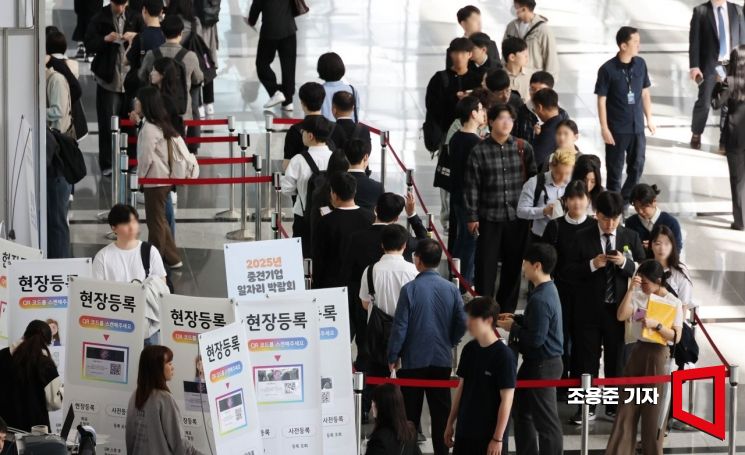
Typically, people in their 40s have the highest income and expenditures in the life cycle. According to the “2023 National Transfer Accounts,” income begins to exceed consumption at age 28, turning into a surplus, and peaks at 44.33 million won at age 45. The surplus amount is also the largest at 17.48 million won. As such, this group has played a key role in the Korean economy, serving as its backbone, with housing purchases, child-rearing and education, and durable goods consumption concentrated during this period.
There is analysis that continued employment contraction among people in their 40s is also affecting their expenditures. According to the Household Income and Expenditure Survey, households with a head in their 40s among non-agricultural, non-forestry households with two or more members saw their per-household consumption expenditure growth rate reach only 1.4 percent in the third quarter. This is the lowest in nine quarters since the second quarter of 2023 (1.0 percent).
Heo Junyoung, Professor of Economics at Sogang University, told Yonhap News, “People in their 40s are the generation that supports both older and younger generations in Korea. Especially, many people took out loans to buy homes during the period of rising housing prices before and after COVID-19, so it appears they are also burdened with household debt repayment.”
Yang Joonseok, Professor of Economics at the Catholic University of Korea, told Yonhap News, “Due to the seniority-based wage system in Korea, people are often pushed out of companies by their mid-50s. It is difficult for people in their 50s, who have to worry about retirement, to fully replace the consumption role of those in their 40s.”
© The Asia Business Daily(www.asiae.co.kr). All rights reserved.

![Clutching a Stolen Dior Bag, Saying "I Hate Being Poor but Real"... The Grotesque Con of a "Human Knockoff" [Slate]](https://cwcontent.asiae.co.kr/asiaresize/183/2026021902243444107_1771435474.jpg)
















