Korea Employers Federation Releases 2026 Labor-Management Relations Outlook Survey
More than 7 out of 10 domestic companies expect labor-management relations in 2026 to deteriorate compared to this year. This perception is at its highest level in the past five years, reflecting companies' concerns over the implementation of the Yellow Envelope Act and upcoming changes to retirement age and working hour systems.
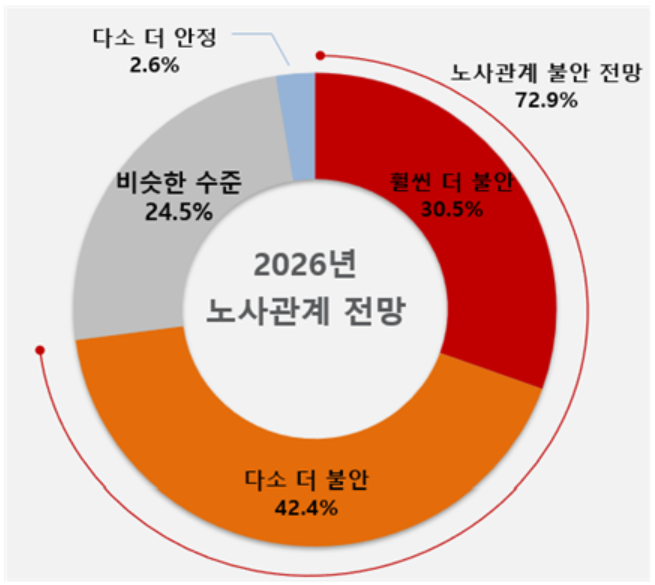
On December 21, the Korea Employers Federation announced the results of its "2026 Labor-Management Relations Outlook Survey" conducted among 151 member companies (based on responding companies). Of the respondents, 72.9% answered that "labor-management relations in 2026 will become more unstable than in 2025." This is the highest figure since 2020.
The main reason companies are concerned about worsening labor-management relations is "increased conflict and labor union struggles due to the implementation of the Yellow Envelope Act," cited by 83.6% of respondents. This was followed by "diversification of union demands such as extending the retirement age and reducing working hours," at 52.7%.
As for the key issues expected to be at the center of 2026 wage and collective bargaining negotiations, "retirement age extension" was cited most frequently at 49.7%. This was followed by "increasing management performance bonuses and recognizing them as wages" (33.8%), "workforce expansion" (26.5%), and "reduction of working hours" (23.2%). However, wage and welfare benefits were excluded from this survey as they are discussed repeatedly every year.
Regarding the impact of the Yellow Envelope Act, negative outlooks prevailed. Of the responding companies, 64.2% said that "increased labor struggles targeting parent companies will intensify instability at industrial sites," while 58.3% predicted that "the expansion of bargaining subjects will prolong negotiations and disputes." In contrast, only a very small percentage expected "mitigation of labor market dual structure" (3.3%) or "a decrease in disputes due to the promotion of dialogue between labor and management" (2.0%).
When asked which employment and labor-related legislation would place the greatest burden on business management, "reduction of working hours (implementation of a 4.5-day workweek)" ranked highest at 73.5%, followed by "statutory extension of the retirement age" at 70.2%. This was followed by "expansion of the definition of workers" (16.6%), "mandatory cross-company bargaining" (11.9%), and "strengthening the right to stop work under the Industrial Safety and Health Act" (11.3%).
Jang Jungwoo, Director of Labor-Management Cooperation at the Korea Employers Federation, stated, "The highest level of concern over labor-management instability since the 2020s appears to reflect companies' worries about the implementation of the Yellow Envelope Act and discussions on institutional changes such as retirement age and working hours." He added, "As various labor-management issues are expected next year, dialogue and cooperation to stabilize labor-management relations are more important than ever."
© The Asia Business Daily(www.asiae.co.kr). All rights reserved.












