December 19 Ministry of Gender Equality and Family Briefing to the President
Expansion from Eight Ministries to All Ministries
Introduction of Equal Employment and Wage Disclosure System in Public and Private Sectors
Development of AI System for Identifying At-Risk Youth
Eased Eligibility Criteria for Childcare Services
The government plans to expand the "Gender Equality Policy Officer," a department dedicated to gender equality policies currently established in eight ministries, to all ministries. In addition, the government will make every effort to strengthen its workforce and upgrade systems to block the increasing spread of digital sex crimes.
On December 19, the Ministry of Gender Equality and Family reported its "Key Work Implementation Plan" to President Lee Jaemyung at the Seoul Government Complex.
Under the vision of "A Korea Built Together, the Ministry of Gender Equality and Family by Everyone's Side," the ministry has selected ten key tasks across four areas to achieve three major goals: "Equal Everyday Life, Safe Living, and a Future of Shared Growth."
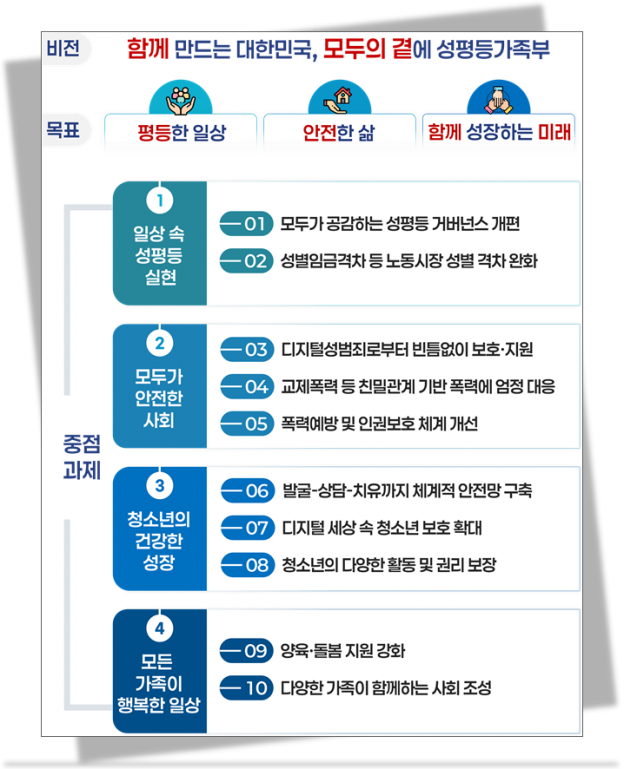
First, the ministry will push to restructure the "Gender Equality Committee" to strengthen cross-ministerial collaboration and oversight of gender equality policies. The ministry will also gradually expand the Gender Equality Policy Officer, currently established in eight ministries, to all ministries starting next year. To reinforce gender equality accountability in relevant policies and foster a gender-equal environment in local communities, the ministry will also expand regional Gender Equality Centers.
To bridge the gender perception gap, the "Youth Coexistence and Empathy Network"-a public forum where the younger generation can directly participate in policymaking-will be fully launched next year.
To narrow the gender gap in the labor market, the ministry will expand and reform the "Gender-Based Employment Disclosure System," currently piloted in the public sector, into an "Equal Employment and Wage Disclosure System" that applies to the private sector as well. By systematically releasing data on gender-based wage and employment structures, the ministry aims to encourage companies to voluntarily address the gender wage gap. Legal and system frameworks will be established by 2026, with phased implementation in both public and private sectors.
The ministry will also focus on comprehensive protection and support against digital sex crimes. The number of staff at the Central Digital Sex Crime Victim Support Center (Digital Sex Crime Center) will increase from 33 this year to 43 next year. The system for detecting and deleting illegal recordings will also be upgraded. Additionally, local Digital Sex Crime Center staff will be increased to provide closer support for victims, including counseling, legal and medical assistance, and accompaniment during investigations.
The ministry will establish a constant cooperation system with relevant agencies, such as the police, to enable in-depth analysis of distribution trends, rapid blocking of illegal content, and strong responses to illegal acts. To this end, the ministry plans to set up a "Digital Sex Crime Victim Integrated Support Team" (tentative name) to ensure an integrated response to digital sex crime victimization.
For victims at high risk of repeat dating violence, a joint monitoring system between the police and domestic violence counseling centers will be implemented in the first half of next year. In addition, the ministry will promote amendments to the Anti-Stalking Act to provide a legal basis for supporting the deletion of personal information related to stalking victims online, even when it is not combined with digital sex crimes.
Enhancing the Identification of At-Risk Youth... Detecting Them Even in the Digital Sphere
To quickly identify at-risk youth, the ministry will develop a new "AI-Based Crisis Detection System." The number of online counselors for the 1388 counseling service will be increased to ensure that youth experiencing crises such as suicidal impulses or violence can promptly receive counseling and rescue services.
To help out-of-home youth achieve independence, the ministry will launch the new "Growth Workplace" program next year, which supports job experience opportunities. Services for out-of-school youth will also be strengthened, including new support for mock university entrance exam fees and expanded meal assistance.
A "Reporting Channel" will be operated to allow youth, who frequently use digital media in daily life, to monitor and report illegal or harmful online information themselves. The ministry will also develop a new "Digital Citizenship Education Program" to help youth build competencies such as personal information protection and responsible AI use. This program will be piloted at youth facilities.
In addition, international youth exchange activities, which were suspended since last year, will resume. Moving beyond traditional visit and experience-based formats, these activities will be operated as "joint projects" planned directly by youth on international issues such as climate change, with follow-up activities included.
A Family-Friendly Society... Strengthening Support for Childcare and Caregiving
The government will relax the eligibility criteria for public childcare services to expand support for childcare and caregiving. For single-parent and other vulnerable households, government-supported hours will be increased to ensure there are no gaps in care. To attract more childcare workers, the ministry will raise the care allowance by 5% and improve working conditions. A national certification system for childcare workers and a registration system for private care service providers will be implemented starting in April next year.
To alleviate the financial burden of child support for single-parent families, the eligibility for welfare benefits will be expanded from households earning up to 63% of the median income to those earning up to 65%.
In response to the increasing inflow of immigrants, the ministry will introduce special support measures so that multicultural family support services, previously focused on marriage migrant families, will also be available to children and youth with immigrant backgrounds. Dedicated managers for families with immigrant backgrounds will be assigned at family centers, and services for children and youth with immigrant backgrounds-including language education, basic learning, and career planning-will be expanded.
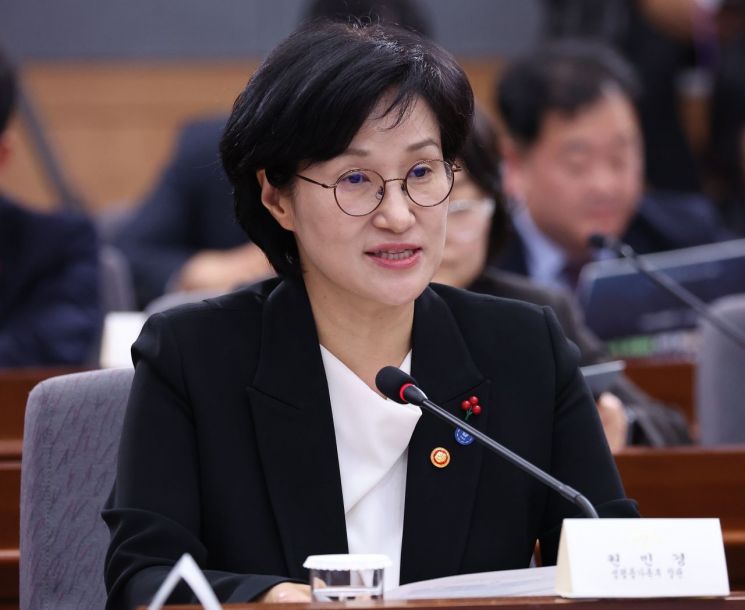
Minister Won Minkyoung of the Ministry of Gender Equality and Family stated, "We will fulfill our role in line with the ministry's enhanced functions by realizing substantive equality, closing gender gaps, supporting victims of gender-based violence, and ensuring seamless implementation of youth and family policies. We will further strengthen cooperation with related agencies and continue to communicate with the public to ensure that policy outcomes are effectively realized on the ground."
© The Asia Business Daily(www.asiae.co.kr). All rights reserved.

![Clutching a Stolen Dior Bag, Saying "I Hate Being Poor but Real"... The Grotesque Con of a "Human Knockoff" [Slate]](https://cwcontent.asiae.co.kr/asiaresize/183/2026021902243444107_1771435474.jpg)















