2026 National New Drug Development Project Roadmap Unveiled
Up to 4.55 Billion Won for Phase 1 Clinical Trials, 9.1 Billion Won for Phase 2
The National New Drug Development Foundation (KDDF) is set to expand its national new drug development project with the goal of securing approval for more than four global innovative drugs and creating blockbuster drugs with sales exceeding 1 trillion won by 2030. The foundation plans to select a total of 130 new projects next year and to increase funding for clinical-stage research, with a focus on strengthening the global commercialization capabilities of domestic pharmaceutical and biotech companies.
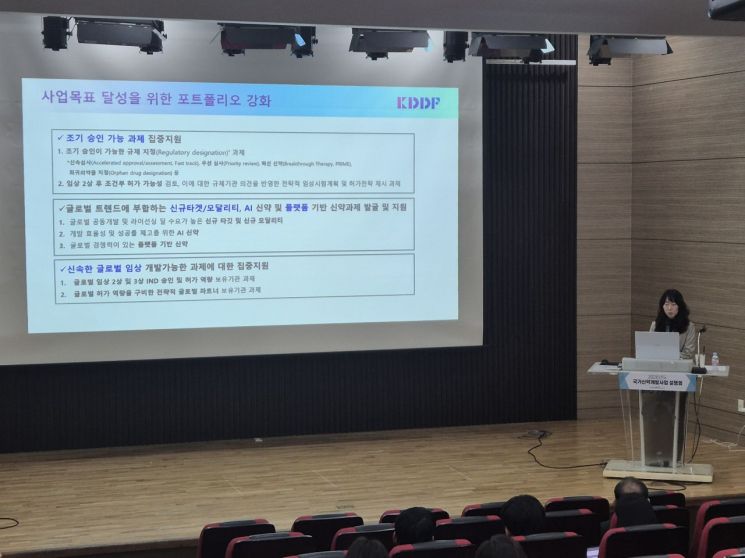 Wonjung Lee, Head of the Research and Development (R&D) Team at the National New Drug Development Foundation, held the "2026 National New Drug Development Project Briefing" on the 19th at Korea Bio Park in Seongnam, Gyeonggi Province, explaining the project's goals. Photo by Taewon Choi
Wonjung Lee, Head of the Research and Development (R&D) Team at the National New Drug Development Foundation, announced this strategy at the "2026 National New Drug Development Project Briefing" held on the 19th at Korea Bio Park in Seongnam, Gyeonggi Province. The core elements of this strategy are: strengthening the portfolio to achieve project goals; enhancing commercialization support for global new drug development; improving global competitiveness in new drug development; and advancing the project management system.
In particular, the foundation has decided to focus its support not only on new targets and modalities (therapies) that align with global trends, but also on AI-driven drug development and platform-based drug projects starting next year. Support will also be strengthened for "early approval candidates" that have received expedited review or innovative drug designation, as well as for institutions with partners capable of obtaining global approvals, with the aim of increasing the potential for substantial technology transfer and commercialization.
Next year's new project calls will be divided into three categories: "Research to Expand New Drug Base (Category 1)" for identifying active and lead compounds; "Research to Build New Drug R&D Ecosystem (Category 2)" for supporting candidate compound identification and non-clinical studies; and "New Drug Clinical Development (Category 3)" for supporting Phase 1 and 2 clinical trials.
The foundation plans to select a total of 130 projects next year, with 66 projects in the first round (starting in April) and 64 in the second round (starting in December). A key feature is the significant increase in funding for clinical-stage projects in response to field demands. Funding for Phase 1 clinical trials has been raised to approximately 4.55 billion won, and for Phase 2 clinical trials to approximately 9.1 billion won.
The institutional contribution rate is waived for non-profit organizations. However, for for-profit companies, the rate varies by stage. From active compound identification to the non-clinical stage, companies must contribute at least 25% to 50% of the R&D costs, depending on company size. For clinical stages, all companies must contribute at least 50% regardless of size. Research funding is disbursed after the agreement is signed and the institutional contribution has been paid.
Supported fields include synthetic drugs, biopharmaceuticals (gene and cell therapies, antibodies, vaccines, etc.), and natural product drugs. Improved drugs, biosimilars, generic drugs, and veterinary drugs are excluded from support. Treatments for dementia and statutory infectious diseases are also excluded. For cell therapies, all "in vivo" approaches are eligible, but "ex vivo" approaches are limited to anti-cancer immune cell therapies.
The evaluation process consists of preliminary review, document review, presentation review, on-site due diligence, and investment eligibility assessment. Starting next year, if the same pipeline receives an "excellent" rating in a previous stage and advances to the next stage, it will be awarded two additional points, as part of a new system to encourage continuity in high-quality research. At the investment review stage, the final investment value will be determined based not only on data quality, but also on marketability, product potential, and global competitiveness.
Lee said, "Given the ambitious goals we must achieve by 2030, we will further advance our project management system and provide full support to ensure that the selected projects can grow into global innovative drugs."
© The Asia Business Daily(www.asiae.co.kr). All rights reserved.












