Raised Again After 11 Months Since January
First Annual 0.5 Percentage Point Hike Since 1990
Takaichi Cabinet with 'Proactive Fiscal Policy' Also Approves
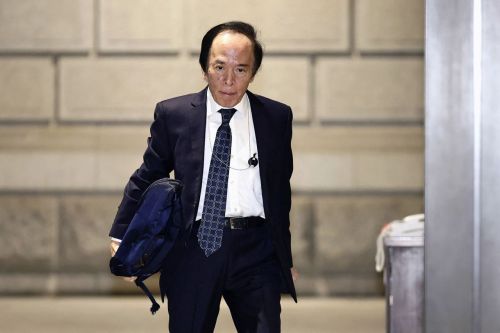 Kazuo Ueda, Governor of the Bank of Japan (BOJ), is entering the BOJ building located in Tokyo on the 19th. Photo by AFP Yonhap News
The Bank of Japan (BOJ), Japan's central bank, raised its benchmark interest rate on the 19th at its monetary policy meeting, marking its first rate hike in 11 months, as widely expected by financial markets. The BOJ had kept rates unchanged for six consecutive meetings, citing global uncertainty stemming from the tariff policies of the Donald Trump administration in the United States, but has finally made a decisive move. On the same day, Japan's 10-year government bond yield surpassed 2% for the first time in 19 years.
According to Kyodo News, the BOJ decided at its two-day monetary policy meeting to raise its short-term policy rate, the benchmark interest rate, from the current "around 0.5%" to "around 0.75%," an increase of 0.25 percentage points. All nine policy board members voted in favor of the rate hike.
As a result, Japan's benchmark interest rate has reached its highest level in 30 years since 1995. In 1995, the de facto benchmark rate was lowered from 1.75% to 1.0% in April, and then further reduced from 1.0% to 0.5% in September. Since then, Japan's benchmark interest rate had never exceeded 0.5% until now.
Under the leadership of Governor Kazuo Ueda, the BOJ began tightening monetary policy last March by ending its negative interest rate policy for the first time in 17 years. In July of last year, the benchmark rate was raised from 0-0.1% to around 0.25%, and in January of this year, it was further increased to around 0.5%, gradually tightening policy.

The Background Behind the 'Rate Freeze→Hike'
Governor Ueda had previously suggested that the BOJ would consider further rate hikes, given that real interest rates remained low since January. However, the bank froze rates for six consecutive meetings starting in March, taking into account the tariff policies of the Donald Trump administration in the United States and other factors.
However, within the BOJ, the view spread that the Trump administration's tariff policies were having less impact on the economy and inflation than initially expected, which appears to have contributed to the decision to raise rates. In addition, the steady rise in the consumer price index above 2%, and expectations that corporate wage increases next spring will not be insignificant, are also seen as influencing this decision.
The BOJ has maintained that if inflation stabilizes above 2% and wages rise in tandem, it could consider further rate hikes.
Kyodo News also explained that the continued depreciation of the yen has led to higher import prices, increasing the likelihood that high inflation will put pressure on households, which is another factor behind the rate hike. Prime Minister Sanae Takaichi, who has advocated for "responsible and proactive fiscal policy," appears to have accepted the BOJ's rate hike in light of these factors.
In a speech on the 1st, Governor Ueda stated, "We intend to make an appropriate judgment regarding whether to raise rates. Even if we do raise the policy rate, it will be an adjustment to the accommodative financial environment, not an attempt to put the brakes on the economy," signaling a possible rate hike.
Japan's 10-Year Bond Yield Surpasses 2% for the First Time in 19 Years

According to Nikkei and Kyodo News, Japan's 10-year government bond yield temporarily rose to 2.005%, surpassing 2% for the first time since 2006. This is the first time in 19 years, since May 2006, that the 10-year yield has climbed into the 2% range. Previously, the 10-year bond yield had risen to 1.98% on the 17th and continued its upward trend on this day.
Nikkei analyzed that the BOJ's rate hike, combined with concerns about fiscal deterioration due to Prime Minister Takaichi's "responsible and proactive fiscal policy" stance, contributed to the rise in government bond yields. The newspaper also noted that the rise in long-term U.S. interest rates was another factor pushing up yields.
In contrast, the yen-dollar exchange rate showed little volatility despite the BOJ's rate hike. The yen-dollar rate was in the 155-yen range in the morning, briefly rising to the 156.1-yen level after news of the rate hike, but soon returned to the 155-yen range.
© The Asia Business Daily(www.asiae.co.kr). All rights reserved.
![Clutching a Stolen Dior Bag, Saying "I Hate Being Poor but Real"... The Grotesque Con of a "Human Knockoff" [Slate]](https://cwcontent.asiae.co.kr/asiaresize/183/2026021902243444107_1771435474.jpg)


















