Ministry to Finalize Streamlining Measures by Q1 Next Year
Proposals Include Establishing a Third Institution, Unification, and Division of Functions
Experts Cite "Failed Case of Third Institution in France"
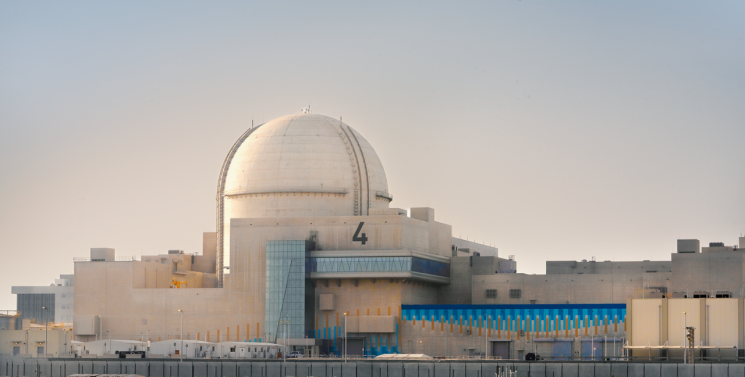 Panoramic view of Barakah Unit 4 nuclear power plant constructed by Korea Electric Power Corporation (KEPCO) in the United Arab Emirates (UAE). Korea Electric Power Corporation (KEPCO)
The government is expediting efforts to streamline the nuclear power plant export system, which is currently divided between Korea Electric Power Corporation (KEPCO) and Korea Hydro & Nuclear Power (KHNP).
On December 17, the Ministry of Trade, Industry and Energy presented a work report to President Lee Jaemyung, outlining three options to improve the dual nuclear power export system: establishing an independent third institution, unifying the system under either KEPCO or KHNP, and dividing responsibilities by function.
The ministry has been conducting an external research project since August and plans to finalize detailed policies by the first quarter of next year. A ministry official explained, "Originally, we planned to decide on the direction by June next year, but due to the growing urgency, we have moved up the timeline to the first quarter." The Korea Nuclear Export Association is currently conducting the research.
The push to improve the nuclear export channel comes as nuclear power export cooperation between Korea and the United States is becoming more tangible, following recent tariff negotiations. Earlier this month, U.S. Secretary of Commerce Howard Lutnick cited nuclear power plant construction as a major investment destination for the $750 billion that Korea and Japan have committed to invest, during a meeting at the White House. As a result, expectations are rising for Korean nuclear companies to enter the U.S. market.
Currently, nuclear power exports are jointly handled by KEPCO and KHNP, following the adjustment of functions for public nuclear export enterprises during the Park Geun-hye administration in 2016.
KEPCO has leveraged its high international credibility, overseas project experience, marketing capabilities, and funding capacity to win nuclear power plant contracts in countries that do not require changes to the Korean reactor design. KHNP, utilizing its domestic nuclear operation experience, has focused on exports to countries that require technical modifications such as reactor design changes. Through this division, KEPCO was responsible for the Barakah nuclear power plant in the United Arab Emirates (UAE), while KHNP handled the export of the Dukovany nuclear power plant in the Czech Republic.
The government expected that maximizing the strengths of both KEPCO and KHNP would increase the chances of winning contracts. However, criticism has arisen that the dual structure of the overseas nuclear industry makes it difficult to implement a consistent international strategy and reduces efficiency.
This year, the two companies filed for arbitration with the London Court of International Arbitration (LCIA) over the settlement of additional construction costs amounting to approximately 1 trillion won incurred during the construction of the Barakah nuclear power plant in the UAE. Regarding this, Minister of Trade, Industry and Energy Kim Jeonggwan stated during a National Assembly audit in October, "This is something that should never have happened," and added, "We are working on a plan to determine whether a unified approach is better and how to manage the governance of KEPCO and KHNP."
Experts have expressed negative views on the option of establishing a third institution, one of the proposals presented in the ministry's work report. In the past, France established AREVA as a separate entity from Electricite de France (EDF) to export nuclear power plants, but this model failed. AREVA won a contract for a nuclear power plant in Finland, but frequent construction delays led to losses exceeding 6 trillion won in 2014, resulting in the sale of its nuclear business to EDF.
The failure of AREVA has instead highlighted the "On Time On Budget" competitiveness of Korean nuclear companies. AREVA later changed its name to ORANO and now focuses on the nuclear fuel business.
Son Yanghoon, a professor at Incheon National University and former president of the Korea Energy Economics Institute, stated, "There is no need for us to adopt a model that has failed overseas. It would be more efficient to unify the system under either KEPCO or KHNP, allowing a single operator to lead engineering, procurement, and construction (EPC)." He also noted that establishing a third institution would require significant time and debate to determine its organization and staffing.
The third option proposed by the ministry, dividing responsibilities by function, effectively maintains the current system.
Even the second option, unifying the work under either KEPCO or KHNP, faces many obstacles. Both companies currently have personnel dedicated to nuclear exports and are reluctant to relinquish these roles. KEPCO has high external recognition and can lower financing costs during construction, while KHNP has extensive nuclear operation experience. Although KHNP's lack of overseas project experience was once seen as a weakness, it overcame this through securing the Czech project.
A ministry official stated, "We will carefully consider the advantages and disadvantages of each option and formulate the government's plan based on the results of the research."
© The Asia Business Daily(www.asiae.co.kr). All rights reserved.












