A digital technology has been developed that allows the movement of seafood products to be tracked at a glance. This technology also meets international standards, and is expected to serve as a kind of "digital export passport" that will facilitate the global expansion of Korean seafood products.
KAIST announced on the 19th that "OlioPass," a digital transformation solution developed by Daeyoung Kim, Director of the KAIST Auto-ID Lab Busan Innovation Research Center (Professor of Computer Science), recently passed the performance verification of the Global Dialogue on Seafood Traceability (GDST), a global seafood traceability alliance, and became the first in Korea to receive the "GDST Capable Solution" certification.
There are only 13 technologies worldwide that have received GDST certification. In particular, only seven organizations, including KAIST, support "full chain" traceability technology that covers the entire process from production to processing, distribution, and sales.
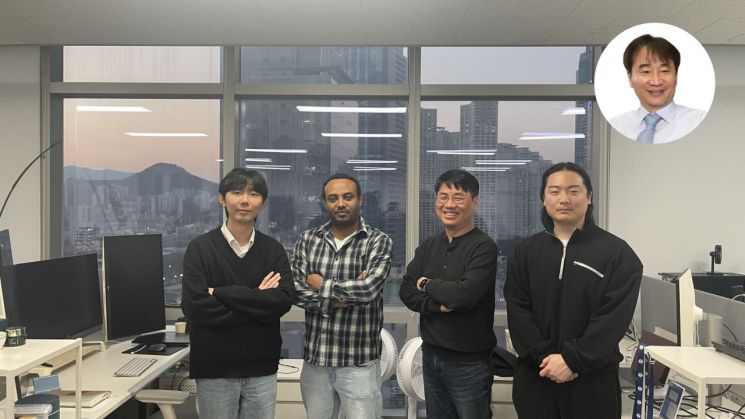 (From left) Hyeontaek Hwang, PhD candidate at KAIST; Yalew Kidane, Research Professor; Youngjong Lee, Senior Researcher; Gunwoo Park, Researcher; (top) Daeyoung Kim, Director. Provided by KAIST
GDST is an international organization established in 2015 at the suggestion of the World Economic Forum (WEF). It helps to digitally record and share information on all stages of seafood movement according to GS1, an internationally agreed standard. This can be likened to creating a "common language for supply chains" that is recognized internationally.
The GDST certification sets global standards for seafood traceability by defining key data elements (KDEs) that must be recorded during seafood movement, as well as critical tracking events (CTEs) specifying "when, where, and what" was moved, thereby enhancing the reliability of seafood traceability information.
Recently, major food distribution companies in the United States and Europe have begun requiring compliance with GDST certification standards, making these standards a "mandatory requirement" for entering the global market. The U.S. Food and Drug Administration (FDA) has also announced that food traceability will become mandatory (FSMA 204) starting in July 2028.
Given these circumstances, the GDST certification of OlioPass is highly significant, as it provides Korean seafood export companies with a technical solution to meet regulatory requirements in the U.S. and other global markets.
 Global Seafood Traceability Alliance (GDST) Global Certification Logo (left) and KAIST OlioPass Platform Logo (right). Provided by KAIST
OlioPass is a digital traceability platform that combines KAIST's Internet of Things (IoT) technology with international standards (GS1 EPCIS 2.0, GS1 Digital Link). It records and shares movement information of products and assets in a standardized language, and fundamentally prevents forgery and tampering through blockchain technology. A key advantage is that traceability data can be seamlessly integrated even if each company uses a different system.
In addition, OlioPass is designed as an "AI-ready data" infrastructure, making it easy to apply next-generation AI technologies such as large multimodal models, AI agents, knowledge graphs, and ontologies. This enables the platform to support not only simple traceability management, but also digital and AI transformation simultaneously.
Director Kim stated, "This certification is a result that internationally recognizes KAIST's 'trusted' data technology capabilities across the global supply chain," adding, "We will ensure that OlioPass is widely used not only in seafood and food sectors, but also in pharmaceuticals, logistics, defense, smart cities, and other fields, so that KAIST technology can grow into a global platform."
Meanwhile, KAIST has participated as a founding member of GDST since 2019, playing a key role in designing information integration between seafood traceability models and systems.
© The Asia Business Daily(www.asiae.co.kr). All rights reserved.
![User Who Sold Erroneously Deposited Bitcoins to Repay Debt and Fund Entertainment... What Did the Supreme Court Decide in 2021? [Legal Issue Check]](https://cwcontent.asiae.co.kr/asiaresize/183/2026020910431234020_1770601391.png)
















