Science Selects Renewable Energy as "Breakthrough of the Year"
"Surpassing Fossil Fuel Energy Production in Multiple Sectors"
"China's Overwhelming Manufacturing Capacity Drives Energy Transition"
Science, the renowned global academic and scientific journal, has selected renewable energy as this year's "Breakthrough of the Year," recognizing it as the most significant achievement in the scientific community. According to Yonhap News on December 19, the American Association for the Advancement of Science (AAAS), which publishes Science, stated, "2025 marks a pivotal year in humanity's energy paradigm, as renewable energy produced from the sun and wind has begun to surpass fossil fuel-based energy production in various sectors."
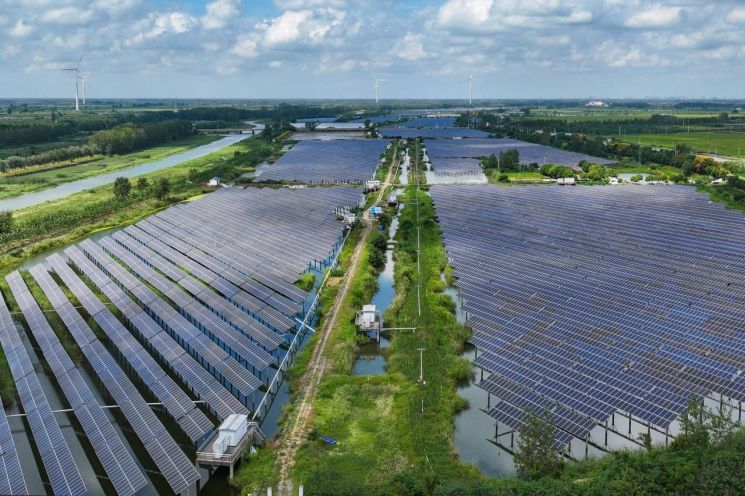 Solar panels installed over a pond in Jinhu County, Huai'an City, Jiangsu Province, eastern China. Photo by AFP Yonhap News Agency
According to Science, since the Industrial Revolution, humanity has relied on fossil fuels such as coal, oil, and gas for energy, with carbon emissions from these sources contributing significantly to the acceleration of global warming. However, this year, renewable energy worldwide-centered on solar and wind power-has grown rapidly, increasing enough in the first half of the year to meet all new global electricity demand. It is now reported that, globally, more electricity is being supplied from renewables than from coal.
This growth has been largely driven by China. Science explained, "China is leading the energy transition through large-scale expansion of solar panel, wind turbine, and lithium battery storage technologies," adding, "It has firmly established itself as a global leader in renewable energy production and technology."
China's overwhelming manufacturing capacity has lowered the cost of renewable energy production and improved accessibility, which has led to the rapid spread of small-scale rooftop solar systems in other regions. Science highlighted that, especially across the Global South-including developing countries in Europe, South Asia, Africa, Latin America, the Middle East, and Oceania-hundreds of millions of people are now being supplied with reliable, low-cost energy.
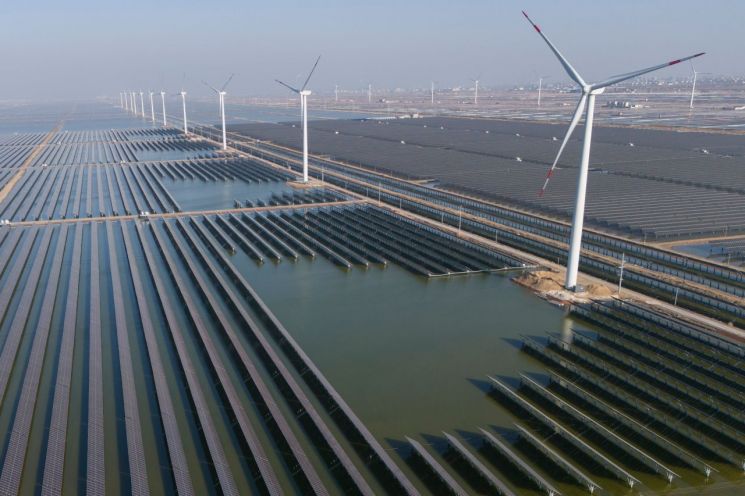 Wind turbines operating at a solar power plant near Weifang City, Shandong Province, eastern China. Photo by AP Yonhap News
However, in some regions, coal use remains widespread, and infrastructure bottlenecks, as well as political resistance in certain countries such as the United States, continue to pose obstacles to the energy transition. Nevertheless, the shift from fossil fuels to clean renewable energy is accelerating, and Science assessed that renewables are becoming the most practical and cost-effective option.
Science stated, "Renewable energy has already been proven to significantly slow the rate of greenhouse gas emissions in China," adding, "This suggests that a global turning point in the fight against ongoing climate warming is approaching." The journal further noted, "Additional technological innovations, such as high-efficiency solar cells and new battery chemistries, are expected to further expand the scope and effectiveness of renewable energy."
In fact, even as China's economic growth rate slows, the country continues to steadily increase investment in eco-friendly industries, including renewable energy. According to statistics from Forbes, the proportion of renewable energy in China is expected to exceed 55% by 2035 and reach 88% by 2050. The Centre for Research on Energy and Clean Air (CREA), a Finnish climate and environmental think tank, estimates that if the global transition toward renewables continues, the economic value that China-having secured dominance in key industrial sectors-could generate may reach 15 trillion yuan (approximately 2,925 trillion won) by 2035.
© The Asia Business Daily(www.asiae.co.kr). All rights reserved.
![User Who Sold Erroneously Deposited Bitcoins to Repay Debt and Fund Entertainment... What Did the Supreme Court Decide in 2021? [Legal Issue Check]](https://cwcontent.asiae.co.kr/asiaresize/183/2026020910431234020_1770601391.png)
















