Sokcho City Holds First Public Hearing Since Border Area Designation
Unveils Vision for the Future with 26 New Projects
Sets Strategic Goals: 40 Million Visitors and a Population of 100,000
On December 18, Gangwon Special Self-Governing Province and Sokcho City held a public hearing at the main auditorium of the Sokcho City Workers' Comprehensive Welfare Center, attended by approximately 150 local residents and experts, to discuss amendments to the Comprehensive Plan for the Development of Border Areas.
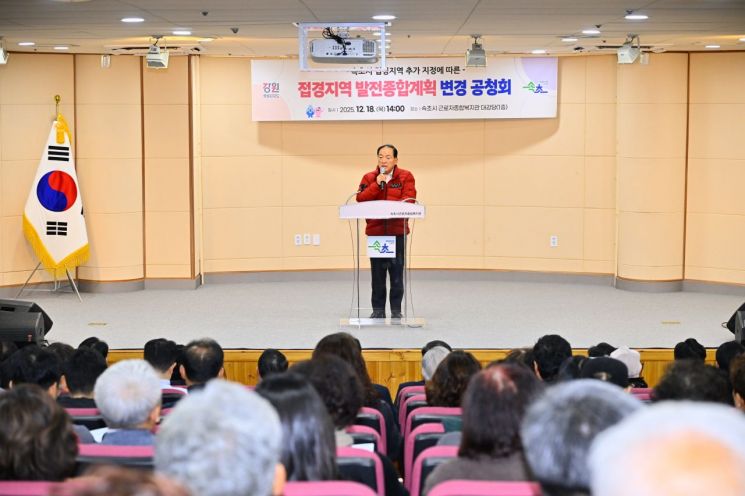 Lee Byungsun, Mayor of Sokcho, is holding a public hearing for the 'Comprehensive Plan for Development of Border Areas Amendment' at the main auditorium of Sokcho Workers' Welfare Center on the 18th. Provided by Sokcho City
The "Comprehensive Plan for the Development of Border Areas" is a statutory plan established in 2011 to promote the sustainable development of border areas that have been underdeveloped due to the division of the Korean Peninsula, with the goals of improving resident welfare and creating new growth engines. The plan was amended twice, in 2019 and 2024, and currently covers 227 projects with a total budget of 10.5 trillion won in 15 cities and counties across three provinces, excluding Sokcho City and Gapyeong County.
This public hearing was organized to incorporate new projects for Sokcho City into the Comprehensive Plan for the Development of Border Areas (2011-2030), following its designation as a border area on March 11, in accordance with Article 5 of the Special Act on Support for Border Areas, and after gathering opinions from various sectors.
The city unveiled four strategic visions: 1) the completion of a smart, nine-minute connected compact city; 2) transforming into Korea’s leading hotspot tourism city; 3) creating a smart wellness city where culture, sports, and welfare thrive; and 4) establishing a marine tourism and education hub connecting the world and the two Koreas. Along with these visions, the city announced 26 balanced regional development projects by area, totaling 1.04 trillion won, including 710 billion won in national funding.
This plan is particularly significant as it marks the first mid- to long-term development plan established since Sokcho City was designated as a border area.
The city focused on discovering projects that encompass the entire city and its five regions (Northern, Station Area, Seorak, Southern, and Downtown), in line with the Special Act’s objective of balanced regional development.
Major new projects by region include: the "Third Underground Dam for Climate Crisis Response" covering the entire city; the "Well-being Center Project" in the Northern region; "Expansion of Urban Infrastructure (including connecting roads) around the Station Area"; the "Seorak Re:born Renewable Energy Project" in the Seorak region; the "Regional Comprehensive Welfare Town Project" in the Southern region; and the "Seorak Arena 365 Project" in the Downtown area. These strategic projects span safety, tourism, welfare, and the economy.
The city plans to systematically implement these strategic projects to lay a solid foundation for sustainable growth as a city with a population of 100,000 and 40 million annual visitors in the upcoming era of dual railways.
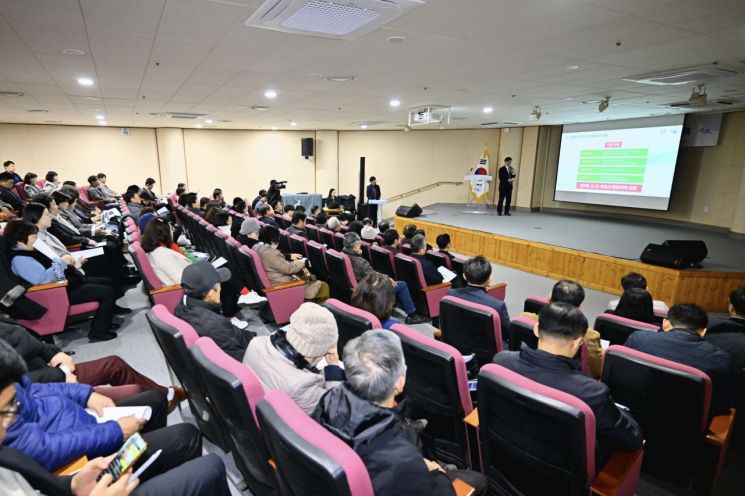 Sokcho City held a public hearing for the 'Comprehensive Plan for the Development of Border Areas Amendment' on the 18th at the main auditorium of the Sokcho City Workers' Comprehensive Welfare Center. Provided by Sokcho City
Lee Byungsun, Mayor of Sokcho, stated, "We will thoroughly review all opinions presented at this public hearing and incorporate them into our mid- to long-term strategy. We will do our utmost to ensure that this new opportunity of being designated as a border area leads to tangible changes in citizens’ daily lives, rather than remaining a mere institutional framework."
Meanwhile, after Sokcho City was designated a border area this year, six projects were selected for the Ministry of the Interior and Safety’s 2026 new project competition for special border area development, securing 21 billion won in national funding. Based on citizen feedback from this public hearing, the city plans to finalize the comprehensive development plan by the end of this year, submit it to Gangwon Special Self-Governing Province and then to the Ministry of the Interior and Safety, and ultimately reflect Sokcho City’s plan in the 2026 plan. From 2027, the city aims to secure national funding and fully launch support projects for the development of the border area.
© The Asia Business Daily(www.asiae.co.kr). All rights reserved.


















